
-
Vijit
- September 29, 2026
- No categories assigned.
- No Comments
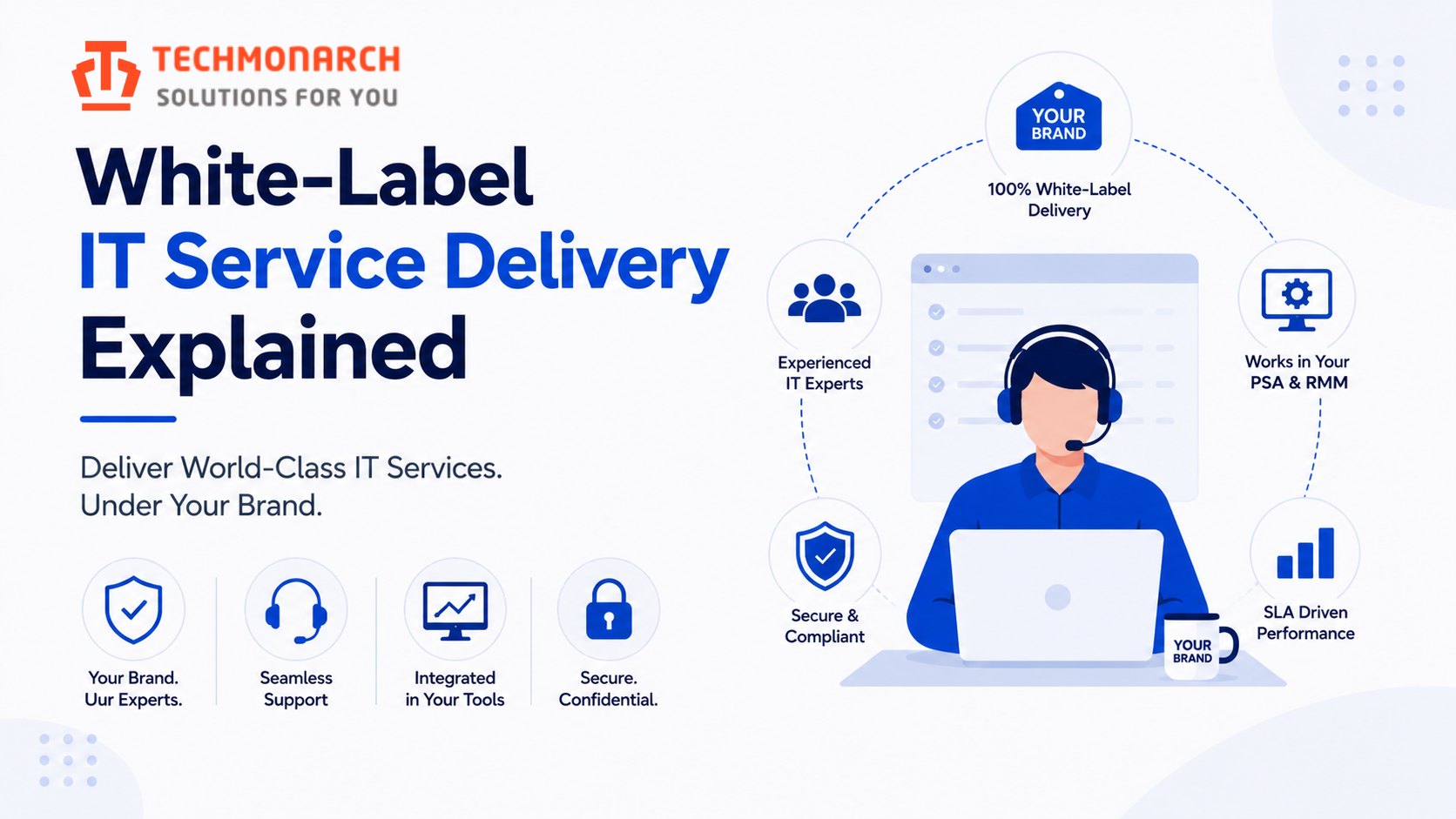
White-Label IT Service Delivery Explained
Every article in this series eventually arrives at the same word: white-label. It’s the mechanism that makes MSP outsourcing actually work — the reason a client can get 24/7 help desk, NOC, or SOC coverage from a partner without ever knowing a third party is involved. But “white-label” gets thrown around loosely enough in vendor marketing that it’s worth pinning down exactly what it requires operationally, because the difference between a partner that delivers this properly and one that doesn’t shows up directly in your client relationships.
This is the delivery model itself — how it’s structured, what the onboarding process actually looks like, what belongs in the contract, and how you keep quality in check once it’s running.
The Core Requirement: Total Brand Invisibility
The defining feature of white-label delivery, as distinct from a visible outsourcing arrangement, is that the end client never knows a third party is involved. They call your number. They email your domain. The ticket in their portal shows your company name. The engineer on the phone introduces themselves as part of your team, because functionally, they are — for the duration of that interaction, they’re operating entirely inside your identity.
This is a meaningfully different commitment than a referral partnership or a co-branded tool, where the vendor’s name stays visible somewhere in the client experience. If your outsourcing partner’s brand shows up anywhere the client can see it — a co-branded dashboard, a support email with their domain in the reply-to, a technician who slips and mentions their actual employer — the arrangement has failed the one test that defines white-label delivery in the first place.
How Onboarding Actually Works
A properly structured white-label engagement follows a fairly consistent sequence, regardless of which function is being delivered:
Legal groundwork first. Before any access is granted or work begins, a non-disclosure agreement and, typically, a non-solicitation agreement get signed. The NDA covers client data, your internal SOPs, pricing structures, SLAs, and tech stack details. The non-solicit prevents the partner from ever contacting your clients directly or attempting to poach the relationship — a protection worth being explicit about rather than assuming.
Access and tool integration. The partner gets access to your PSA, RMM, and any relevant documentation systems — either directly into your existing stack or through a configured instance that mirrors it. This phase typically covers the first one to two weeks of a new engagement: branding setup, tool integration, and documentation transfer.
Pilot before full rollout. Rather than migrating your entire client base on day one, a sound onboarding process starts with a small pilot group — often beginning in the third week — so both sides can validate the workflow before scaling. Full ramp to your whole client base is typically a 60-to-90-day process, not an overnight switch.
Ongoing quality controls. Weekly ticket audits during the first 90 days, CSAT surveys after resolved tickets, and monthly SLA review meetings are standard practice for a partner confident in their own delivery. A provider that resists this kind of scrutiny is signaling something worth paying attention to.
What Belongs in the Contract
A white-label agreement needs to do more than describe the services being delivered. At minimum, it should specify:
- Confidentiality scope — explicitly covering client data, your SOPs, pricing, SLAs, and internal tooling, not just a generic confidentiality clause.
- Non-solicitation terms — a defined timeline (commonly extending a year or more past contract end) preventing the partner from marketing to or directly engaging your clients.
- No independent branding or cross-selling — the partner should be explicitly barred from any client-facing branding, marketing, or upselling that isn’t routed through you.
- Insurance and liability — general liability and cyber liability coverage on the partner’s side, with language that aligns to your own MSP’s insurance terms.
- SLA definitions — response and resolution targets stated as contractual commitments, not aspirational language.
- Data breach and service failure protocols — what happens, who’s liable, and how it gets communicated if something goes wrong on the partner’s end.
Skipping any of these isn’t a hypothetical risk. A partner operating under your name has real exposure to your brand if something goes wrong, and a contract without these terms leaves you absorbing that exposure with no recourse.

The Technical Integration Layer
Beyond the legal framework, delivery quality depends heavily on how deeply the partner integrates into your actual operating environment rather than running a parallel process you have to reconcile manually. That means working inside your existing PSA and RMM rather than a separate platform, following your documented escalation matrix and priority definitions rather than a generic one, and maintaining your communication tone and templates so client-facing interactions feel consistent regardless of which engineer is handling a given ticket.
This integration depth is what separates a genuine white-label partnership from a rebranded overflow vendor. A partner that can only offer their own portal, their own escalation logic, and their own reporting format is asking you to adapt to them — which undermines the entire premise of the model. For more on how this plays out specifically for help desk, NOC, and SOC functions, our guides on help desk outsourcing and NOC outsourcing go into function-specific detail.
Where This Model Commonly Breaks
It’s worth being honest about failure modes, because they’re predictable and largely avoidable. The most common one is a partner that treats onboarding as a formality rather than a real integration project — skipping the pilot phase, going live across your whole client base immediately, and only discovering process mismatches once something’s already gone wrong in front of a client. The second most common failure is escalation discipline: a partner that forwards tickets upward without context, effectively passing you the same workload you were trying to offload, just with an extra handoff step attached.
The third, and the one that does the most lasting damage, is a brand slip — a technician who identifies their actual employer, an email that leaks the wrong domain, a report that carries the partner’s own logo. These are rare in a well-run partnership, but they’re also usually preventable with the contractual protections and QA cadence described above. Screening for a partner with real MSP-specific experience, rather than a general outsourcing vendor treating IT as one vertical among many, tends to be the single best predictor of avoiding all three.
Why This Model Compounds Over Time
The MSPs that get the most out of white-label delivery treat it as an ongoing partnership rather than a one-time staffing fix. Regular reviews of SLA performance and ticket backlog trends keep the arrangement aligned as your client mix and service offerings evolve, and as trust builds between both sides, the partnership tends to expand into higher-complexity services without compromising the SLA performance you started with. That trajectory — starting with a well-scoped pilot and expanding gradually as quality proves out — tends to produce far better long-term results than trying to migrate everything at once.
At Techmonarch, this is exactly how our white-label managed IT services are structured: full branding customization, a streamlined onboarding process built around your specific operations, and delivery that integrates directly into your existing tools rather than asking you to adapt to ours. For the complete picture of how white-label delivery fits into a broader outsourcing strategy, see our guide to IT outsourcing for MSPs.
Recent Comments
- No comments to show