
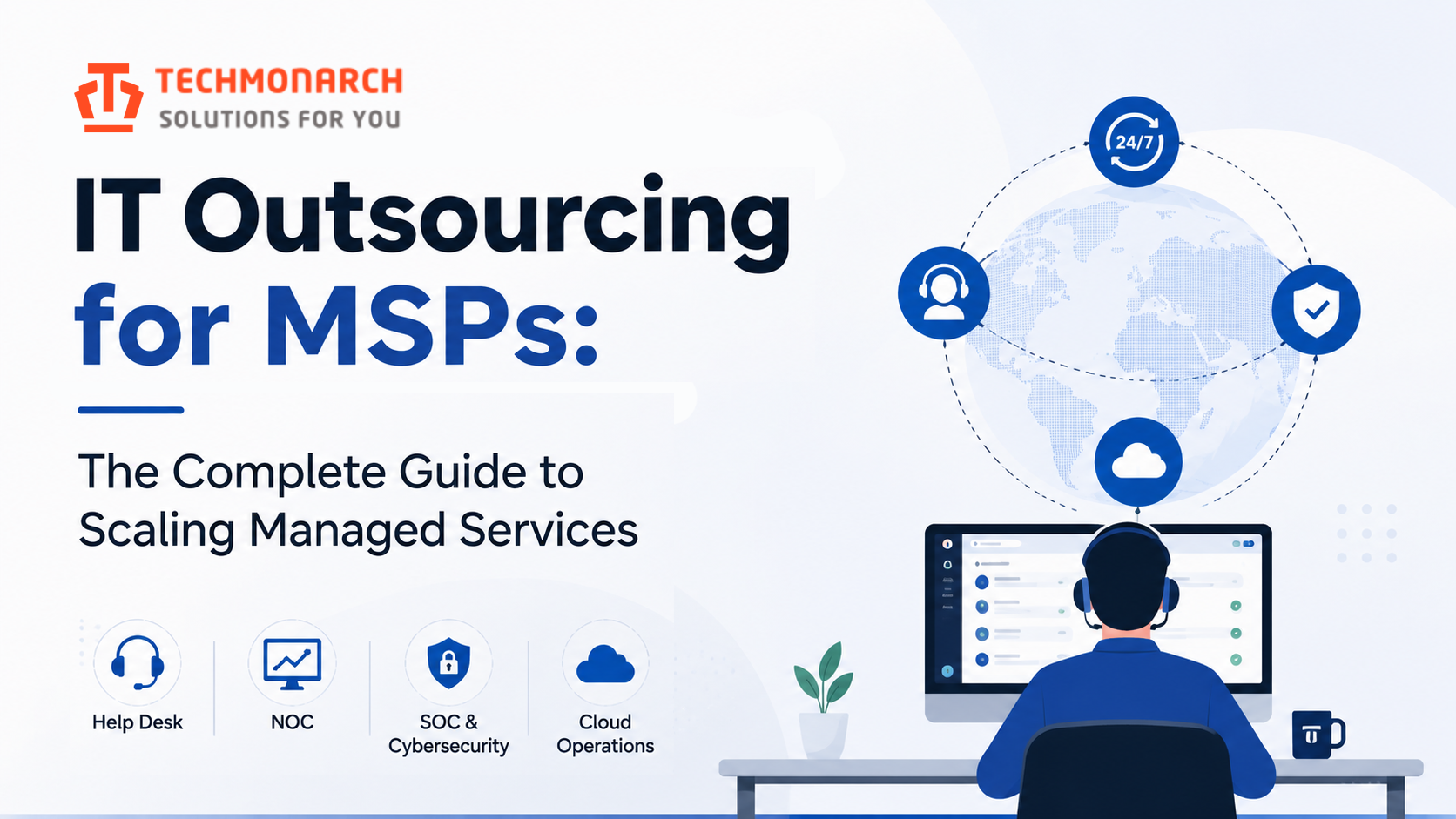
IT Outsourcing for MSPs: The Complete Guide to Scaling Managed Services
If you’ve been running an MSP for any length of time, you already know the math doesn’t work the way it did five years ago. Client expectations have moved to 24/7. Compliance requirements keep stacking up. And every time you win a new contract, you’re supposed to somehow find another L2 engineer or SOC analyst who wants to work the night shift for a salary you can actually afford. Good luck with that.
This is the gap that IT outsourcing for MSPs exists to close. Not as a buzzword, but as an operating model that a growing share of the channel now runs on. If you’re an MSP owner, ops lead, or technical director trying to figure out whether outsourcing is a real strategy or just a way to cut corners, this guide walks through what it actually is, why it works, and where it fits into how you deliver services.
What “IT Outsourcing for MSPs” Actually Means
There’s a common mix-up worth clearing up first. IT outsourcing, in this context, isn’t about a business handing its IT department to a vendor. It’s MSP-to-MSP: one managed services provider delivering specific functions — help desk, NOC, SOC, cloud administration — under another MSP’s brand, so the client never knows a third party is involved.
That’s the white-label piece. Your logo stays on the ticket. Your SLA stays on the contract. The engineer answering the phone at 2 a.m. introduces themselves using your company name. The outsourcing partner becomes an extension of your delivery team, not a subcontractor the client has to be told about.
We go deeper into the mechanics of this in what MSP outsourcing actually means, but the short version is: it’s a delivery model, not a staffing shortcut, and treating it as the latter is where most MSPs get it wrong.
Why This Model Exists Now
The managed services market isn’t shrinking, and neither is the talent pool problem. Recruiting firms have been flagging skills shortages in cybersecurity and cloud roles for years, and most MSP owners don’t need a report to confirm it — they’ve lived it through six months of an open req that nobody qualified applied for.
Meanwhile, client expectations haven’t budged. A mid-market client signing with you today expects round-the-clock monitoring, sub-15-minute response on P1 tickets, and a SOC that can actually detect something before it becomes a breach. Building that in-house means payroll for a team big enough to cover three shifts, weekends, and PTO — for a function that might only need to escalate a handful of times a month.
Outsourcing converts that fixed, always-on payroll cost into a flexible operating expense tied to what you’re actually delivering. That’s the practical reason white-label partnerships have become the default answer for MSPs trying to add 24/7 coverage or specialized security services without blowing up their cost structure. We break this down further in why MSPs outsource.
The In-House vs. Outsourced Question
Every MSP owner eventually sits down and runs the numbers on hiring versus outsourcing, and it’s worth doing honestly rather than defaulting to whichever option feels more comfortable.
An in-house L2/L3 engineer, fully loaded with salary, benefits, tools, and training, is a serious annual commitment — and that’s before you account for the 3-6 months it typically takes a new hire to become fully productive on your stack and your clients’ environments. A white-label equivalent can often be sold to a client within weeks of the partnership going live, at a fraction of the cost, with none of the recruiting risk.
That doesn’t mean outsourcing wins every category. Strategic account management, sales, and anything requiring deep institutional knowledge of a specific client relationship usually stays in-house. The functions that outsource well are the ones that are process-driven, tool-based, and don’t require the client relationship history to execute — help desk tickets, network monitoring, patch cycles, threat alerts. Our full breakdown of in-house vs. outsourced IT operations covers how to draw that line for your own business.
The Core Functions MSPs Outsource
Help Desk
Tier 1 and Tier 2 support is the highest-volume, most repetitive function most MSPs run, which also makes it the easiest to outsource cleanly. A white-label help desk answers under your brand, resolves the routine stuff, and escalates what actually needs your senior engineers’ attention. See help desk outsourcing for MSPs for how the handoff typically works.
NOC
Network operations — monitoring, alerting, patching, remediation — is the classic 24/7 pain point. Building an internal NOC that covers nights and weekends without burning out two people is genuinely hard. A white-label NOC exists specifically to absorb that load. More detail in NOC outsourcing for MSPs.
SOC and Cybersecurity
This is where outsourcing has grown fastest across the channel, and for good reason — a real internal SOC with round-the-clock threat monitoring, incident response, and compliance reporting is a seven-figure build for most MSPs, and the analyst talent to staff it is scarce and expensive. A white-label SOC gives you that capability as a monthly line item instead of a capital project. Read more in SOC and cybersecurity outsourcing for MSPs.
24/7 Coverage
All three functions above intersect at the same requirement: coverage that doesn’t stop at 5 p.m. Clients that offer round-the-clock support tend to retain business better than ones that don’t, which puts pressure on every MSP to figure out an after-hours model — whether that’s an internal night shift or an outsourced one. We cover the trade-offs in 24/7 IT support models for MSPs.
How White-Label Delivery Actually Works
The part that makes or breaks this model isn’t the technical delivery — it’s whether the client can tell. A good white-label partner works inside your PSA and RMM stack, follows your documented processes, uses your ticketing branding, and reports through your existing channels. If a client ever has to ask “wait, who is this?” the partnership has already failed at its one job.
At Techmonarch, this is the entire premise of our white-label managed IT services — help desk, NOC, and SOC delivery that runs under your brand, integrated into your existing tools, so your clients experience a seamless extension of your team rather than a third party. We’ve written a dedicated breakdown of how this delivery model is structured in white-label IT service delivery explained, which is worth reading if brand invisibility is your biggest concern going in.
What to Actually Look For in an Outsourcing Partner
A few things separate a partnership that scales your business from one that creates a support headache down the line:
- Process compatibility. Can they work inside your existing PSA, RMM, and documentation, or are they asking you to adapt to theirs?
- SLA transparency. Response and resolution times should be contractual, not aspirational.
- Security posture. If they’re touching client environments, their own security practices need to hold up to scrutiny — ask about compliance frameworks, not just uptime numbers.
- Escalation clarity. You need to know exactly when and how something gets kicked back to your internal team.
- Brand discipline. Scripts, ticket language, and communication style should match yours, not theirs.
None of this is exotic. It’s the same due diligence you’d apply to any vendor that’s going to represent your company to your clients — it just matters more here because the exposure, if it goes wrong, lands directly on your reputation.
Where This Leaves You
Outsourcing isn’t a replacement for having a strong internal team — it’s a way to extend what that team can cover without hiring your way into an unsustainable cost structure every time you land a new client. The MSPs getting the most out of this model treat it as infrastructure, not a stopgap: they pick functions that are process-heavy and coverage-intensive (help desk, NOC, SOC), find a partner who can disappear into their brand, and use the freed-up capacity to focus on the parts of the business that actually require their institutional knowledge — strategy, account growth, and the client relationships that got them here in the first place.
The eight linked guides above go deeper into each piece of this model. If you’re evaluating whether outsourcing makes sense for where your MSP is right now, they’re a reasonable place to keep reading.