
-
Vijit
- September 25, 2026
- No categories assigned.
- No Comments
24/7 IT Support Models for MSPs
At some point every MSP owner gets asked the question directly: “What happens if something breaks at 2 a.m.?” The client isn’t asking out of curiosity. They’re asking because a competitor already promised round-the-clock coverage, or because their last provider left them stranded during an overnight outage, or because their compliance requirements simply demand it. However it comes up, your answer to that question increasingly decides whether you win the deal.
The problem is that “24/7 support” isn’t one thing. There are several structurally different ways to deliver it, and the model you pick has real consequences for cost, quality, and whether your team is still functioning normally in six months. Here’s what the actual options look like.
Why This Question Keeps Getting Harder to Dodge
Client expectations around availability have shifted decisively. A large majority of customers now expect real-time support regardless of the hour, and that expectation doesn’t stop at consumer apps — it’s carried straight into how businesses evaluate their IT provider. MSPs offering genuine round-the-clock coverage consistently report stronger client retention than those limited to business hours, because the moment a client experiences a real overnight outage with no one answering, the relationship is functionally over regardless of how good daytime support has been.
At the same time, security threats don’t observe business hours either. A ransomware event or a critical infrastructure failure that happens at midnight and doesn’t get addressed until 9 a.m. can do a full day’s worth of damage before anyone even notices. That combination — client expectation plus real operational risk — is why 24/7 coverage has moved from a premium differentiator to something closer to a baseline requirement for any MSP serving clients with real uptime needs.
The Three Structural Models
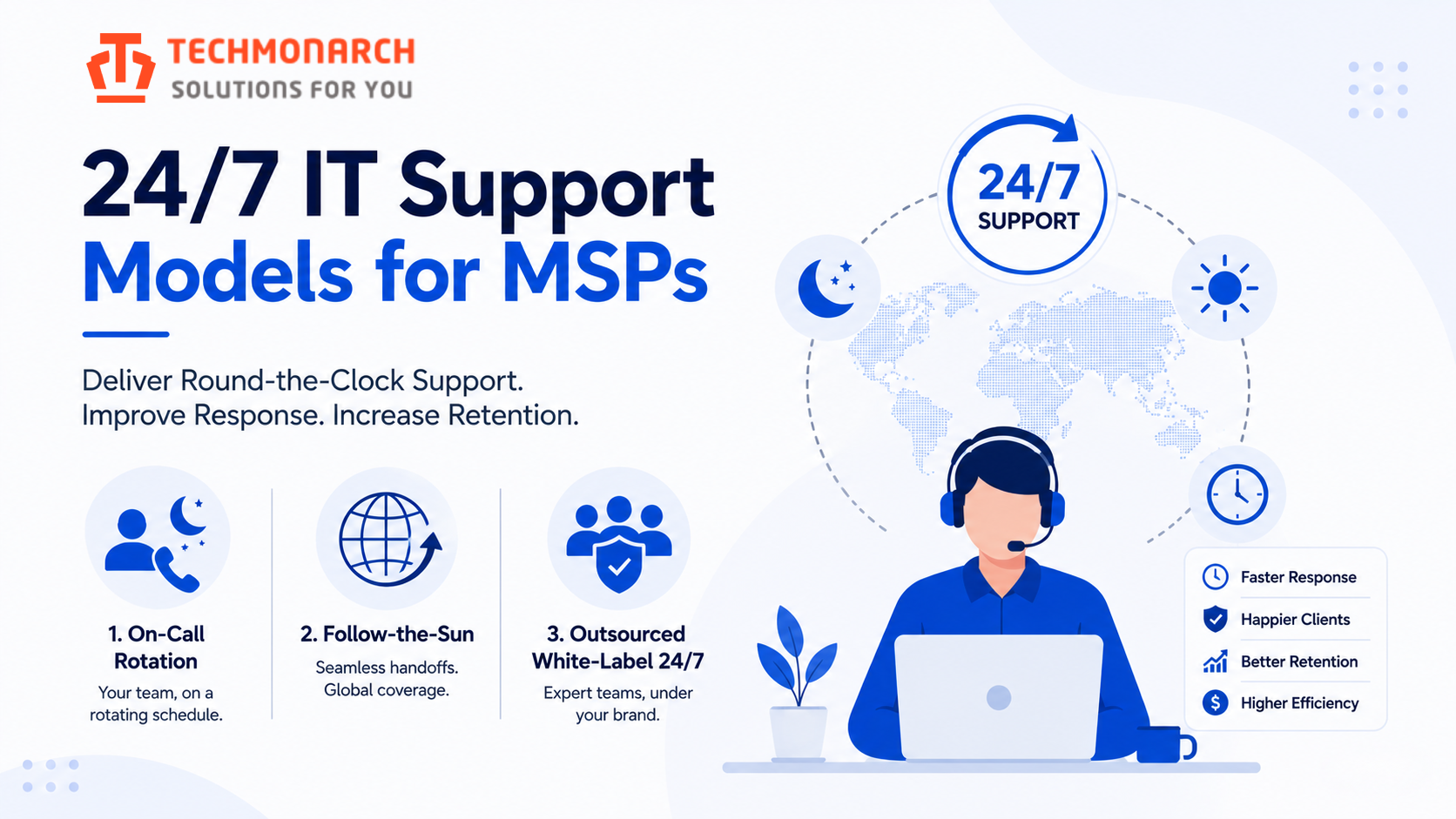
Model 1: Internal On-Call Rotation
This is the model most MSPs start with, out of necessity rather than preference. A rotating on-call schedule — commonly a week at a time, with meaningful time off between rotations — puts the burden of after-hours coverage on your existing technicians, compensated through a stipend plus per-incident pay.
It’s the cheapest model to set up because it doesn’t require new hires or a vendor relationship. But it has a real ceiling: it depends entirely on the goodwill and stamina of a small group of people, it doesn’t scale cleanly as client count grows, and it’s a well-documented driver of technician burnout and turnover. A rotation that looked sustainable at 15 clients often stops looking sustainable at 40, and by the time that becomes obvious, you’re usually already losing people.
Model 2: Follow-the-Sun
Follow-the-sun distributes coverage across time zones so that, as the workday ends in one region, tickets hand off to a team where it’s still daytime. Done well, this delivers genuine round-the-clock coverage without asking anyone to work through the night — first response happens in minutes at any hour, and the engineers handling it are working normal daytime shifts wherever they happen to be.
The model’s real risk isn’t the concept — it’s the handoff. Most follow-the-sun programs that fail don’t fail because the time-zone math is wrong; they fail at the handover points, where unclear ownership or thin overlap between regions lets issues fall through the cracks between shifts. A follow-the-sun model needs explicit overlap windows, clear escalation rules, and shared visibility into ticket status across regions to actually work — without that discipline, it just relocates the coverage gap instead of closing it.

Model 3: Outsourced/White-Label 24/7 Coverage
The third model hands after-hours (or full round-the-clock) coverage to a white-label partner who’s already built the staffing and process for continuous operation, delivered under your brand so clients never know a third party is involved. This is functionally a specialized version of follow-the-sun, except you’re not building or managing the distributed team yourself — the partner already runs it, across multiple MSP clients, which is what makes their staffing economics work at a price point you likely can’t replicate internally.
This tends to be the fastest path to genuine coverage for MSPs that don’t already have the client volume or geographic footprint to run their own follow-the-sun operation. We cover the mechanics of how this delivery actually works in what MSP outsourcing actually means.
The Hybrid Approach Most MSPs Actually Land On
In practice, few MSPs run a single pure model. The most common structure blends in-house daytime coverage — where your team’s client relationship knowledge adds the most value — with outsourced or follow-the-sun coverage for nights, weekends, and holidays, where raw availability matters more than deep account familiarity. Organizations using this kind of blended approach have reported meaningful gains in response times and client satisfaction compared to a business-hours-only model, largely because staffing gets matched to actual demand patterns instead of being spread thin across every hour equally.
This hybrid structure also lets you apply different logic to different functions. Help desk overflow after hours might route to an outsourced Tier 1 team, while NOC monitoring runs continuously through a white-label partner, and SOC alerts get handled by a dedicated 24/7 security team — three different functions, potentially three different partners, all coordinated under your brand. Our guides on help desk outsourcing and NOC outsourcing cover how each of those pieces works individually.
Not Everything Needs the Same Coverage Level
One thing worth being deliberate about: not every system or client tier genuinely requires 24/7 attention, and treating all tickets as equally urgent around the clock wastes coverage capacity you could allocate more usefully. Critical infrastructure — production servers, security alerts, systems tied to compliance obligations — justifies round-the-clock monitoring. Routine, non-urgent requests can reasonably wait for business hours even at an MSP that markets itself as fully 24/7. Being explicit about that tiering with clients, rather than implying everything gets equal urgency, keeps expectations aligned and keeps your after-hours capacity focused on what actually matters.
Choosing a Model for Your MSP
The right starting point is usually your current pain, not an abstract preference for one model over another. If your team is burning out on an unsustainable on-call rotation, that’s the signal to move toward outsourced or follow-the-sun coverage before the attrition costs you more than the outsourcing would. If you’re losing deals specifically because you can’t promise round-the-clock coverage, that’s a more direct case for adding an outsourced layer sooner rather than later.
At Techmonarch, round-the-clock monitoring and event management is core to how we help MSPs close this gap — our monitoring and event management services run continuously under your brand, so coverage doesn’t depend on your internal team absorbing every night and weekend shift. For the full picture of how 24/7 coverage fits into a broader outsourcing strategy, our guide to IT outsourcing for MSPs covers the complete model.
Reference 0
Recent Comments
- No comments to show