
-
Vijit
- September 15, 2026
- No categories assigned.
- No Comments
Help Desk Outsourcing for MSPs
Help desk is usually the first function an MSP considers outsourcing, and for good reason — it’s the highest-volume, most repetitive part of the business, and it’s the function most directly responsible for whether clients feel taken care of day to day. It’s also, not coincidentally, the function most MSPs burn out their best people on, because senior engineers end up fielding password resets instead of the work they’re actually good at.
If you’re weighing whether to outsource help desk, this covers what actually gets outsourced, how the tiering works, and what separates a partner that strengthens your operation from one that just adds noise.
Why Help Desk Outsources Well
Not every function is a good outsourcing candidate, but help desk hits every criterion cleanly. It’s high-volume. It’s process-driven — the vast majority of tickets follow patterns that can be documented into SOPs. And it doesn’t require deep institutional knowledge of a specific client’s business the way account management does. A well-run Tier 1 team resolves a large majority of tickets — commonly cited in the 60-70% range — without ever needing to escalate, simply by following documented procedure.
That combination is exactly what makes a function outsource cleanly: repeatable work, at scale, that doesn’t depend on who’s answering the phone as long as they’re following your process. It’s also why help desk consistently shows up as one of the first functions MSPs hand off, well before NOC or SOC.
How the Tiering Actually Works
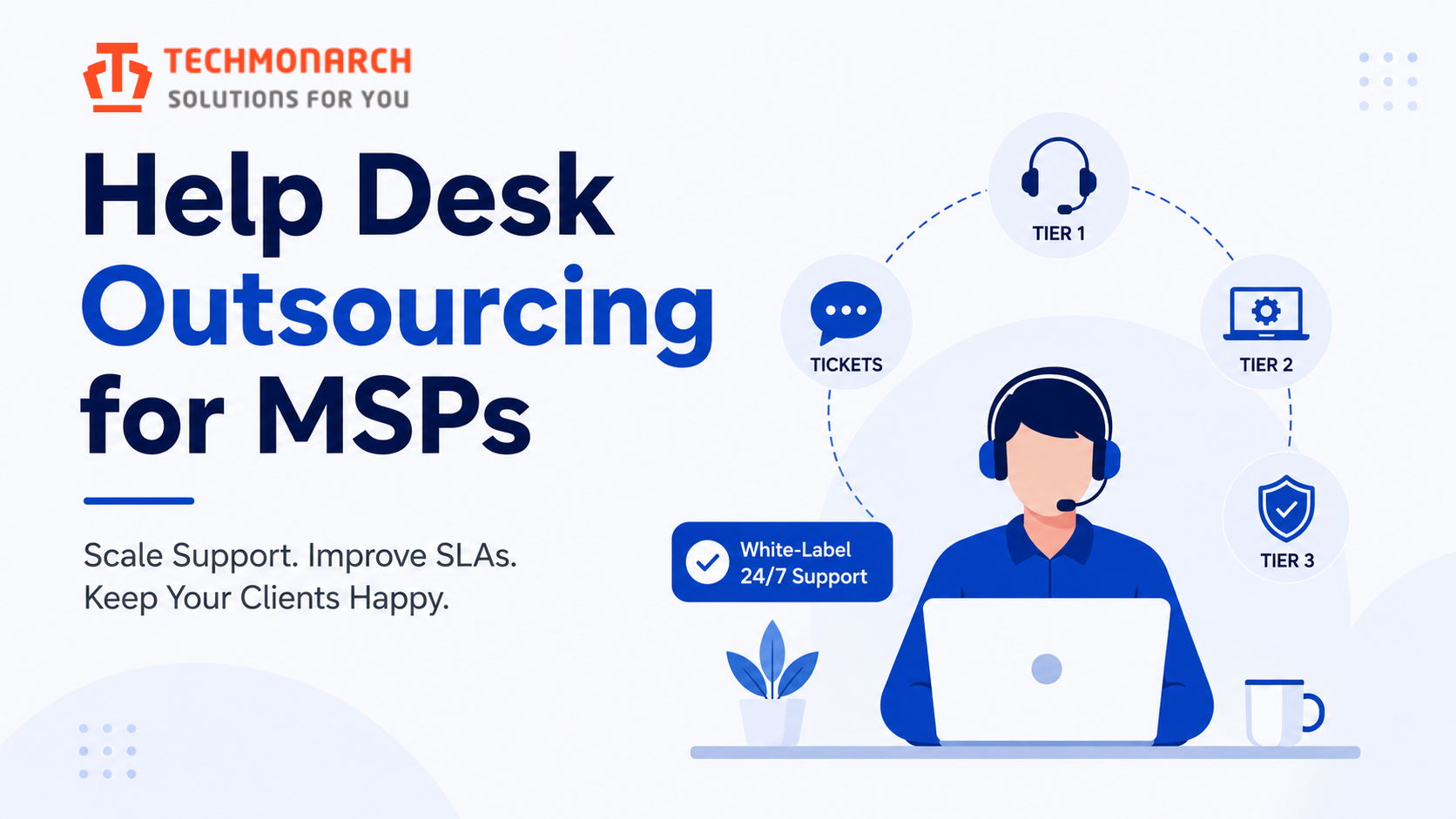
A white-label help desk arrangement typically mirrors the tier structure you’d run internally, just delivered by a partner:
Tier 1 handles the bulk of volume — password resets, software installs, basic connectivity issues, account access requests. This tier owns the ticket until a defined escalation trigger hits: a privileged change, a security concern, repeated failure to resolve, or anything outside documented scope.
Tier 2 handles deeper troubleshooting — server issues, Active Directory and Microsoft 365 administration, network problems that need more than a documented fix. This is where technical depth starts mattering more than process adherence.
Tier 3 covers infrastructure-level and security-adjacent issues that need your senior engineers’ judgment, not just their availability. A good outsourcing partner escalates cleanly here rather than attempting to hold onto tickets outside their competence.
The mechanism that makes this work is the escalation packet — a structured handoff that includes what the user reported, what’s already been tried, device and account details, and what action is being requested next. Partners that escalate with a clean packet save your senior team real time. Partners that escalate a bare ticket with no context just move the workload instead of reducing it, which is one of the fastest ways an outsourcing relationship stops paying for itself.
What “White-Label” Actually Requires Here
The technical delivery of help desk outsourcing isn’t the hard part — most competent providers can answer tickets and follow a script. What separates a partner worth using from one that quietly damages your brand is whether the client can tell a third party is involved at all.
That means the partner answers using your company name, works inside your existing PSA and ticketing system rather than their own, follows your documented SOPs rather than a generic playbook, and reports through your channels so client-facing metrics look like they came from your team — because functionally, they did. If a client ever has to ask who they’re actually talking to, the arrangement has failed its one job. This is the same standard covered in more depth in our guide on what MSP outsourcing actually means.
The Cost Case
Run the numbers and the gap is hard to ignore. A single entry-level in-house hire, once you factor in benefits, payroll tax, and tooling on top of salary, commonly climbs toward the high five figures annually — and that covers one person, business hours only, with zero backup coverage when they’re out. Outsourced help desk is typically priced per user or per seat, often somewhere in the range of $15-$20 per user monthly for a solid tier, which delivers a full team with built-in backup rather than a single point of failure.
That’s the part easy to miss when comparing sticker prices: one in-house hire isn’t actually comparable to one outsourced seat, because the outsourced model gives you coverage continuity — someone’s always on shift — that a single employee structurally can’t provide. We break down this comparison more broadly, across all outsourced functions, in in-house vs. outsourced IT operations.
The Effect on Your Senior Team
There’s a second-order benefit that rarely makes it into the pricing conversation: what outsourcing Tier 1 does to the rest of your team’s time. Every hour a senior engineer spends resetting passwords or walking a user through a printer issue is an hour they’re not spending on the higher-margin work your business actually depends on — infrastructure projects, security posture improvements, the technical depth that justifies your rates. Offloading the repetitive volume to a dedicated Tier 1 team frees that capacity without you having to hire a junior technician just to absorb it.
This also tends to reduce burnout-driven attrition on the team you already have. Senior engineers who signed up for infrastructure and security work, not ticket triage, don’t stay long at MSPs that can’t get them out of the queue. Outsourcing the volume that doesn’t need their skill level is as much a retention strategy as a cost one.
What to Screen For in a Partner
A few things separate a help desk partner that scales your business cleanly from one that creates support headaches:
- First-response and resolution benchmarks. Ask for actual numbers, not marketing language — average time to first response, first-contact resolution rate, mean time to resolve.
- PSA/RMM compatibility. They should work inside your existing stack, not ask you to adapt to theirs.
- Documented escalation discipline. Ask to see a sample escalation packet before signing anything.
- Scalability without re-negotiation. Winning a large new client shouldn’t require a fresh contract conversation every time your ticket volume jumps.
- Security posture. Help desk agents routinely touch identity and endpoint access — least-privilege access, MFA, and logging on their side aren’t optional extras.
Where This Fits Into a Broader Coverage Strategy
Help desk is rarely outsourced in isolation for long. MSPs that start here often extend the same logic to NOC and SOC once they see the model working — the coverage and cost benefits compound when the same partner (or a coordinated set of partners) is handling ticket overflow, infrastructure monitoring, and security alerts together rather than as disconnected vendors. If round-the-clock coverage across multiple functions is the eventual goal, our guide to 24/7 IT support models for MSPs covers how that typically gets structured.
At Techmonarch, help desk is one of the core pieces of our 24/7 IT helpdesk support services — ITIL-aligned L1 through L3 technicians working inside your PSA, under your brand, with full SLA tracking and reporting so the outsourcing itself stays invisible to your clients. For the fuller picture of how help desk fits alongside NOC and SOC in a complete outsourcing strategy, see our guide to IT outsourcing for MSPs.
Recent Comments
- No comments to show