
-
Vijit
- September 22, 2026
- No categories assigned.
- No Comments
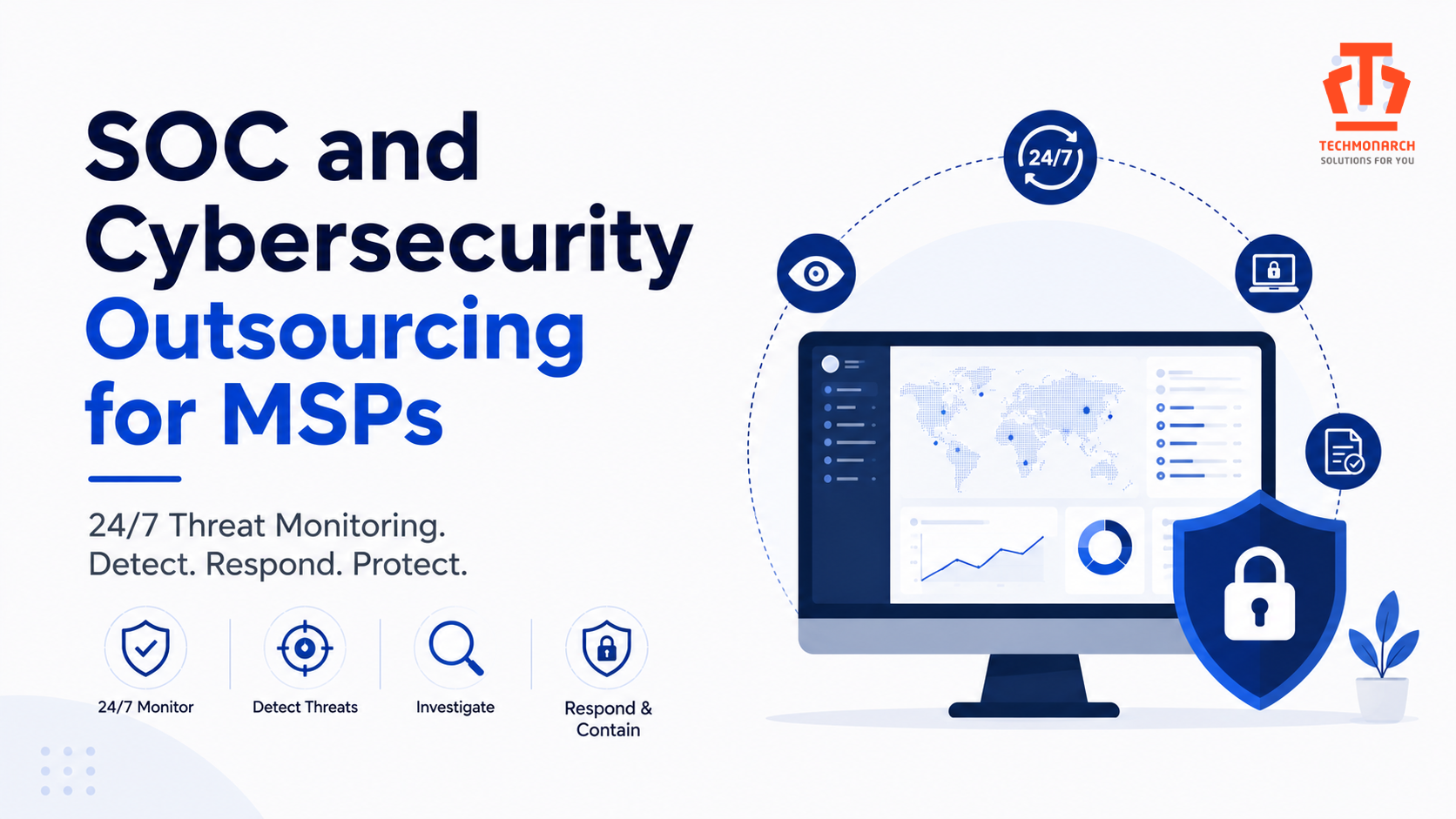
SOC and Cybersecurity Outsourcing for MSPs
Security is the one function where “we’ll get to it eventually” is no longer an acceptable answer, and most MSP owners know it. Clients ask about cyber insurance questionnaires. Compliance frameworks show up in contracts. Threat actors don’t wait for you to finish hiring your first SOC analyst. And yet building a genuine 24/7 SOC internally is, without much exaggeration, one of the most expensive operational builds an MSP can attempt.
This is why SOC outsourcing has grown faster than almost any other category of white-label service over the last few years. If you’re deciding whether to build security monitoring internally or bring in a partner, here’s what actually goes into that decision.
What “Real” SOC Coverage Actually Means
Before comparing options, it’s worth being precise about what a SOC does, because the term gets used loosely across the industry. A genuine Security Operations Center provides continuous monitoring of security telemetry — SIEM alerts, EDR/XDR signals, log data — with trained analysts triaging, investigating, and responding to threats around the clock, not just forwarding alerts for someone else to look at during business hours.
That distinction matters more than it sounds. Industry analysis has found that a meaningful share of companies marketing themselves as security providers don’t actually run a genuine 24/7 SOC behind the branding — verifiable only through things like shift logs, analyst headcount, and real detection-to-response time data. If you’re outsourcing this function, or evaluating whether to build it, “24/7 SOC” needs to mean an actual staffed operation, not a monitoring dashboard with an on-call rotation bolted on.
The Cost of Building This Internally
Run the numbers on an internal SOC and the case for outsourcing becomes hard to argue against for most MSPs. A fully staffed internal SOC — genuinely covering nights, weekends, and holidays with enough analysts to avoid burnout — commonly runs into seven figures annually once you account for headcount, tooling (SIEM, EDR/XDR, ticketing), and the ongoing training security analysts need to stay current against an evolving threat landscape. Analyst turnover compounds the problem: security roles see meaningfully higher attrition than most other IT functions, which means the team you finally finish building doesn’t stay built for long.
Outsourced SOC coverage, by contrast, is priced per endpoint and typically runs somewhere in the high single digits to mid-twenties of dollars per endpoint monthly for mainstream managed detection and response, with volume moving the rate — larger endpoint counts negotiate toward the lower end of that range. That difference isn’t a rounding error. It’s routinely cited as being a small fraction of what an equivalent in-house build costs annually, which is exactly why SOC has become one of the highest-margin services an MSP can resell without ever touching the underlying infrastructure themselves.
MDR, SOC-as-a-Service, and MSSP: Knowing the Difference
Outsourced security comes in a few distinct flavors, and mixing them up leads to buying the wrong thing:
MDR (Managed Detection and Response) actively hunts, detects, and contains threats — the provider takes action, not just alerts you to a problem. Pricing is almost always per endpoint, with the provider’s own EDR/XDR tooling typically bundled in.
SOC-as-a-Service is a fully outsourced SOC function delivered in tiers — monitoring, detection, response, and compliance reporting bundled together, scaling from basic log monitoring up to active threat hunting and incident response.
MSSP (Managed Security Service Provider) in its narrowest sense covers broader infrastructure security management — firewalls, SIEM, log management — but historically leans more toward alerting than direct action, though the term is used loosely across the industry.
For most MSPs evaluating a white-label partner, what actually matters isn’t which label the provider uses — it’s whether they run genuine 24/7 coverage, whether containment happens under your brand rather than theirs, and whether the reporting they generate holds up under a compliance audit. This is the same brand-invisibility standard covered in what MSP outsourcing actually means.
Why White-Label Specifically Matters Here
Security is one area where “outsourced but visible” genuinely damages the relationship you’re trying to build with clients. If a client’s SIEM alerts route through a vendor with someone else’s name on the dashboard, you’ve effectively told them your MSP isn’t actually running their security — which undercuts the exact trust you need for them to take your recommendations seriously on everything else.
A true white-label SOC operates entirely under your brand: alerts, investigations, and containment actions all appear as your team’s work, with the underlying provider invisible to the client. Not every security vendor offers this — some platforms remain co-branded or fully vendor-branded regardless of what you’re calling it in your sales deck, so this is worth confirming explicitly before signing rather than assuming it’s included.
Compliance Is Often the Real Driver
For a growing share of MSPs, the push toward SOC outsourcing isn’t really about the threat landscape in the abstract — it’s about a specific client asking for SOC 2, HIPAA, or PCI-DSS evidence they can’t currently produce. Auditable, client-ready reporting requires process, tooling, and trained staff most MSPs haven’t built internally, and building it from scratch specifically to answer one client’s compliance questionnaire rarely makes financial sense. A white-label SOC partner that already produces audit-ready reporting closes that gap immediately rather than over the 12-18 months an internal build typically takes.
What to Evaluate Before Signing
- Verified 24/7 coverage, not a dashboard with an on-call escalation path bolted on.
- True white-label delivery — confirm explicitly whether the client ever sees the underlying vendor’s brand.
- Containment authority, not just alerting. Ask specifically what the partner can do without waiting on your team.
- Compliance reporting mapped to the frameworks your clients actually need — SOC 2, HIPAA, PCI-DSS, CMMC.
- Data and tenant ownership — understand what happens to your detection history and tuning if you ever switch partners; some fully outsourced models make this expensive to unwind.
Where This Fits Your Broader Strategy
SOC is frequently the last of the three core functions MSPs outsource, arriving after help desk and NOC are already running smoothly with a partner. That sequencing makes sense — by the time security monitoring is added, the MSP already has proof the white-label model works operationally, which lowers the risk of extending it to the function with the highest stakes. If you haven’t outsourced NOC yet, our guide to NOC outsourcing for MSPs covers that groundwork first.
At Techmonarch, our SOC services deliver 24/7 threat monitoring, detection, and response entirely under your brand, with compliance reporting built for the frameworks your clients are actually being asked about. For how SOC fits into a complete outsourcing strategy alongside help desk and NOC, see our guide to IT outsourcing for MSPs.
Recent Comments
- No comments to show