
-
Vijit
- July 20, 2026
- soc
- No Comments
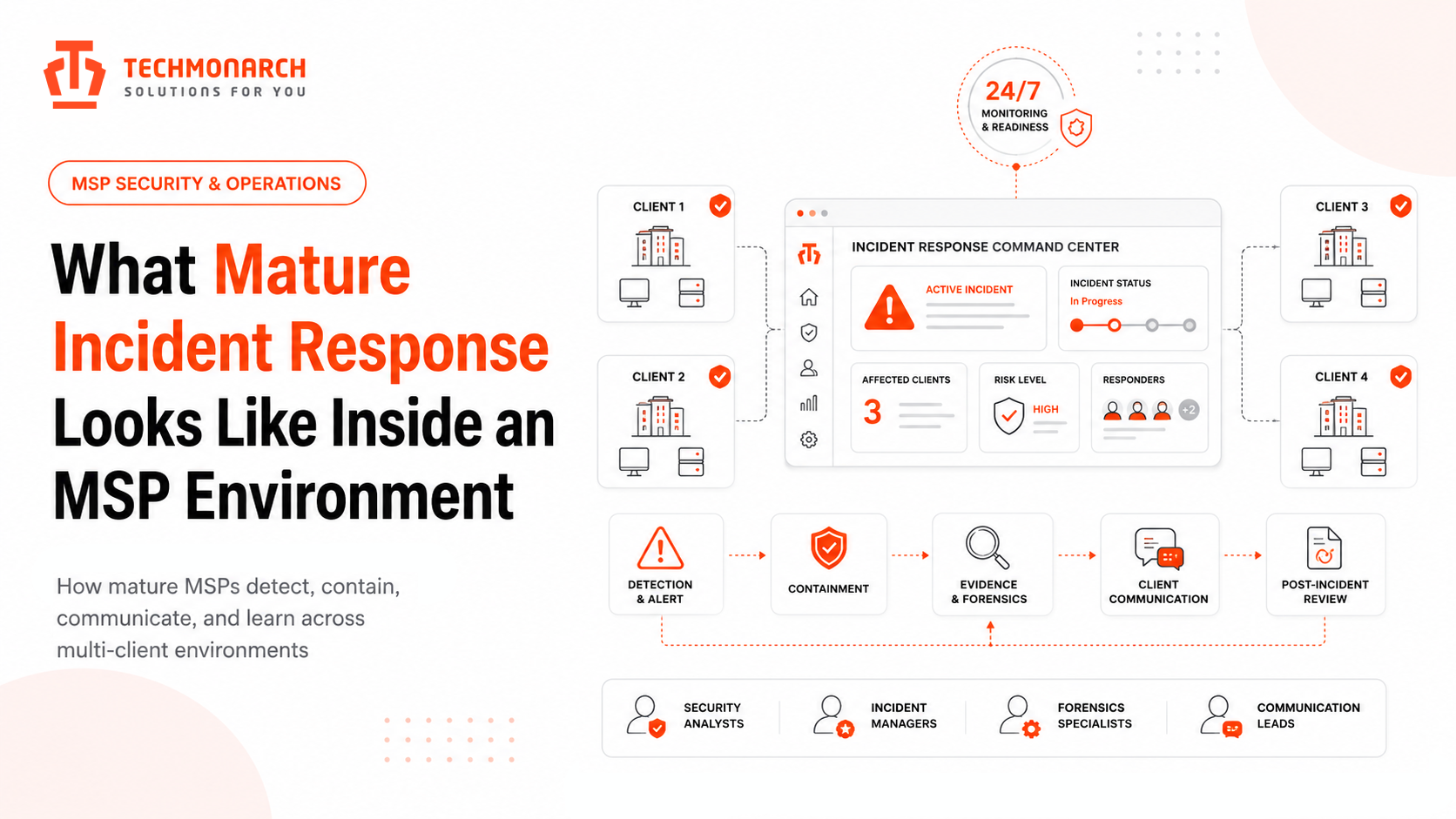
What Mature Incident Response Looks Like Inside an MSP Environment
Incident response maturity in an MSP context is a fundamentally different discipline from incident response maturity in a single-organization enterprise. The frameworks are the same — NIST SP 800-61, the SANS PICERL model, ISO 27035 — but the operational environment that surrounds them is categorically more complex. An MSP does not respond to incidents in one environment. It responds in dozens or hundreds simultaneously, each with a distinct architecture, compliance posture, escalation preference, and client relationship dynamic. A playbook that is perfectly adequate for a single organization becomes insufficient the moment it is applied across a multi-client operational footprint without the adaptations that footprint demands.
This distinction matters because many MSPs evaluate their incident response capability against enterprise benchmarks and reach a conclusion of adequacy that the operational reality does not support. The right benchmark is not “do we have an incident response plan.” It is “does our incident response capability scale across our entire client base, differentiate by client environment, operate under 24/7 coverage conditions, and learn from every incident in a way that makes the next response more effective.” That is a significantly higher bar, and the gap between where most MSPs sit and where mature incident response actually lives is worth mapping precisely.

The Multi-Client Complexity That Changes Everything
The foundational challenge of MSP incident response is that a single threat event rarely affects a single client. Ransomware delivered through a phishing campaign that targeted one client’s email environment may carry lateral movement potential into shared infrastructure. A compromised credential may grant access to systems across multiple tenants if account governance is not tightly segmented. An RMM compromise — as discussed extensively in supply chain risk contexts — can simultaneously expose every client environment under management. The blast radius of a single incident in an MSP environment is bounded not by one organization’s perimeter but by the entire MSP operational footprint.
Mature incident response in this context requires that the initial triage phase of every security incident explicitly assess cross-client exposure — not as a secondary consideration but as a first-order question. Before containment actions are decided, before client communications are drafted, before the incident severity is finalized, the response team needs to answer: which other client environments share relevant infrastructure, credentials, software versions, or integration points with the affected environment? That scoping question, answered incorrectly or not at all, is where MSP incident responses most frequently become multi-client disasters.
This also means that MSP incident response playbooks cannot be generic templates applied uniformly. Each client environment needs a profile that captures its specific exposure relationships — which shared platforms it relies on, which integrations it shares with other client environments, which credentials have cross-environment scope, and what the regulatory notification obligations are in the event of a breach. That profile does not need to be lengthy. It needs to be accurate, current, and accessible to the response team within minutes of an incident declaration.
The Preparation Phase Is Where Maturity Lives or Dies
Every serious incident response framework begins with preparation, and every post-incident analysis of a poorly handled response traces the failure back to preparation deficits rather than execution failures. The Verizon 2025 Data Breach Investigations Report documented that exploitation of vulnerabilities to gain initial access grew by 34 percent compared to the prior year — which means the preparatory investment required to meet an increasingly aggressive threat environment is itself increasing, not stable.
For MSPs, preparation has three components that are distinct from single-organization IR preparation. The first is playbook differentiation by incident type and client classification. A ransomware playbook for a healthcare client operating under HIPAA has materially different notification timelines, evidence preservation requirements, and regulatory communication obligations than a ransomware playbook for a professional services client with no specific compliance framework. Treating these as a single playbook because the technical response actions overlap produces a response that is technically adequate and legally or contractually deficient — a failure mode that becomes visible only when the regulatory consequences arrive.
The second preparation component is role clarity under incident conditions. During a high-stress security incident, role ambiguity produces the most damaging decisions: the wrong person making the containment call, client communications going out without legal review, evidence being overwritten during recovery actions that should have waited for forensic preservation. Mature MSPs designate specific roles — incident commander, technical lead, client communications owner, documentation owner — and those designations are known, practiced, and invoked automatically when an incident is declared. They are not improvised in the moment.
The third preparation component is tabletop exercise cadence. A response capability that exists only on paper and has never been executed under simulated pressure is not a reliable operational asset. Mature MSPs run scenario-based exercises — ransomware impacting a regulated client, RMM compromise with multi-client exposure, business email compromise affecting financial transaction integrity — on a regular schedule, with documented outcomes and specific playbook improvements following each exercise. The exercise is not a compliance checkbox. It is the mechanism through which theoretical preparation becomes operational muscle memory.
Detection and Identification at MSP Scale
Detection in an MSP environment operates across a monitoring stack that spans multiple client tenants, multiple toolsets, and — for MSPs using white-label NOC or SOC partners — multiple organizational layers. The detection challenge is not primarily a tooling problem. Most mature MSPs have adequate monitoring coverage. The challenge is signal quality, alert routing, and the triage discipline required to distinguish actual security incidents from the high-volume noise that monitoring systems generate across a large, heterogeneous client base.
Alert fatigue is the detection gap that most frequently allows early-stage incidents to progress beyond the point where simple containment would have been sufficient. When a security event generates an alert that is categorized alongside dozens of routine operational alerts, the probability that it receives immediate human attention depends heavily on the triage protocols governing the monitoring queue. Mature incident response at the detection layer means clear alert classification criteria, automated escalation for indicators of compromise that match known attack patterns, and defined response time windows that are enforced rather than aspirational.
Identification — the process of confirming that an alert represents a genuine incident rather than a false positive, and scoping its initial boundaries — is where the cross-client exposure question enters the response workflow. Identification should produce a preliminary incident scope that includes both the directly affected client environment and an assessment of adjacent exposure across the MSP’s client base. That preliminary scope drives the initial containment decisions and the client communication sequence. Getting it wrong in either direction — under-scoping the incident and missing cross-client exposure, or over-scoping and triggering unnecessary client notifications — produces downstream operational and reputational costs that the initial triage should have avoided.
Containment Decisions Under Operational Pressure
Containment in a security incident represents one of the highest-stakes operational decisions in managed services because it involves a direct tradeoff between client business continuity and breach scope limitation. Isolating a compromised endpoint or disabling an affected account stops the lateral movement but also interrupts client operations. In a single-organization context, that tradeoff is navigated with one stakeholder. In an MSP context, it may need to be navigated simultaneously across multiple clients with different risk tolerances, different business impact profiles from downtime, and different contractual entitlements to influence containment decisions.
Mature containment decision-making in MSP environments requires pre-negotiated authority frameworks. Before an incident occurs, the MSP’s engagement agreements should define what containment actions the MSP can take unilaterally without client approval, what actions require client notification before execution, and what the notification timeline obligations are for each tier of action. An MSP that isolates a client’s domain controller during a ransomware incident without prior authority to do so — even if the action was operationally correct — has created a contractual and relationship problem on top of a security incident.
The technical execution of containment should follow documented playbook steps rather than real-time improvisation. Endpoint isolation via EDR, account disablement in the identity provider, session revocation, firewall rule deployment, and backup isolation from the production environment are all actions that should be mapped to specific tools, specific command sequences, and specific verification steps in the playbook. Under the cognitive load of an active security incident, improvised containment produces mistakes that extend breach duration and complicate forensic preservation.
Evidence Preservation and Forensic Discipline
One of the clearest markers of incident response immaturity in MSP environments is evidence destruction during recovery. The instinct under client pressure to restore systems and return to normal operations as quickly as possible frequently produces the overwriting of forensic artifacts that would have been required for root cause analysis, cyber insurance claims, or regulatory reporting. In a healthcare client environment, that evidence destruction is not just an analytical loss — it is a HIPAA breach notification problem with its own reporting timeline and potential penalty structure.
Mature incident response treats forensic preservation as a parallel track to containment, not a sequential phase that follows it. Before recovery actions begin, memory dumps and disk snapshots of affected systems should be captured. Log preservation from relevant systems — identity platforms, endpoint detection tools, network monitoring — should be initiated and isolated from the production environment. The incident timeline should be reconstructing using those artifacts before any remediation action that could alter the system state. These steps add time to the response. They also provide the evidentiary foundation for everything that follows: client reporting, regulatory notification, insurance claims, and the post-incident review that drives future preparedness improvement.
Client Communication as a Response Discipline
Client communication during a security incident is not a soft skill adjunct to the technical response — it is a core operational discipline with its own playbook, its own role designations, and its own timing requirements. How an MSP communicates during an incident often determines the client relationship outcome as much as how the technical response is executed. A technically excellent response communicated poorly produces client anxiety, loss of confidence, and frequently, churn. A technically imperfect response communicated with transparency and clarity can preserve the relationship through a difficult event.
Mature MSPs maintain communication templates for common incident types that are reviewed legally before use, updated at least annually, and tailored for the communication channel and regulatory requirements applicable to each client. Template maintenance is not bureaucratic overhead — it ensures that under incident pressure, the person drafting client communications is not also simultaneously making language decisions that could create liability. The Barracuda Networks guide on MSP cybersecurity incident response planning notes that well-structured Cybersecurity Incident Response Teams help MSPs meet compliance obligations by ensuring clear procedures for identifying and responding to incidents, preserving forensic evidence, and reporting to regulators or affected clients in a timely and accurate way — noting that this is often a contractual or legal necessity, not merely a best practice.
Communication timing matters as much as content. Clients who learn about an incident affecting their environment from a source other than their MSP — a news report, a vendor notification, an employee who saw unusual system behavior — experience a trust failure that is very difficult to recover from. The communication playbook should specify maximum time-to-notification thresholds for each incident tier, with the clock starting at incident declaration rather than at resolution.
The Post-Incident Review as Operational Investment
Most MSPs conduct some form of post-incident review. Fewer conduct post-incident reviews that produce durable operational changes. The difference is in how the review is structured and what it is expected to output.
A post-incident review that produces a narrative account of what happened and a list of findings that are not operationalized into specific playbook changes, detection rule updates, or role accountability adjustments is a documentation exercise. A post-incident review that answers four specific questions — what was detected and when, what containment decision was made and on what basis, what the actual blast radius turned out to be versus the initial scope estimate, and what would have produced a materially better outcome — generates the specific inputs that drive capability improvement.
NIST SP 800-61 recommends holding lessons-learned reviews within two weeks of incident closure, with findings feeding back into updated playbooks, detection rules, and training. The cadence matters because the operational memory of an incident is sharpest immediately after resolution. Reviews conducted months later reconstruct events from documentation rather than from lived experience, and the quality of insight declines accordingly. For MSPs managing multiple simultaneous client environments, the discipline of completing post-incident reviews within this window — despite the operational pressure to move on to the next priority — is one of the most reliable indicators of overall incident response maturity.
Where NOC and SOC Integration Fits the Maturity Model
MSPs that operate 24/7 incident response capability through a combination of internal teams and white-label NOC or SOC partners face a specific maturity challenge: ensuring that the response capability is seamless across the organizational boundary. An incident that begins during a NOC monitoring shift and escalates to internal security engineers needs to transition without context loss, without role confusion, and without the delay that organizational handoffs create when the interface is not engineered in advance.
The SOC function within a white-label partnership arrangement — as structured in engagements with providers like Techmonarch — needs to operate with the same incident classification criteria, escalation thresholds, and playbook access as the internal team. That alignment is not automatic. It requires documented interface agreements, shared playbook access, defined escalation triggers that both teams interpret identically, and a regular operational review that examines cross-boundary incidents specifically for handoff quality. Where those elements are in place, the white-label SOC extends the MSP’s incident response capability without degrading its coherence. Where they are absent, the organizational seam becomes a response gap that threat actors can exploit.
Maturity as an Ongoing State, Not a Destination
Incident response maturity is not a certification or a checklist completion. Todyl’s State of MSP Security Maturity Report 2025 observes that the highest-maturity MSPs treat incident response as a continuous discipline rather than a static set of procedures and tools — continuously refining processes based on new threat intelligence, incident lessons, and changes in client environments. That framing correctly describes the operational reality: the threat environment that incident response capability is designed to address is itself evolving, and a capability that does not evolve with it decays in effectiveness even if nothing about the MSP’s own operations changes.
For MSPs evaluating their own incident response maturity, the most useful assessment is not a capability audit against a framework checklist. It is an honest operational question: if a significant security incident affecting three client environments simultaneously were declared tonight, how confident is the leadership team that the response would be coordinated, well-documented, legally defensible, and would produce a post-incident review that actually changed something about how the next incident is handled? The distance between the honest answer and the desired answer reveals the specific investments worth prioritizing.
Recent Comments
- No comments to show