
-
Vijit
- August 10, 2026
- No categories assigned.
- No Comments
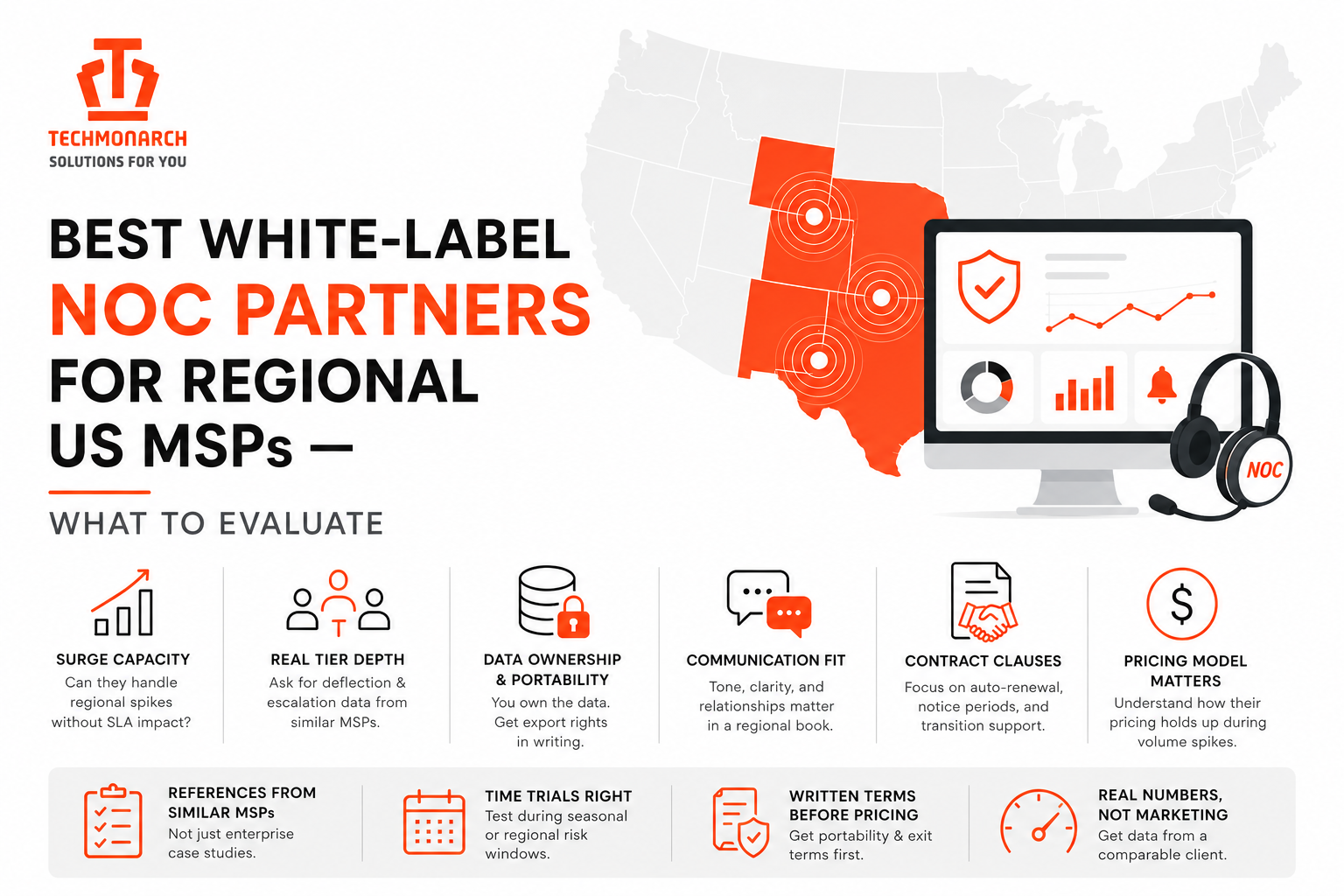
Best White-Label NOC Partners for Regional US MSPs — What to Evaluate
If you run an MSP that covers a metro area or a couple of neighboring states rather than a national footprint, most of the “how to pick a NOC partner” content out there wasn’t written with you in mind. It’s written for the generic MSP archetype — the one with clients scattered across time zones, industries, and risk profiles evenly enough that averages mean something. Regional MSPs don’t get that luxury. Your client base is concentrated, your reputation travels fast in a smaller professional circle, and a bad week for one client is often a bad week for three others hit by the same regional event. That changes what actually matters when you’re vetting a white-label NOC partner, and it’s worth going past the standard checklist.
The concentration problem nobody puts in the sales deck
Every NOC provider will hand you a steady-state SLA: average response time, average resolution time, average uptime. Those numbers are close to meaningless for a regional book of business, because your risk isn’t steady-state. It’s correlated. A grid failure, a regional ISP outage, or a hurricane moving through the Gulf Coast doesn’t hit one client’s server closet — it hits a dozen at once, all served by the same NOC team, all inside the same two-hour window. What you actually need to know is how that provider behaves under a correlated spike, not how it performs on a quiet Tuesday. Ask directly: what’s your ticket volume ceiling before response times degrade, and what’s the staffing model when 30–40% of a regional client set goes dark simultaneously? Most providers haven’t been asked this before, and the quality of their answer tells you more than any SLA sheet.
Tier depth versus tier theater
Anyone who’s managed a help desk contract for more than a few years has run into this: a provider advertises tier 1, 2, and 3 escalation, but tier 2 and tier 3 turn out to be the same three engineers wearing different hats depending on the hour. That’s not necessarily a dealbreaker — plenty of lean, capable teams operate this way — but you want to know it going in rather than discover it three months into a contract when a complex networking issue keeps bouncing back to you unresolved. Ask for actual deflection data: what percentage of tickets from a comparably sized regional MSP client were closed at first contact over the last two full quarters, not since the provider’s best-case pilot account. If they can’t produce that number, they’re probably not tracking it internally either, which is its own answer.
Who actually owns the telemetry
This one gets skipped constantly, and it’s the single most expensive mistake to unwind later. A lot of white-label NOC arrangements route your RMM and PSA data through the provider’s own overlay dashboard. It looks fine while the relationship is working. It becomes a real problem the day you want to switch providers, or bring monitoring back in-house, and discover that the raw alert history, the closed-ticket logs, and the historical baseline data your team built up over two years live inside a system you don’t have direct export rights to. Before signing anything, get written confirmation of exactly what you can extract, in what format, and on what timeline if the partnership ends. This is a five-minute question during evaluation and a multi-week headache if you skip it.

Communication fit matters more for regional books than people admit
A NOC team optimized for high-volume enterprise ticket queues tends to communicate in a particular register — efficient, templated, a little impersonal. That’s fine when your end users are anonymous employees at a 2,000-person company. It reads very differently to the office manager at a family-owned manufacturing shop or the practice administrator at a small clinic who’s used to recognizing a name and a voice. Regional MSPs live and die on exactly that kind of relationship continuity, and it’s worth listening to a handful of recorded calls or reviewing chat transcripts from a prospective provider’s existing MSP clients before assuming their tone will transfer well to yours. This is one of the areas where providers built specifically around MSP-to-MSP white-label work — Techmonarch included — tend to differentiate themselves from generalist outsourcing shops that treat every ticket queue the same way, because the entire model depends on the end client never suspecting a third party is involved.
The contract clause that outranks price
Most evaluations spend 80% of their attention on the pricing table and maybe 20% on the contract terms. Flip that ratio, at least for two clauses. First, auto-renewal and notice periods — a 60- or 90-day notice window buried in section 14 can trap you in a relationship you’ve already decided to leave. Second, transition assistance in the exit clause: does the provider commit, in writing, to help build a clean handoff — updated runbooks, current credentials, documented client-specific quirks — or does the relationship just end with a data dump and a goodbye email? A provider confident in its own service quality generally has no problem writing a strong exit clause, because they’re not counting on friction to keep you. If a prospective partner hedges on this point, treat it as a signal worth weighing alongside anything else you’ve learned in the evaluation.
Per-endpoint versus per-ticket pricing, and why it matters more regionally
Pricing structure gets treated as a spreadsheet exercise, but the model itself changes provider behavior in ways that hit regional MSPs harder than diversified ones. A per-ticket model rewards a provider for closing tickets fast and reopening them often — fine in theory, except during a correlated regional event when ticket volume spikes and the incentive suddenly favors speed over root-cause work. A per-endpoint model is more predictable for budgeting, but it can mask under-resourcing if the provider hasn’t scaled staff in step with your endpoint growth. Neither model is inherently better. What matters is asking the provider to walk through how their pricing structure behaves specifically during a volume spike, since that’s the scenario a concentrated regional client base will actually hit, rather than treating pricing as a static number to compare across quotes. The NOC-as-a-service market has grown fast enough — industry estimates put it on track to roughly triple over the next several years — that plenty of newer entrants haven’t been tested by a real regional-scale event yet, which is exactly why this question is worth asking directly rather than assuming it from a case study.
A leaner evaluation framework for regional MSPs
Skip the generic 20-point scorecard and focus on the handful of questions that actually separate providers for a book of business like yours:
• Request three references from MSPs with a similar geographic concentration and client mix — not just the biggest logos on their case-study page.
• Ask to structure the trial period around an actual seasonal or regional risk window if you can time it that way, rather than a quiet month that flatters everyone.
• Get data portability and exit-transition terms in writing before you get anywhere near a pricing conversation.
• Push for real deflection and escalation numbers from a comparable client, not aggregate marketing stats.
None of this replaces the fundamentals — MSP-specific experience, documented SOPs, PSA and RMM compatibility — those still matter and plenty has already been written about them. What’s harder to find is guidance on the parts that are specific to running a concentrated, regionally exposed book of clients, which is exactly where most white-label NOC comparisons fall short. The market for this kind of outsourced capacity keeps growing quickly, and providers who understand the MSP-to-MSP model specifically — Techmonarch is one example, alongside a handful of others built the same way — tend to be a better structural fit than large-scale generalist NOC operations built primarily around enterprise contracts.
The providers worth shortlisting are the ones willing to answer the surge-capacity question honestly, put data ownership in writing without being asked twice, and show you real numbers from a client that looks like you rather than their best-case account. Everything else is closer to noise.
Recent Comments
- No comments to show