
-
Vijit
- September 13, 2026
- No categories assigned.
- No Comments
What MSP Outsourcing Actually Means
Ask ten MSP owners what “outsourcing” means and you’ll get ten slightly different answers. Some picture offshoring a help desk to a call center. Some think of hiring a freelance engineer for a one-off migration. Some assume it means handing a client relationship over to someone else entirely. None of those are wrong, exactly, but none of them describe what MSP outsourcing actually looks like in practice for most of the channel today.
If you’re an IT professional who’s spent years in this industry, you’ve probably already got a working sense of it. This article is here to pin the definition down precisely, because the difference between “outsourcing” in the general sense and “MSP outsourcing” as a delivery model matters when you’re the one deciding what to hand off and to whom.
The Core Definition
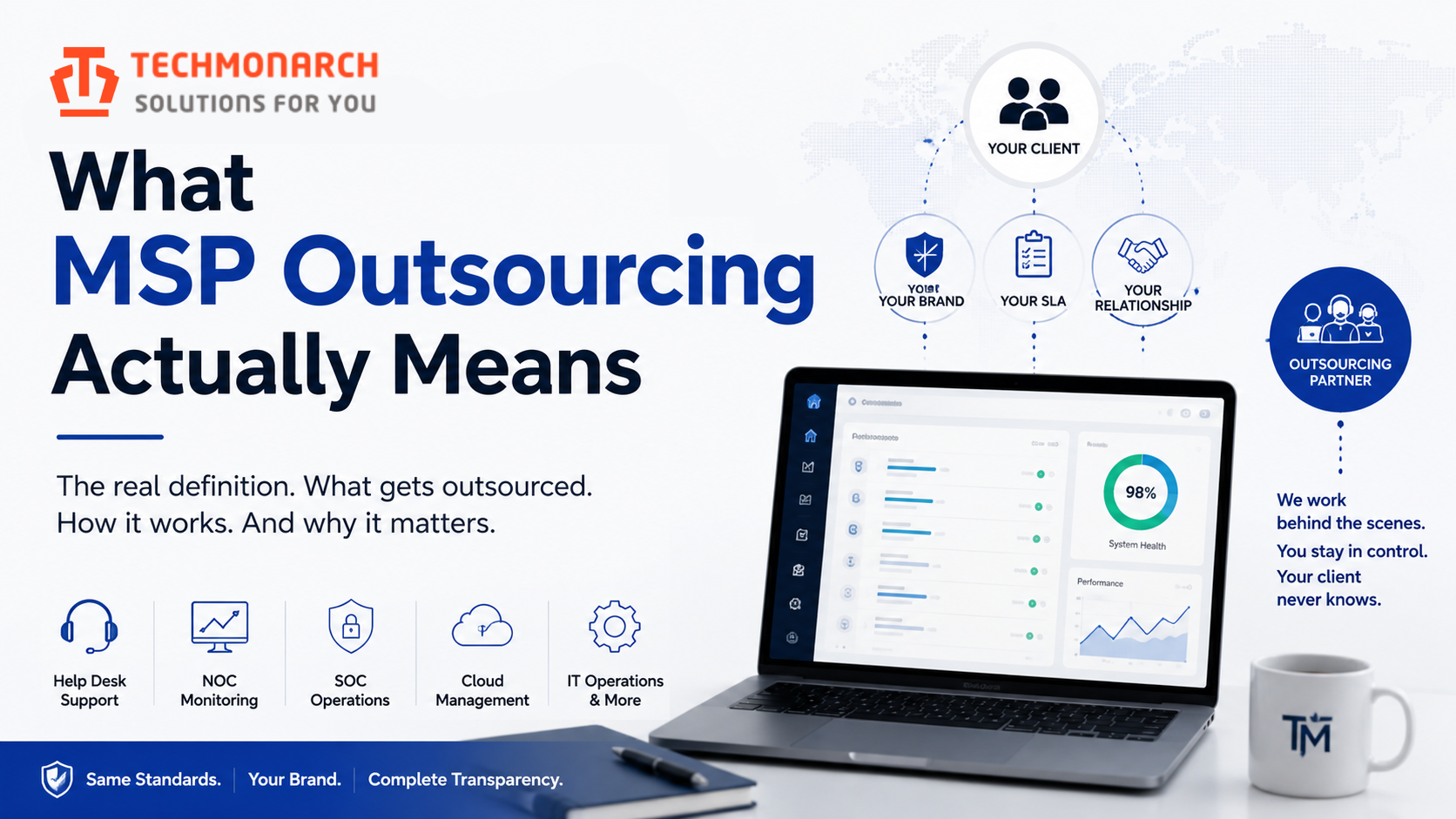
MSP outsourcing, in its current form, is when one managed services provider delivers a specific operational function — help desk, NOC, SOC, cloud administration, patch management — on behalf of another MSP, under that MSP’s own brand. The client of the outsourcing MSP never interacts directly with the outsourcing partner. They see your logo, your ticketing system, your SLA, your engineers.
This is the part that trips people up: MSP outsourcing and white labeling are the same thing in this context. There isn’t a meaningful distinction between “we outsourced our NOC” and “we white-labeled our NOC” when the delivery model looks identical either way — a third party doing the work, invisibly, under your name. Some vendors will try to draw a sharper line between the two terms for marketing reasons, but functionally, if the client can’t tell a third party is involved, you’re looking at the same model regardless of what you call it.
Contrast that with a referral partnership, where you point a client toward another provider and step out of the relationship, or a reseller arrangement, where you’re selling someone else’s branded product as-is. Neither of those is what MSP outsourcing means. Outsourcing means the work happens somewhere else, but the relationship, the brand, and the accountability stay entirely with you.
What Gets Outsourced, and What Doesn’t
Not every function in an MSP is a good candidate for this model, and understanding why helps clarify what outsourcing actually is.
The functions that outsource cleanly share a few traits: they’re process-driven, they’re documented (or documentable), they don’t require deep institutional memory of a specific client relationship, and they benefit from scale or round-the-clock coverage. That’s why help desk, NOC monitoring, and SOC operations are the three most commonly outsourced functions across the channel — they’re high-volume, tool-based, and the value they deliver doesn’t depend on who’s sitting in the chair, as long as the person sitting there is competent and following your documented process.
Compare that to account management, sales, or vCIO strategy conversations. Those depend on relationship history, trust built over years, and context that’s expensive to transfer to a third party. That’s why almost nobody outsources those functions, even MSPs that outsource everything else. Our guide on in-house vs. outsourced IT operations goes into more detail on where that line typically sits.

The Mechanics of How It Actually Works
Here’s roughly what an outsourcing arrangement looks like once it’s operational, using a white-label NOC as the example:
Your outsourcing partner gets access to your RMM platform, either through your existing tooling or a shared instance configured to your standards. They monitor client environments against your alert thresholds, follow your documented escalation paths, and remediate what falls within their scope. When something needs your internal team’s attention, it gets escalated through your PSA, appearing to your team (and, if visible, to the client) as an internally generated ticket.
The partner’s engineers typically use your company name when communicating, whether that’s a phone call, an email signature, or a ticket note. Reporting rolls up under your brand — client-facing reports look like they came from your team, because functionally, they did; the outsourcing partner is acting as an extension of it, not a separate entity.
This only works cleanly when the outsourcing partner has real process discipline. A partner that can’t operate inside your existing stack, or that improvises instead of following documented procedure, creates more support burden than it removes. That’s the operational risk worth screening for before signing anything, and it’s a theme we return to across why MSPs outsource and our breakdown of white-label IT service delivery.
Why the Term Gets Muddled
Part of the confusion comes from the fact that “outsourcing” carries baggage from other industries. In manufacturing or customer support, outsourcing has historically meant lower quality at a lower price, often offshore, often with a noticeable dip in service consistency. That reputation follows the word into IT conversations even though the MSP version of outsourcing looks nothing like it in practice.
The better mental model is a staffing extension, not a quality trade-off. A well-run white-label NOC or SOC partner isn’t cutting corners to hit a lower price point — they’re running the same function at scale across multiple MSP clients, which is exactly what lets them offer 24/7 coverage and specialist depth that would be uneconomical for any single MSP to build alone. The economics work because the partner amortizes the cost of round-the-clock staffing and tooling across many client bases, not because anyone involved is doing lower-quality work.
Where Techmonarch Fits Into This
This is the model our own white-label managed IT services are built around — help desk, NOC, and SOC delivery that operates entirely under your brand, integrated into your existing PSA and RMM, so the outsourcing itself stays invisible to your clients. It’s worth saying plainly because it’s easy for the term “outsourcing” to sound abstract until you see the actual mechanics: it’s your ticket, your SLA, your name on the email. The work just happens to be delivered by a team that specializes in doing it around the clock.
The Definition, Stated Plainly
If you take one thing from this article: MSP outsourcing is not a staffing shortcut, a quality compromise, or a way to quietly downgrade service. It’s a delivery model where a specialized partner performs a defined operational function, under your brand, integrated into your systems, invisible to your clients, so that you can offer coverage and capability you couldn’t economically build and staff alone.
Understanding that distinction matters before you go shopping for a partner, because it changes what you’re actually evaluating. You’re not looking for the cheapest labor. You’re looking for a team that can disappear seamlessly into your operation and hold up your standard of service without you having to hire, train, or manage them directly. For the broader case on why MSPs are increasingly choosing this route over hiring, our guide on IT outsourcing for MSPs covers the full picture.
Recent Comments
- No comments to show