
-
Vijit
- September 18, 2026
- No categories assigned.
- No Comments
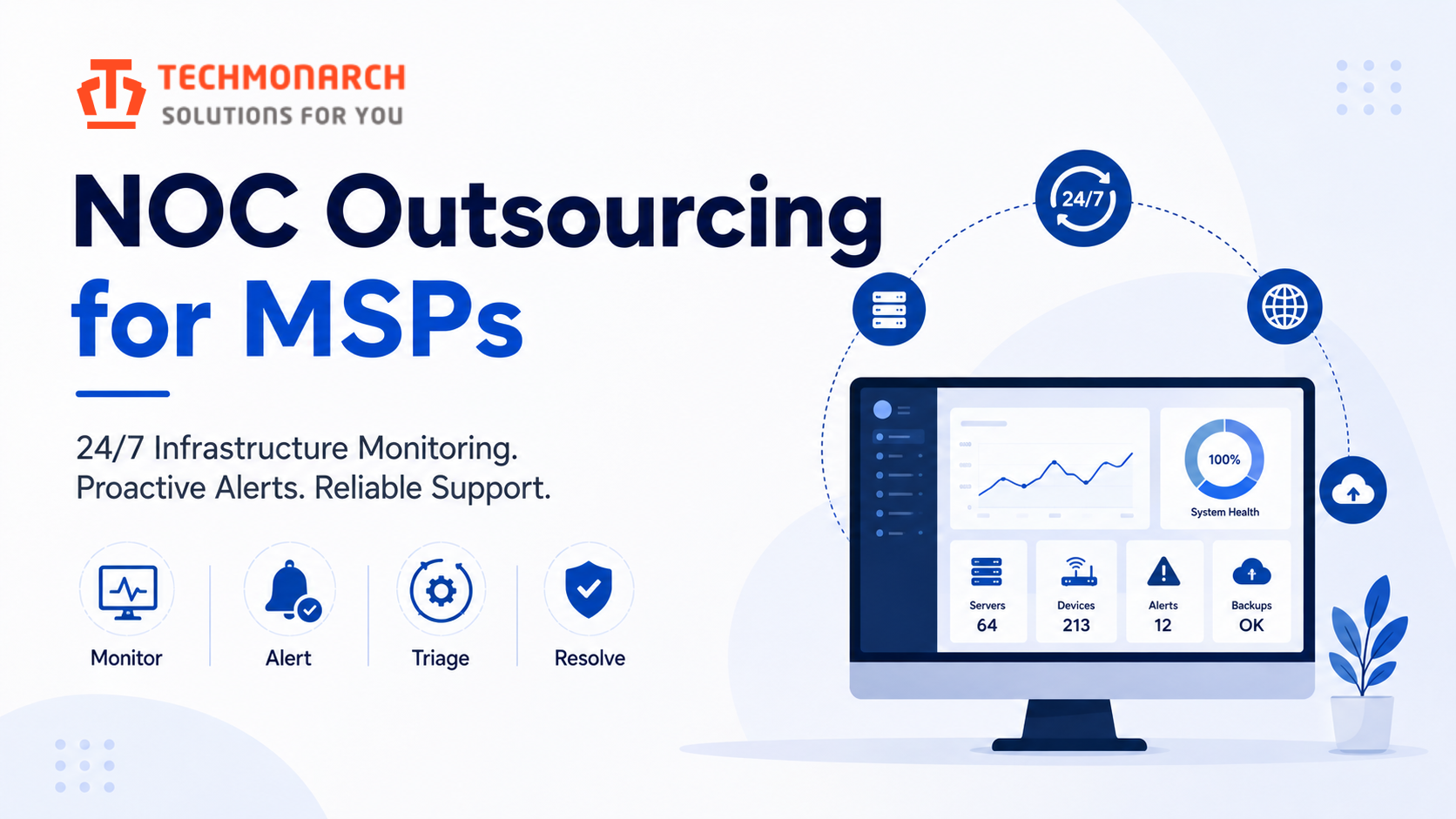
NOC Outsourcing for MSPs
Every MSP owner running client infrastructure eventually hits the same wall: monitoring never stops, but your team does. Servers don’t care that it’s 2 a.m. on a Saturday. Neither does the disk that’s about to fill up, the backup job that silently failed three nights running, or the switch that just started dropping packets. Someone needs to be watching, all the time, and building that coverage internally is one of the more expensive problems in this business.
This is the gap NOC outsourcing exists to close. If you’re weighing whether to bring in a white-label NOC partner, here’s what the function actually covers, how the economics work, and what separates a partner worth trusting with your infrastructure from one that’s just answering alerts.
What a NOC Actually Does
A Network Operations Center is the function responsible for continuous infrastructure monitoring and first-line response — CPU, memory, disk, and service health on servers; uptime, throughput, and configuration changes on network devices; backup job monitoring and failure alerts; patch deployment and compliance tracking. The job isn’t glamorous, but it’s the difference between catching a failing disk before it takes down a client’s file server and finding out about it during an outage call.
A well-run NOC doesn’t just forward every alert to your team — it triages. The engineer looking at an RMM dashboard decides what’s noise, what needs documented remediation on the spot, and what genuinely needs escalation to your senior staff. For an MSP running dozens of clients, the alert volume alone can run into the thousands per week; without real triage, that volume either overwhelms your internal team or gets ignored, and ignored alerts are exactly how outages happen.
Why This Is One of the Hardest Functions to Staff Internally
NOC coverage has a structural problem that other functions don’t share as acutely: it needs bodies in seats around the clock, regardless of ticket volume at any given hour. A help desk can flex staffing to match daytime call volume. A NOC can’t — a critical alert at 3 a.m. is just as urgent as one at 3 p.m., which means you need genuine 24/7/365 coverage, not a best-effort on-call rotation that burns out whoever’s holding the pager.
Building that internally means staffing enough engineers to cover nights, weekends, and holidays without any single person working an unsustainable schedule — which for most mid-sized environments means a team in the ten-to-twelve range once you account for shift overlap and time off. That’s a serious payroll commitment for a function that, on any given night, might only need to actively intervene a handful of times.
This is the exact mismatch white-label NOC partnerships are built to solve: coverage that doesn’t scale linearly with how often you actually need it to act, delivered by a partner who’s already amortizing that staffing cost across many MSP clients rather than just yours. We cover the broader economics of this trade-off in in-house vs. outsourced IT operations.

The Cost Picture
The pricing gap between building a NOC internally and outsourcing it is one of the largest of any function MSPs consider outsourcing. Onshore NOC engineering commonly runs well into five figures monthly per engineer once fully loaded, and that’s before multiplying by the headcount needed for real round-the-clock coverage. Outsourced NOC arrangements, by contrast, are typically priced per device or per endpoint and commonly land 30-60% below the equivalent onshore engineering cost, with entry-level packages often starting in the low thousands per month rather than requiring a six or seven-figure annual commitment.
That gap is why NOC outsourcing has become close to standard practice for MSPs that don’t already have the scale to justify an internal team — the math simply doesn’t favor building this function from scratch until you’re operating at a size where the per-device outsourced cost starts approaching what an internal team would cost anyway.
What Good NOC Delivery Actually Looks Like
The technical side of NOC work — watching dashboards, responding to thresholds — isn’t where partnerships succeed or fail. The differentiator is operational discipline:
- Working inside your existing stack. A real white-label NOC operates directly in your RMM and PSA — ConnectWise, Datto, NinjaOne, Kaseya, Atera, N-able, whatever you’re already running — rather than asking you to adopt a separate platform.
- Following your runbooks, not generic ones. Remediation should follow procedures you’ve defined or approved, not a one-size-fits-all playbook that ignores how your specific environment is configured.
- Clean escalation, not alert forwarding. A partner that just relays every alert to your team hasn’t actually reduced your workload. Escalations should come with context — what happened, what was tried, what’s needed next.
- Brand invisibility. Communication should use your company name and email domain, with clients never aware a third party is involved. That’s the same standard covered in what MSP outsourcing actually means.
- Security posture on their end. A NOC partner typically holds meaningful access to client infrastructure. Ask about their own security practices — access controls, logging, compliance alignment — with the same scrutiny you’d apply to any vendor touching client environments.
NOC as Part of a Bigger Coverage Strategy
NOC rarely stands alone for long. MSPs that outsource NOC monitoring often extend the same logic to help desk and SOC once the model proves out, because the three functions share the same underlying problem: coverage-intensive, process-driven work that’s expensive to staff internally and straightforward to hand to a specialized partner. If your help desk is already outsourced, adding NOC coverage from a coordinated partner tends to be a smoother extension than most MSPs expect. See help desk outsourcing for MSPs if that’s the piece you haven’t tackled yet, or SOC and cybersecurity outsourcing for MSPs if security monitoring is next on your list.
There’s also a strategic filtering question worth asking before you outsource anything: which capabilities actually differentiate your MSP to clients, and which just need to be delivered consistently? Clients generally value your advisory relationship, your responsiveness, and your understanding of their business — they rarely care whether a failed backup job was caught by someone sitting in your office or a NOC engineer working under your documented procedures somewhere else entirely. That distinction is worth keeping in mind when deciding what stays in-house versus what gets handed to a partner, and it’s the same framework we apply across 24/7 IT support models for MSPs.
At Techmonarch, managed NOC services are built around exactly this model — 24/7 infrastructure monitoring, alert triage, and remediation delivered inside your existing PSA and RMM, under your brand, with escalation paths that respect your documented procedures rather than a generic script. For the full picture of how NOC fits alongside help desk and SOC in a complete outsourcing strategy, our guide to IT outsourcing for MSPs covers the whole model.
Recent Comments
- No comments to show