
-
Vijit
- August 3, 2026
- No categories assigned.
- No Comments
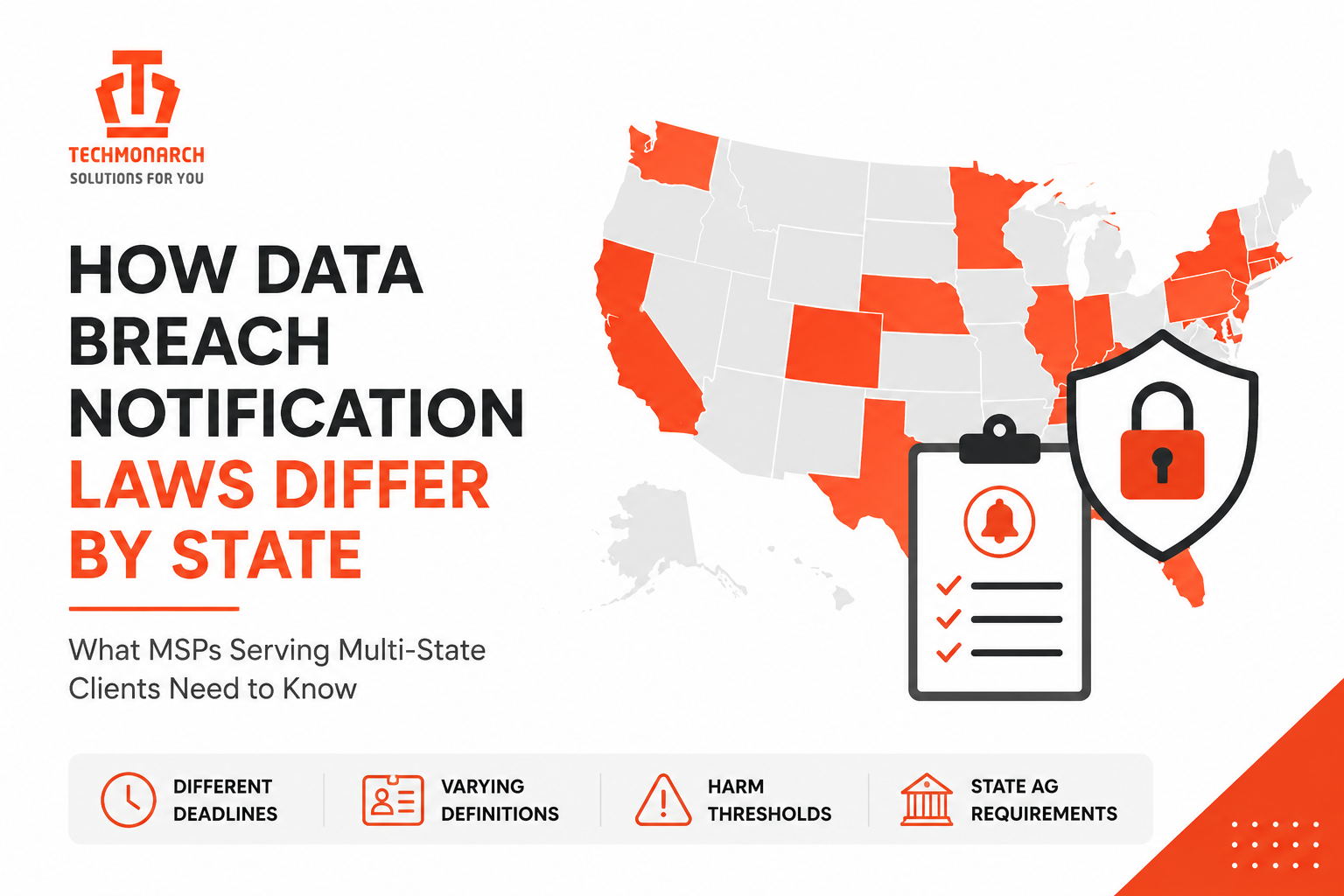
How Data Breach Notification Laws Differ by State — What MSPs Serving Multi-State Clients Need to Know
A field-level look at the compliance patchwork every white-label security desk eventually has to navigate.
If you’ve been on the operations side of managed IT for a while, you already know the uncomfortable truth about breach response in the United States: there is no single rulebook. Fifty states, plus D.C., Guam, Puerto Rico, and the U.S. Virgin Islands, each run their own statute, their own definitions, and their own clock. For an MSP with one client in one state, that’s manageable. For an MSP whose client base spans a dozen states — or whose end clients themselves have remote employees and customers scattered across the country — it turns a technical incident into a legal jigsaw puzzle almost overnight.
This isn’t a primer on what a data breach is or why notification matters. You’ve handled incidents. What’s worth unpacking here is the part that trips up even experienced teams: the specific ways these 54 statutes diverge, why that divergence is getting sharper rather than settling down, and how to structure a response process that doesn’t require rewriting your playbook every time a client’s footprint changes.
The patchwork isn’t shrinking — it’s getting more textured
It’s tempting to assume that after two decades of state breach laws (California passed the first in 2002; Alabama, the last holdout, finally passed one in 2018), the rules would have converged into something reasonably uniform. They haven’t. If anything, 2025 and 2026 have brought a fresh wave of amendments that widen the gaps rather than close them.
California is the clearest example. Its long-standing standard of notifying “in the most expedient time possible and without unreasonable delay” — a phrase with plenty of room for judgment calls — was replaced by SB 446, which now imposes a hard 30-calendar-day deadline for notifying affected residents, plus a 15-day window to notify the state Attorney General once 500 or more residents are involved. That’s a meaningful shift from a standard built around reasonableness to one built around a countdown clock, and it puts California alongside Colorado, Florida, Maine, Rhode Island, and Washington in the group of states with some of the tightest fixed deadlines in the country.
Oklahoma moved in the same legislative cycle with SB 626, which broadens what counts as reportable personal information to include government-issued identification numbers and expanded categories of financial account credentials. Multiply changes like these across dozens of legislatures that all convene, amend, and adjourn on different schedules, and you get a compliance surface that shifts continuously rather than settling into something you can memorize once.
The four variables that actually matter operationally
For teams building or refining incident response procedures, most of the state-to-state variation boils down to four practical questions. These are the ones worth building your intake checklist around.
1. Is the deadline a fixed number or a standard?
Roughly forty percent of states now specify a numeric deadline for consumer notification — most commonly somewhere in the 30-to-60-day range. The rest still rely on qualitative language like “without unreasonable delay,” which sounds more forgiving but actually carries its own risk: without a bright-line number, regulators and plaintiffs’ attorneys get to argue after the fact about what “reasonable” should have meant given your specific circumstances. A documented, defensible timeline matters just as much in these states as in the fixed-deadline ones — arguably more, since you’re building the record that will justify your pace.
2. What counts as “personal information”?
Hawaii’s statute is often cited as the narrowest in the country, limited essentially to name plus Social Security number, driver’s license number, or financial account credentials. California and Illinois sit at the other end, with definitions stretched to cover medical information, health insurance details, biometric identifiers, genetic data, and — in California’s case — certain automated license plate data. A data element that triggers a mandatory notice in one state may not register as reportable at all in another. When a client’s affected-individual list spans multiple states, this is the point where a single spreadsheet of “who do we need to notify” stops being sufficient and you need a state-by-state filter applied to the same underlying dataset.
3. Does the state require proof of harm?
About thirty state laws include some form of harm threshold — language requiring a “reasonable likelihood” of harm, “material risk,” or actual/potential misuse before notification is triggered. Other states, including California, Georgia, Illinois, Massachusetts, Minnesota, North Dakota, and Texas, require no harm showing whatsoever: if the data was exposed, notice goes out, full stop. This is one of the most consequential differences in the entire framework, because it means the exact same incident can be legally reportable in one jurisdiction and legally optional in another, depending solely on where the affected individual lives.
4. When does the Attorney General need to be looped in?
Thirty-four states require AG notification once certain thresholds are crossed, and those thresholds vary from 250 affected residents (North Dakota, Oregon) up to 1,000 in many others. A handful of states, Connecticut and New York among them, require AG notice regardless of headcount. A few, like New Jersey, actually require the AG to be notified before consumer notices go out — reversing the sequence most teams default to.
Encryption still buys real protection — if you can prove it
One consistent thread across most state statutes is a safe harbor for encrypted data: if the compromised information was encrypted with a reasonably strong algorithm and the decryption key wasn’t also exposed, notification obligations are frequently reduced or eliminated. The catch that experienced teams already know but that’s worth restating: the defense only holds up if you can document it. Encryption standard, key management practice, and rotation history all need to be sitting in the incident file before the breach happens, not reconstructed afterward. Regulators and opposing counsel will ask for the paperwork, not just the assurance.

Building a response process around the strictest common denominator
The operational fix that most mature MSPs eventually land on isn’t tracking fifty-four separate playbooks in real time during an active incident — that’s a recipe for missed deadlines during exactly the moment you can least afford one. Instead, the more resilient approach is to pre-build your incident response templates, escalation paths, and client communication drafts around the most restrictive standard your client base is exposed to, then relax specific elements down for jurisdictions with lighter requirements once the state mix for a given incident is confirmed.
- Maintain a live map of which states each client’s data subjects reside in, refreshed at onboarding and at least annually — not just where the client’s office sits.
- Pre-draft notification letter templates that satisfy the strictest content requirements you’re likely to hit (plain-language description of the incident, categories of data involved, remediation steps), then trim per state as needed.
- Log every encryption and key management control as it’s implemented, not retroactively — this is the difference between a safe harbor defense that holds and one that collapses under scrutiny.
- Build AG notification sequencing into your runbook explicitly, since a small number of states require it before — not after — consumer notices go out.
This is territory where the SOC and NOC functions of a white-label partner earn their keep — not by replacing legal counsel, which every breach response still requires, but by making sure the technical timeline (detection, containment, forensic scoping) is fast and well-documented enough that the legal team isn’t burning its 30-day clock waiting on data. That’s the operational layer TechMonarch’s white-label SOC and 24/7 help desk teams are built around for MSP partners managing multi-state client rosters: tight detection-to-documentation handoffs that give your compliance conversations a running start instead of a scramble.
None of this replaces qualified breach counsel — state breach law is genuinely a specialist’s field, and the statutes above are summarized at a level meant for operational planning, not legal reliance. But for MSPs whose value proposition includes being the calm, competent voice during a client’s worst week, understanding where these fifty-four statutes actually diverge — rather than assuming they’re roughly interchangeable — is what separates a response that holds up from one that quietly creates a second problem on top of the first.
Recent Comments
- No comments to show