
-
Vijit
- September 13, 2026
- No categories assigned.
- No Comments
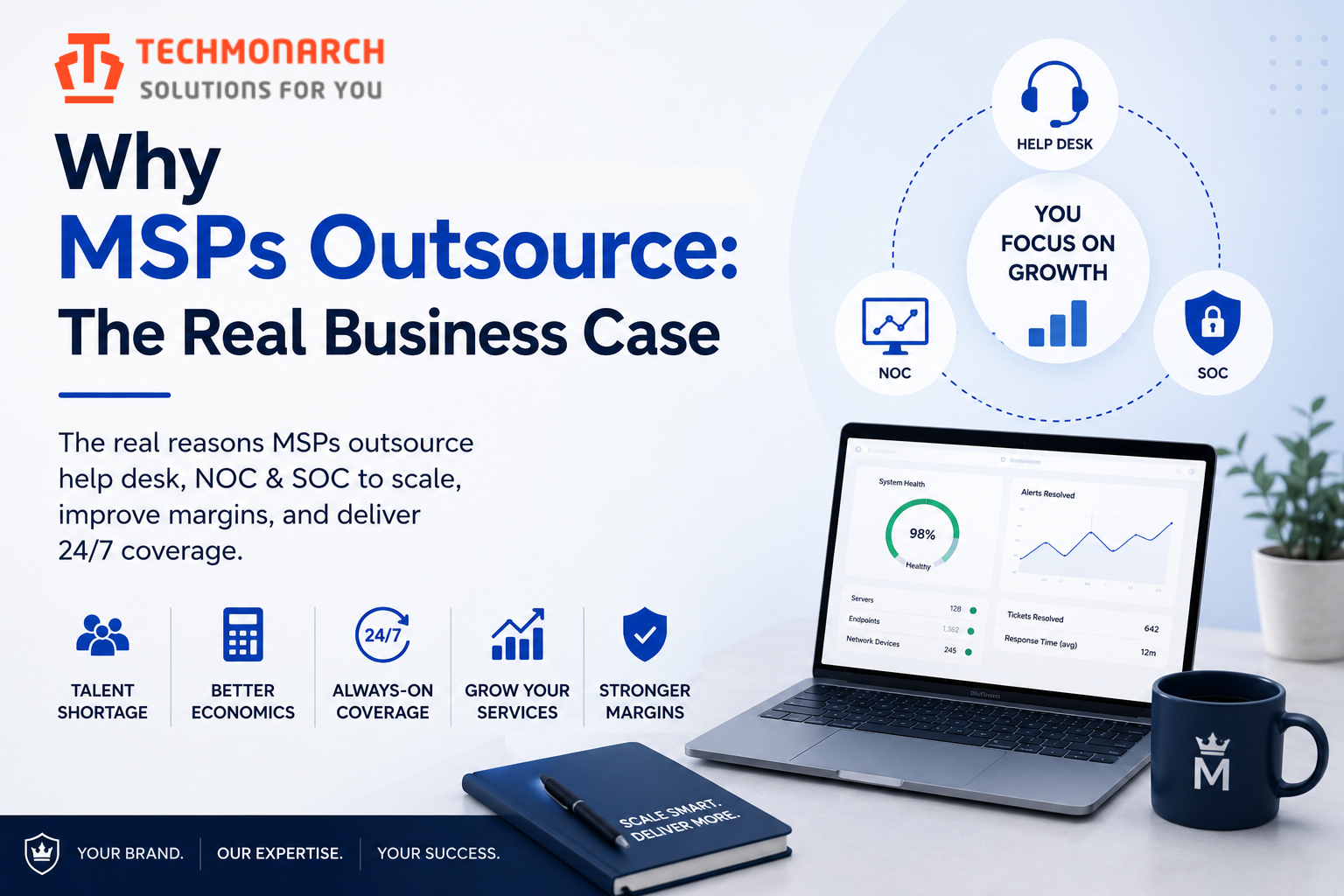
Why MSPs Outsource: The Real Business Case
Nobody outsources a function because it sounds good on a slide. MSP owners make this decision under pressure — a client just asked for 24/7 coverage you don’t have, a senior engineer just quit mid-quarter, or you’ve spent four months trying to fill a SOC analyst role that keeps going stale. Outsourcing gets adopted because the alternative stops being realistic, not because it’s trendy.
If you’ve been circling this decision for your own business, it’s worth separating the actual drivers from the noise. Here’s what’s really pushing MSPs toward outsourcing right now, and where the case is strongest.
The Talent Market Isn’t Cooperating
Start with the plainest reason: you can’t hire your way out of this the way you could a decade ago. Global surveys of employers across dozens of countries continue to show the majority reporting real difficulty filling open technical roles, and cybersecurity is consistently the hardest category to staff. Millions of cybersecurity positions sit unfilled globally at any given time, and the roles that do get filled often don’t stay filled — retention research on security professionals has found a large share actively considering leaving their current employer within the year.
For an MSP, that plays out as a very specific kind of pain: an open SOC analyst or senior NOC engineer requisition that sits for months, while your existing team absorbs the workload and starts eyeing the exit themselves. Time-to-fill for specialized technical roles regularly stretches past a month, sometimes two, and every week it stays open is a week your service delivery is thinner than it should be.
Outsourcing sidesteps this entirely. You’re not trying to win a local hiring competition against enterprises and cloud providers who can outbid you. You’re tapping into a team that’s already built, already trained, and already running the function you need at scale.
The Math Rarely Favors In-House for Coverage-Heavy Functions
Run the actual numbers on a 24/7 function and the case gets clearer. A fully loaded senior engineer or analyst — salary, benefits, tooling, training, management overhead — is a serious annual commitment, and that’s for one person covering one shift. Covering nights, weekends, and holidays properly means multiplying that cost by however many people it takes to avoid burning out the team you already have.
Outsourced equivalents are typically priced as a predictable monthly cost tied to devices, endpoints, or users, which converts a large fixed payroll commitment into a variable operating expense that scales with your client base. That distinction matters more than it sounds — it means your cost structure grows in step with your revenue instead of running ahead of it while you wait for new contracts to catch up. We walk through this comparison function-by-function in in-house vs. outsourced IT operations.
Clients Expect Coverage You Can’t Build Alone
The bar clients set has moved. Round-the-clock monitoring, fast incident response, and continuous threat detection aren’t premium add-ons anymore — they’re baseline expectations for any MSP serving a client with real uptime or compliance requirements. A client running a healthcare or financial services workload isn’t going to accept “we’ll look at it in the morning” as an answer to a 2 a.m. alert.
Meeting that bar with an internal team means building shift coverage most small and mid-sized MSPs simply can’t justify economically for the ticket volume they’re actually seeing. Outsourcing lets you offer that same coverage from day one of the client relationship, without waiting to build the internal capacity first. That’s a meaningful part of why 24/7 IT support models increasingly lean on an outsourced or hybrid structure rather than a fully in-house night shift.

It Lets You Sell Services You Don’t Currently Have
There’s a growth angle here too, separate from the coverage problem. Outsourcing partnerships let an MSP offer services outside its current specialty without the multi-month ramp-up of building that capability internally. A generalist MSP that’s never run a real SOC can start offering managed detection and response within weeks of signing a white-label partnership, rather than spending a year hiring analysts, buying SIEM tooling, and building playbooks from scratch.
That matters competitively. Clients increasingly expect a broader service bundle than help desk and patching — security monitoring, compliance reporting, cloud administration — and MSPs that can’t offer it lose deals to ones that can, regardless of how good their core service actually is. Outsourcing is often the fastest legitimate path to closing that gap. What that looks like in practice is covered in what MSP outsourcing actually means.
Margin, Not Just Cost
It’s worth separating “cheaper” from “better margin,” because they’re not the same argument. Outsourcing specific functions, done well, tends to produce stronger margins on the services being outsourced — not because the labor is cut-rate, but because a specialized partner running that function at scale across many MSP clients has a cost structure your single MSP can’t replicate for one client base. You’re buying into their economies of scale rather than trying to build your own from a much smaller volume base.
That’s a different justification than “we can’t afford to hire,” even though it often gets lumped in with it. Plenty of MSPs that could afford to hire still choose to outsource specific functions because the margin case is simply better than the alternative.
Where the Case Is Weakest
None of this means outsourcing is the right call for every function, and it’s worth being honest about where it isn’t. Functions that depend heavily on institutional knowledge of a specific client relationship — account management, strategic consulting, anything requiring years of context about how a particular client’s business actually operates — don’t outsource well. The value in those roles comes precisely from continuity and relationship history that a rotating outsourced team can’t replicate.
The strongest case for outsourcing is functions that are process-driven, documentable, and benefit from round-the-clock coverage: help desk, NOC, and SOC. That’s not a coincidence — those three functions consistently top the list of what MSPs outsource because they hit all three criteria at once.
Bringing It Back to Your Business
If you’re weighing this decision, the honest starting point is your own coverage gaps and hiring pain, not a generic industry trend. Where are you currently unable to meet client expectations because you don’t have the staff? Where has an open requisition been sitting for months? Those are usually the functions worth outsourcing first.
At Techmonarch, this is the exact problem our white-label managed IT services are built to solve — help desk, NOC, and SOC delivery under your brand, so the coverage gap closes without you having to win a hiring competition you’re not positioned to win. For the fuller framework on evaluating this decision across your whole operation, see our guide to IT outsourcing for MSPs.
Recent Comments
- No comments to show