
-
Vijit
- May 18, 2026
- No categories assigned.
- No Comments
There is a fear that runs quietly through a lot of MSP outsourcing conversations. It does not always get said out loud, but it is there: if I hand this off to someone else, am I still the one in control? What if they drop the ball on a P1 at 2am and my client calls me? What if their engineers do not follow my processes? What if the whole thing starts to feel like my business is being run by someone I have never met?
These are legitimate concerns. They are also manageable ones — if you structure the engagement properly from the start.
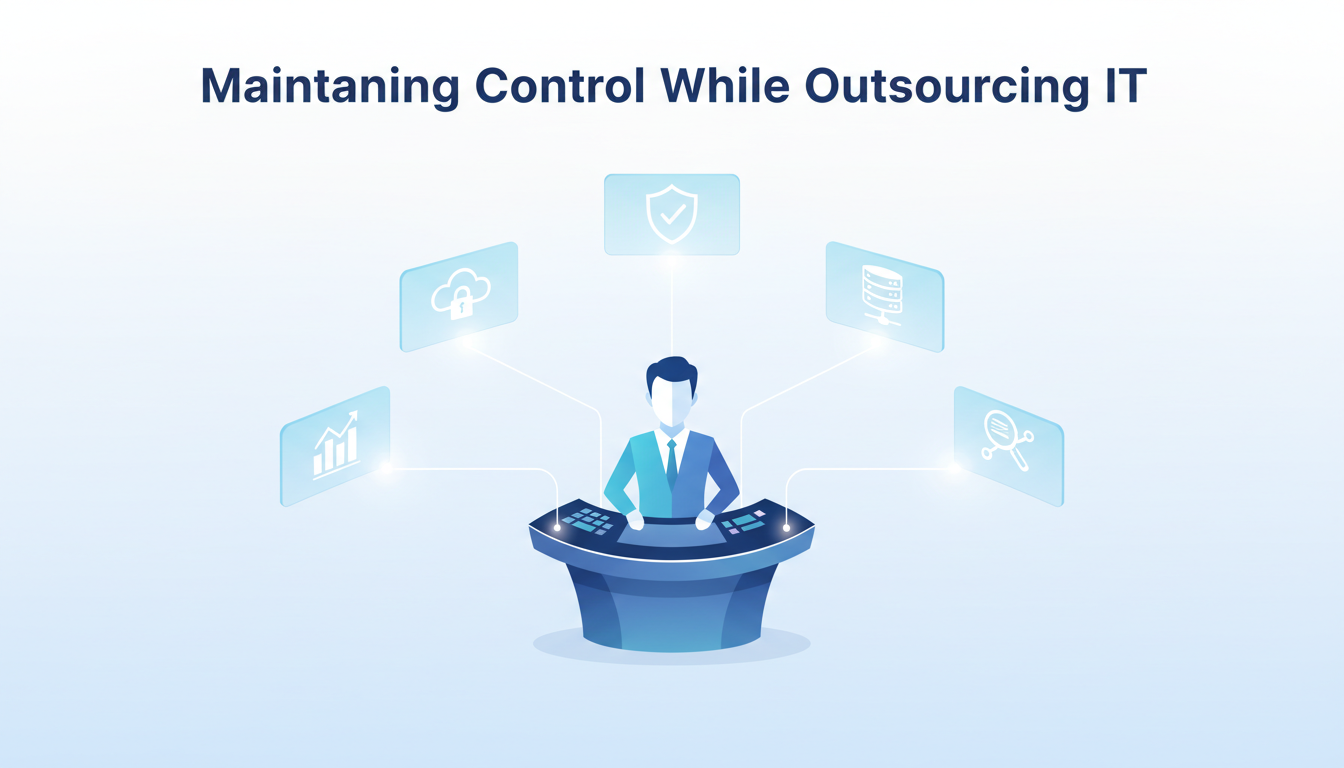
Outsourcing parts of your managed IT stack — whether that is NOC coverage, helpdesk overflow, SOC operations, or cloud support — does not mean giving up ownership. It means shifting execution while retaining strategy, governance, and the client relationship. The MSPs who do this well consistently describe it the same way: the partner handles the work; we handle the client. That division of labour, done right, actually makes the service better — not worse.
Here is how to structure it so that outsourcing genuinely feels like an extension of your team rather than a third party you are constantly chasing.
1. Start with a Clear Division of Ownership
The root cause of most outsourcing failures is ambiguity about who owns what. Not malice, not poor execution — just a fuzzy boundary that nobody thought through clearly before the contract was signed. When something goes wrong (and something will), everyone looks at each other and nobody is sure whose problem it is.
Before any outsourcing engagement starts, sit down and map out responsibilities in three columns: what you keep, what they own, and what is shared. The table below is a practical starting point:
| Function | Keep In-House | Outsource | Shared / Co-managed |
| IT strategy & roadmap | ✓ — This is your vision for the client | ||
| Client relationship management | ✓ — You own the relationship | ||
| SLA definition & contracts | ✓ — You are accountable to the client | ||
| 24/7 helpdesk & ticket handling | ✓ | Or co-managed with overflow | |
| NOC monitoring & alerting | ✓ | Or co-managed | |
| SOC / security operations | ✓ | Or co-managed with internal oversight | |
| Patch management execution | ✓ | Policy defined by you, executed by partner | |
| Vendor & procurement decisions | ✓ — Tool selection stays with you | ||
| Documentation & runbooks | ✓ — Built jointly, owned by you | ||
| Escalation decisions (P1/P2) | ✓ — Partner flags, you approve or ratify | ||
| Client reporting & QBRs | ✓ — You present; partner provides the data |
Responsibility matrix — a starting template for MSP outsourcing engagements
The key column in that table is the first one. Strategy, client relationships, SLA definitions, vendor selection, and how you present to clients — those stay with you. Always. Your outsourcing partner should never be in direct contact with your clients unless you have explicitly designed that to happen under your brand. The moment the client thinks they are talking to someone else, the relationship starts to fracture.
2. The Tools Need to Be Yours
This is one of the most underappreciated control mechanisms in the whole outsourcing model: whoever owns the tooling owns the data, the history, and the operational continuity. If your outsourcing partner runs their own RMM, their own PSA, and their own documentation platform — and you just get reports from them — you are dependent. If they leave or fail, you start from scratch.
The model that works is BYOT: Bring Your Own Tools. Your partner operates inside your RMM, your PSA, your documentation platform. They create tickets in your system. They follow your runbooks. The audit trail lives in your environment, not theirs.
This matters practically for three reasons:
- Continuity: If you ever need to change partners, you retain all the history. Nothing is locked in someone else’s system.
- Visibility: You can see exactly what the partner is doing, in real time, in the same dashboard you already use. No waiting for weekly reports.
- Accountability: SLA tracking is automatic, based on your own ticket data. You are not relying on the partner’s self-reported metrics to know whether they are meeting the bar.
If a prospective outsourcing partner pushes back on operating inside your tools — if they insist on their own systems for service delivery — treat that as a yellow flag. The strongest white-label partners work inside your environment by design, because they understand that your business continuity depends on it.
3. Define the Escalation Path Before You Need It
Here is the test of any outsourcing arrangement: what happens at 2am when a client’s firewall goes down and the on-call engineer cannot resolve it in 15 minutes?
If the answer is ‘I am not sure — I think they call someone,’ the arrangement is not ready. Every conceivable escalation scenario needs a documented, agreed-upon path before the partnership goes live. This is not excessive process — it is the basic architecture that prevents a P1 from becoming a client-relationship crisis.
| Escalation Design Checklist Who is the named escalation contact at the partner for P1 incidents? (Not a team — a person.) What is the maximum time before they escalate to you? (15 minutes for P1 is the standard.) Which decisions require your sign-off before action? (e.g., firewall rule changes, user account modifications, emergency patching) How does the partner communicate with you during an active incident? (Dedicated Slack/Teams channel, not just ticket updates.) What does the post-incident review look like? (Same-day RCA for P1, within 24 hours for P2.) |
The escalation path is also where you define the boundary between what the partner can do autonomously and what requires your approval. Pre-authorised actions — restarting a service, isolating an endpoint, applying an emergency patch from an approved list — should be documented so the partner can act immediately without waiting for you to pick up the phone at 2am. Actions outside that list require your explicit authorisation.
4. Measure What Actually Matters
A lot of outsourcing relationships live or die on the wrong metrics. Response time and ticket close rate are easy to measure, so they get tracked obsessively. The things that actually reflect service quality — whether the same problems keep coming back, whether clients are satisfied, whether the team is catching issues before they become incidents — often get missed entirely.
The metrics worth tracking in any outsourced IT arrangement:
- First-contact resolution rate: What percentage of tickets are resolved without escalation? Low FCR means either the partner lacks knowledge depth, or the runbooks are inadequate.
- Repeat incident rate: The same client, same issue, multiple tickets — this signals root cause is not being addressed. Target under 5% of ticket volume.
- SLA breach rate: Track this per tier (P1, P2, P3). A single P1 breach is a conversation. A pattern of P2 breaches is a structural problem.
- Client satisfaction per ticket: A simple CSAT score after each closed ticket. If this is trending down and the SLA metrics look fine, something is wrong with communication quality.
Review these monthly, not quarterly. Monthly reviews catch drift early. Quarterly reviews catch it after it has already damaged client relationships.
5. Treat the Partner as a Team, Not a Vendor
The MSPs that get the most out of outsourcing partnerships are the ones who invest in them the same way they invest in their own staff. Onboarding a partner properly — sharing your client documentation, your SOPs, your communication style, your brand standards — produces a partner who sounds like you and acts like you. Treating them as a commodity vendor who reads from a generic script produces exactly the experience your clients will notice.
Practically, this means:
- Dedicated onboarding: walk the partner team through your top clients, their quirks, their escalation sensitivities, and your communication standards — not just a PDF of SOPs
- Regular cadence calls: weekly or fortnightly ops calls to review performance, flag issues, and update runbooks as environments change
- Shared incident reviews: when something goes wrong, the debrief involves both teams. Not to assign blame — to improve the runbook for next time
- Feedback loops: if a partner engineer handles a ticket particularly well or particularly badly, that feedback needs to reach the right person, not disappear into a generic support inbox
The single most consistent thing we hear from MSPs who have made outsourcing work is this: it stopped feeling like outsourcing once the partner understood our clients as well as we did. That does not happen automatically. It happens because someone invested the time to make it happen.
The Bottom Line
Outsourcing parts of your managed IT stack is not a loss of control. Done properly, it is a gain of capacity, coverage, and depth — with the client relationship, the strategy, and the accountability remaining entirely yours. The structure that makes it work is not complicated: own the tools, define the escalation path, track the right metrics, and treat the partner like a team.
The fear of losing control usually comes from bad outsourcing experiences — arrangements that were rushed, poorly scoped, or never had the right governance in place from the start. The answer to that fear is not to avoid outsourcing. It is to build the structure that makes it feel like a natural extension of what you already do.
| About TechMonarch TechMonarch provides white-label Managed IT, NOC, SOC, and Cloud Support to MSPs globally. We work inside your tools, follow your SOPs, and communicate under your brand — so your clients see one team, not two. If the structure described in this article sounds like what you have been looking for, let’s have a conversation. Get in touch: www.techmonarch.com |
Recent Comments
- No comments to show