
-
Suresh Kalal
- November 17, 2025
- IT
- No Comments
Managed Security 2.0: Why MDR is Replacing the Old SOC Model
The cybersecurity landscape has changed over the years, and so has the approach for businesses to secure their digital assets. Use case: For decades, organizations have used Security Operations Centers (SOCs) to monitor and defend against cyber adversaries. But given the escalating sophistication of cyber-attacks and the growing complexity of the IT landscape, a traditional SOC model just will not cut it any longer. Introducing Managed Detection and Response (MDR) — the newest-generation cyber security solution.
In this post, we will take a closer look at how and why MDR is a more effective alternative to the traditional SOC model and why it is becoming the service of choice for businesses around the world. At the end of this post, you will know exactly why MDR is the future of managed security.
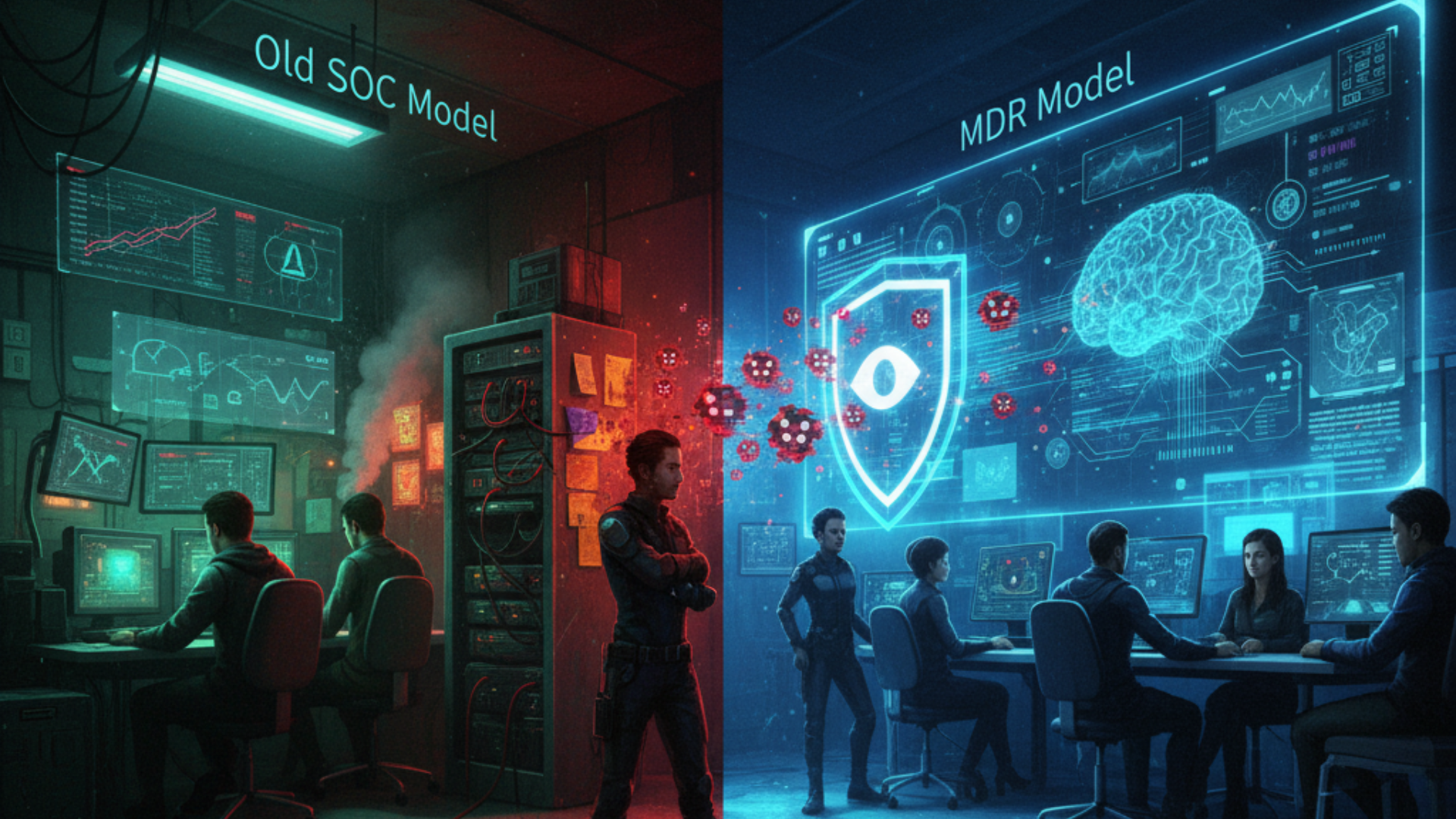
Then and now: Evolution from SOC to MDR in Cybersecurity
The Rise of the SOC
For many organizations, the Security Operations Center (SOC) has been at the center of its security strategy. A SOC stands for Security Operations Center and it is made up of a team of cybersecurity professionals focused on the real-time monitoring, detection and response of security incidents. They beat the odds against their organization by way of technology, processes and people in a bid to safeguard their IT infrastructure.
But conventional SOCs have their constraints. In a world that is distributed, cloud-heavy, and remote work, this focus on detection and incident response within a company perimeter can be a problem. At the same time, the volume and complexity of cyber threats are rising making it difficult for SOCs to keep up.
Why the Traditional SOC Approach Falls Short
Both technology and manpower are really expensive for a SOC. It is costly, and it takes time to hire the right people who possess the relevant knowledge.
Inadequate Threat Intelligence: Conventional SOCs typically depend on basic threat intelligence feeds. Which means they would not be able to catch emerging or extremely innovative cyber threats, especially if they happen beyond the bounds of an organizations network.
Delays in Response: In a fast-paced cyber threat landscape, SOCs often lack the agility needed to respond quickly to diffuse attacks before the damage is done.
What is MDR? A Smarter Approach to Cybersecurity
This type of service manages detection and response to these threats using a combination of technology, intelligence and human analysis coupled with 24/7 detection, monitoring, and response capabilities. MDR services differ from traditional SOCs because SOC services are monitored and alerted, while MDR services are proactive and remediate threats quickly.
MDR services typically include:
MDRs detect odd activities as they continuously watch systems for potential risks that perhaps conventional security systems might fail to identify, hence 24 by 7 threat detection.
Immediate Response to Incidents: Once a threat is identified, MDR services act quickly to contain and mitigate the threat, this significantly reduces response times as compared to traditional Security Operations Centers (SOCs).
Detection capabilities enhanced with threat intelligence: With MDR, the provider utilizes extensive threat intelligence to predict imminent threats that may be coming the way of the organization, to protect the organization against the latest forms of attack.
Dedicated Security Professionals: MDR teams are made up of experienced cybersecurity professionals who monitor, analyze, and respond to threats on behalf of the organization, providing advanced skills that enterprises may find hard to replicate themselves.
What They’re Seeing: Why MDR Is Phasing Out the Old SOC Model
With cyber threats getting more sophisticated and widespread, and traditional SOCs still being limited by human kinds, the obvious conflicts come to light. This is why MDR is dominating:
Cost-Effectiveness and Scalability
A SOC is not cheap to run. Cost of SOC This includes the hiring of cybersecurity analysts, purchasing the needed tools, and creating and maintaining the infrastructure to run a SOC can be expensive. For a small to mid-market player in particular, this can be prohibitive.
Here, however, is where MDR provides the cost-effective solution. As it is a managed service, businesses can save on the costs associated with hiring an in-house team while still gaining access to the required expertise and technology. Most MDR providers work on a subscription basis, which gives businesses flexibility to expand their security services as they expand.
Advanced Threat Detection
MDR services use advanced technologies, including but not limited to machine learning, AI, and behavioral analytics to discover micro-level cyber risk. With these tools, MDR providers can detect anomalies and threats which traditional SOC might miss.
Furthermore, since MDR solutions are combined with real-time threat intelligence, they are always informed on the most recent styles of attacks. This proactive approach ensures quicker detection and containment of attacks.
Faster Response Times
In the modern digital landscape where every second counts, a few minutes wait time can be the difference between stopping a data breach and triggering one! MDR services are built for speed, often engaging in real-time, to form an immediate response to limit and mitigate threats upon detection.
In cases of advanced cyber-attacks — such as ransomware, which has the potential to propagate rapidly if no immediate action is taken — this rapid response is essential.
24/7 Coverage with Less Complexity
The biggest disadvantage with a traditional SOC is that it needs to be monitored 24×7. This is not possible with most organizations, especially SMBs, maintaining a 24/7 SOC.
One of the elements of MDR is that it offers round the clock monitoring as part of the service. Hidden threats are constantly being monitored for. And it eliminates the burden of managing an internal security team, allowing companies to run their businesses without the hassle of constantly updating their security products or waking up in the middle of the night to responsive alerts.
Expertise at Your Fingertips
MedeAnalytics Data Connect enables seamless integration of historical and temporal data into healthcare delivery systems, enabling real-time health data sharing and cross-system prediction to power actionable insight and facilitate information-driven decision making all within existing clinical workflows. This level of expertise is hard to recreate in house and even more difficult for businesses without dedicated IT teams. MDR allows organizations the access to this level of specialized expertise without needing to part ways with a security team.
The Future of Managed Security
MDR is not a trend; it represents a seismic shift from the traditional SOC approach that businesses have employed to tackle security challenges. As cyber-attacks become more ubiquitous and more advanced, organizations have to re-consider their approach to protection — fast, agile, and effective technology based protection.
Businesses striving to stay ahead of the curve without the time, money and complexity of running their own SOC in-house will find MDR services works for them like a charm! MDR provides a means for both SME and enterprise to enhance your cyber security posture without all the capital costs of toolsets and decent but expensive staff.
Conclusion
With the evolution of the digital landscape, Managed Detection and Response (MDR) is turning out to be the modern approach to cybersecurity. Classic Security Operations Center (SOCs) are falling out, and for a good reason, as MDR also comes with reduced costs, superior threat detection, shorter response times, and dedicated teams of experts to do the work. MDR offers a much better proactive and holistic approach to cybersecurity and aids businesses in out-running the rapidly evolving threat landscape.
With cyber-threats getting increasingly advanced, Managed Security 2.0 via MDR permits businesses an unparalleled advantage to defend its digital assets and sustain its longevity.
Recent Posts
- IT Staff Augmentation in Ahmedabad: A Guide for CEOs Hiring Their First Outsourced Engineer
- Why Ahmedabad's IT Talent Shortage Is Pushing Companies Toward Staff Augmentation
- Setting Up IT Infrastructure in Ahmedabad's New Business Parks: What Nobody Tells You Upfront
- Why GIFT City and Gandhinagar Companies Need a Different IT Infrastructure Approach Than Ahmedabad Offices
- Managed IT Services in Ahmedabad: What Local SMBs Pay vs. What They Actually Need
Recent Comments
- No comments to show