
-
Vijit
- April 13, 2026
- IT
- No Comments
What SMBs Can Learn From It
| $300K+ estimated cost of one hour of downtime for SMBs (ITIC 2024) | 60% of SMBs that suffer a cyberattack shut down within six months | 46% of all data breaches target businesses with fewer than 1,000 employees | 11× return on preventive cybersecurity vs. the cost of a single breach |
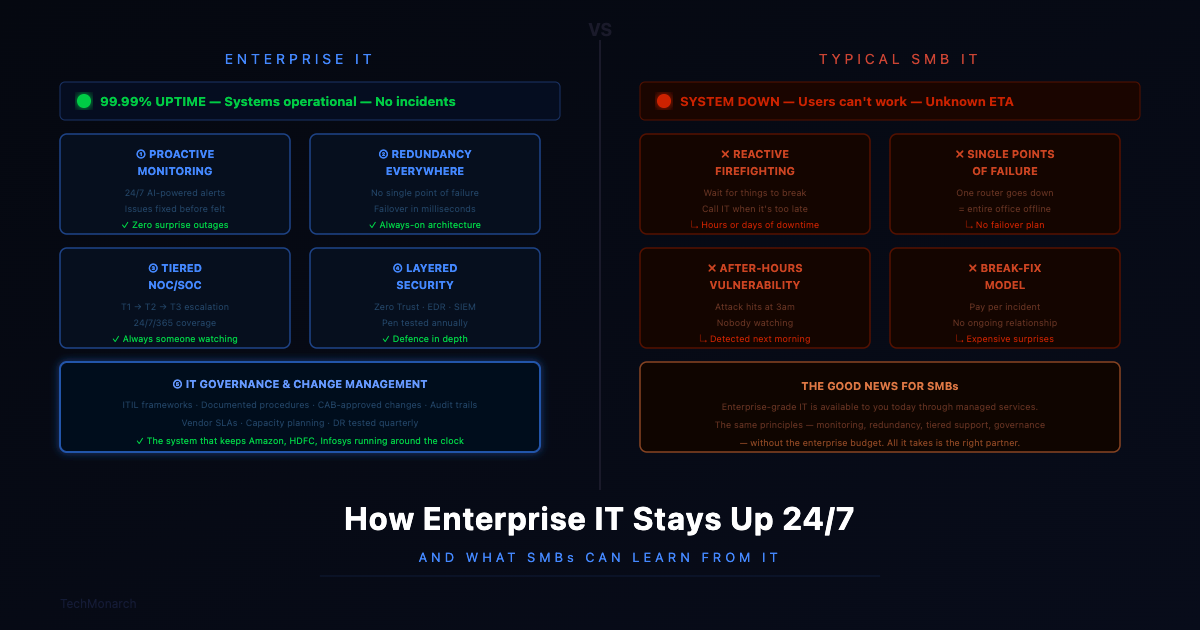
Ever wondered why companies like Amazon, HDFC Bank, or Infosys never seem to go down? Their websites are always up, their staff are always connected, and their systems hum along in silence — 24 hours a day, 365 days a year.
It’s not magic, and it’s not luck. It’s a very deliberate approach to IT governance built over years. And here’s the good news for small and mid-sized businesses: you don’t need an enterprise budget to think like an enterprise. Most of the principles that power the big players are accessible to you today — what they require isn’t crores of spending, just the right strategy and the right partner.
Let’s break down exactly what enterprises do differently — and how SMBs can close the gap.
1. They Don’t Wait for Things to Break — They Prevent It
This is probably the biggest mindset gap between enterprises and most SMBs. Enterprise IT teams run proactive monitoring around the clock. Not someone staring at a screen, but intelligent tools that detect anomalies before they become outages: a server’s storage approaching capacity, a router showing unusual traffic patterns, a critical patch that hasn’t been applied. By the time something actually fails, the underlying issue has often already been resolved.
Most SMBs still operate reactively. Something breaks, someone notices, IT gets called, the problem gets fixed — sometimes hours or even a full day later. Meanwhile, your team is stuck, your customers are frustrated, and the clock is ticking on revenue you’re not making. According to ITIC’s 2024 Hourly Cost of Downtime Report, over 90% of organisations — including SMBs with up to 200 employees — estimate their downtime costs at more than $300,000 per hour when you account for lost productivity, revenue, and recovery.
That figure tends to change how people think about the value of monitoring.
2. Redundancy Is Built Into Everything
Ask any enterprise IT architect what keeps them up at night, and they’ll tell you: a single point of failure. One component that, if it goes down, takes everything else with it. Enterprises systematically eliminate these by building redundancy into their infrastructure:
- Dual internet connections from two different ISPs
- Redundant power supplies and UPS (Uninterruptible Power Supply) systems
- RAID storage configurations — one failed disk doesn’t wipe your data
- Failover servers that kick in automatically if the primary goes offline
Most SMBs have none of this. One connection, one router, one server — and when any of it fails, everything stops. The good news: building meaningful resilience doesn’t require enterprise spending anymore. Cloud services, hybrid setups, and affordable failover solutions mean that even a 15-person company can have genuine redundancy if it’s architected properly. The key word is ‘architected’ — it has to be designed in, not bolted on after a crisis.
3. They Have an IT Roadmap — Not Just a Wish List
Enterprises don’t buy IT equipment when things break. They plan 12, 24, even 36 months ahead. Every server has an end-of-life date tracked. Every software licence has a renewal calendar. Every infrastructure upgrade is budgeted before it’s needed. This is called IT lifecycle management, and it’s one of the most underrated disciplines in business technology.
For an SMB, it doesn’t have to be complicated. The basics are straightforward:
- Know when your hardware is due for replacement — servers typically every 4–5 years, desktops every 3–4
- Plan software renewals 2–3 months in advance, not the day they expire
- Review your IT infrastructure annually and ask: can this support where the business will be in two years?
Planning ahead means fewer emergency purchases at inflated prices, fewer rushed decisions, and far fewer nasty surprises. The cost difference between a planned hardware refresh and an emergency replacement after failure — in time, money, and stress — is substantial.
4. Security Is a Process, Not a Product
When a company gets breached, the first thing people ask is: ‘But did they have antivirus?’ The reality is that modern cybersecurity requires a lot more than a single tool. Enterprises treat security as a continuous, layered process — endpoint protection on every device, email filtering against phishing, next-generation firewalls, patch management, and regular security awareness training for staff.
They also stress-test their defences. They don’t assume everything is secure — they verify it, continuously.
Here’s why this matters especially for SMBs: according to the Verizon 2025 Data Breach Investigations Report, SMBs experience ransomware breaches at more than double the rate of large enterprises. The average cost of a cyberattack on an SMB now sits at $254,445, and 60% of small businesses that suffer a significant attack shut down within six months. Cybercriminals target SMBs precisely because they expect weaker defences — and they’re often right.
| The Layered Security Model SMBs Should Adopt Endpoint protection on every device — including remote and personal devices used for work Email filtering to catch phishing attempts before they reach your staff Next-generation firewalls with threat detection, not just port blocking Patch management — 29,000+ CVEs were published in 2024 alone; unpatched systems are open doors Security awareness training — 82% of breaches involve human error (Verizon DBIR 2025) Regular vulnerability assessments — don’t assume, verify |
5. They’ve Documented Everything
Here’s something most SMBs don’t think about until it’s too late: what happens when the one person who ‘knows everything about your IT’ leaves? In enterprises, IT doesn’t live in one person’s head — it lives in a structured knowledge base. Every configuration, every credential (in a secure vault), every network topology, every vendor contact, every process. Documented, versioned, and accessible to whoever needs it.
For SMBs, this matters for two very practical reasons. First, business continuity: if something breaks at 11pm, anyone with access to the documentation can start troubleshooting — you’re not waiting for one person to be available. Second, vendor independence: you’re never held hostage by a single IT person or provider, because your setup is fully documented and belongs to you.
Documentation feels like admin. It is admin. It’s also the thing that saves you when everything else goes wrong.
6. They Have a Dedicated IT Partner — Not a Break-Fix Number
Most enterprises don’t handle all their IT in-house. They engage specialist vendors and managed service providers who cover specific domains — networking, security, cloud, end-user support. Someone whose job it is to know their IT inside and out, so the business can focus on actually running itself.
This is exactly what a Managed IT Services provider delivers for SMBs in India. Instead of funding a full-time internal IT team — which is expensive and often overkill for a company under 100 people — you get:
- Your systems maintained daily by a team with broad, deep expertise across networking, security, cloud, and hardware
- Defined response times, so you know exactly how quickly issues will be addressed
- Predictable monthly costs rather than surprise emergency bills
- Proactive management — problems caught early, not reported after the fact
Research from Forrester found that SMBs working with MSPs see roughly a 30% improvement in client retention tied to IT reliability. The maths on that tends to be compelling.

7. They Treat IT as a Business Investment, Not a Cost
This is perhaps the most important mindset shift of all. Enterprise leaders understand that good IT directly enables business performance. Faster systems mean more productive employees. Better security means fewer costly incidents. Reliable infrastructure means customers and partners can always reach you when they need to.
They ask: what does a day of downtime actually cost us? And once you do that maths honestly, investing in robust IT looks like a very obvious decision. Research shows that preventive cybersecurity measures — averaging around $12,000 per year for an SMB — offer an estimated 11x return compared to the average cost of a single breach.
We’d encourage every SMB owner to ask the same question. What does one hour of your team being unable to work cost you? What would a data breach cost? What is it worth to always be reachable by your clients? More often than not, the cost of good IT management is a fraction of the cost of bad IT management.
Enterprise vs. SMB IT: What the Gap Actually Looks Like
| Practice | What Enterprise IT Does | What Most SMBs Do Instead |
| Issue Detection | 24/7 proactive monitoring — problems flagged before they become outages | Reactive — something breaks, someone calls, IT scrambles to fix |
| Infrastructure Resilience | Dual ISPs, redundant power, failover servers — no single point of failure | Single connection, single router, single server — one failure = full stop |
| IT Planning | 12–36 month roadmaps, hardware lifecycle tracked, budgets set in advance | Purchases happen when things break — usually at inflated emergency prices |
| Cybersecurity | Layered, continuously tested defence — endpoint, email, firewall, training, patching | Antivirus installed, rarely updated, never stress-tested |
| Documentation | Every config, credential, network topology, and process lives in a structured knowledge base | Exists in one engineer’s head — until that person leaves |
| IT Expertise | Specialist vendors and MSPs covering specific domains | Break-fix contractor called when something is already broken |
| Mindset | IT as a business investment — ROI calculated, decisions data-driven | IT as a cost — minimised until a crisis forces spending |
Table 1: How enterprise IT practices compare to typical SMB approaches — and where the gaps create risk
Wrapping Up
Enterprises aren’t running 24/7 because they got lucky. They built systems, processes, and partnerships that make reliability the default — not the exception.
Everything described in this article is achievable for SMBs in India right now. You don’t need a 50-person IT department or a billion-rupee budget. You need the right infrastructure, the right processes, and a partner who treats your IT the way enterprises treat theirs — proactively, systematically, and with a long-term view.
Recent Posts
- Why IT Vendors in Ahmedabad Take Days to Respond — And What "Managed" Should Actually Mean
- Why More Ahmedabad Companies Are Switching From Freelance IT Support to Managed Partners
- What Ahmedabad Businesses Get Wrong About IT Compliance Under India's DPDP Act
- A Look Inside How We Manage IT Infrastructure for Ahmedabad Businesses Across Industries
- Why Gandhinagar's Growing IT/ITES Sector Needs Local Managed Support, Not Remote-Only Vendors
Recent Comments
- No comments to show