
-
Vijit
- May 18, 2026
- No categories assigned.
- No Comments
Imagine coming into work one morning and finding that every computer in your office is locked. Every file — encrypted. A message on screen demands a ransom in cryptocurrency. Your phones are ringing. Your clients are waiting. And your entire business has, in the space of a single night, ground to a halt.
This isn’t a hypothetical. This is exactly what happened to Universal Health Services (UHS) — one of the largest hospital networks in the United States — in September 2020. And their story is one of the most instructive case studies in cybersecurity that any business, regardless of size or industry, can learn from.
At TechMonarch, we talk about cybersecurity with our clients every week. And while ransomware might sound like a “big company problem”, the reality — and the data — tell a very different story. So let’s walk through what happened to UHS, how they recovered, and what every business in Ahmedabad (and beyond) should take from it.
First, What Actually Happened to UHS?
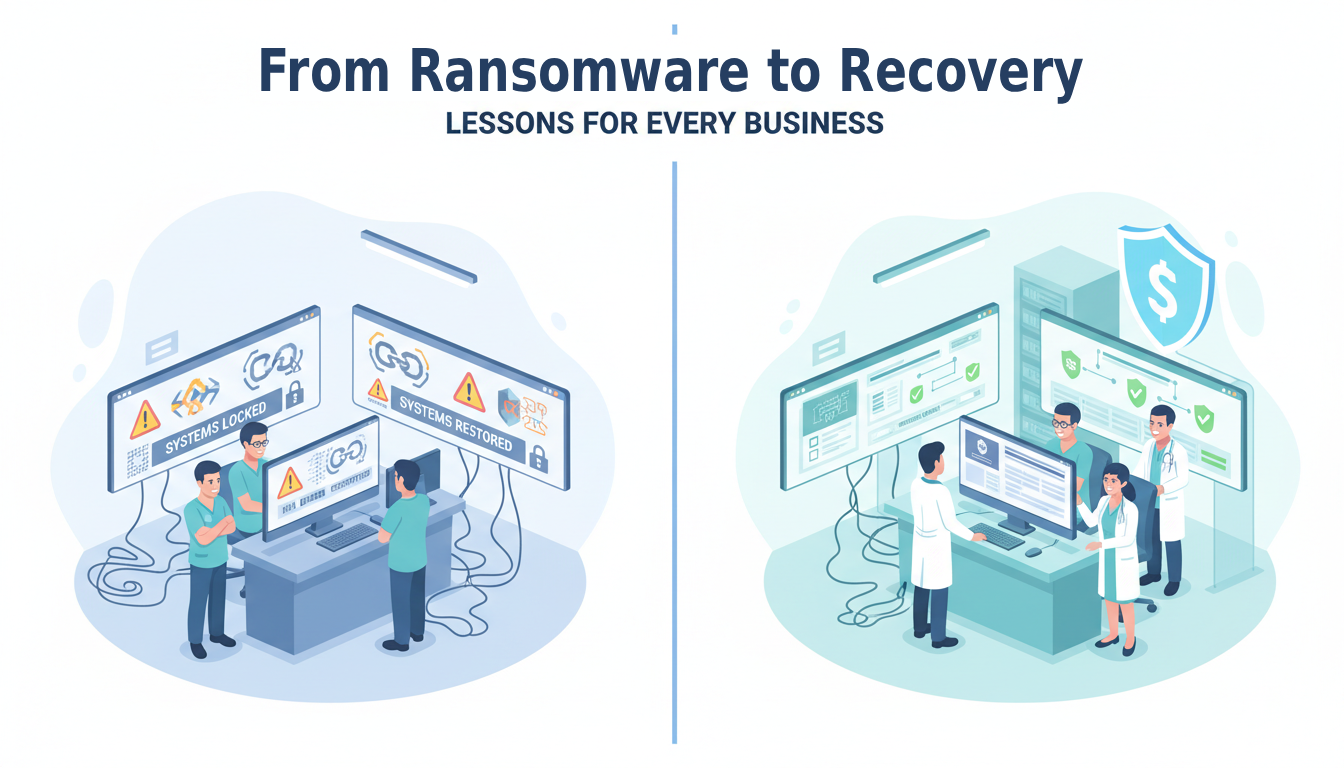
In the early hours of September 27, 2020, the Ryuk ransomware began spreading through the UHS network. Within hours, it had infected systems across the organisation’s 400 hospitals and healthcare facilities across the US and UK. Staff arrived to find computers displaying ransom demands. Electronic health records became inaccessible. Medical equipment that relied on network connectivity stopped functioning properly.
Critically — and this is the part that really drives home the stakes — staff had to revert to paper-based systems. Ambulances were diverted to other hospitals. Lab results had to be physically transported. In healthcare, where minutes can mean lives, this was a genuine crisis.
The attack was attributed to the Ryuk ransomware group, which at the time had already extorted hundreds of millions of dollars from healthcare institutions and corporations worldwide. The UHS incident alone was estimated to cost the organisation approximately $67 million in lost revenue, IT remediation costs, and recovery expenses. Three weeks of system downtime. Three weeks.
| The UHS ransomware attack in 2020 cost an estimated $67 million — spanning lost revenue, IT remediation, and recovery. Full system restoration took approximately three weeks across 400 facilities. Source: UHS Q3 2020 earnings report and subsequent disclosures. |
How Did They Recover?
Recovery from an attack of this magnitude doesn’t happen overnight — and UHS was transparent about the fact that it was an intensely difficult process. But there are clear recovery pillars that their response followed, and they’re worth understanding:
1. Isolate and contain. The first priority was stopping the spread. Affected systems were taken offline. Network segments were isolated. This is an instinctive response, but it requires having a clear network map and documented infrastructure — something many businesses simply don’t have.
2. Activate the incident response plan. UHS had a business continuity plan in place. Were there gaps? Yes. Was it perfect? Far from it. But having a documented plan meant there was a framework to operate within — even in chaos. Without one, the downtime would almost certainly have been longer.
3. Restore from backups — where they existed. Here’s where things get sobering. The speed of recovery was directly tied to the quality and recency of their backups. Systems with clean, recent, offline backups came back faster. Systems without them required more complex (and expensive) remediation.
4. Communication — internally and externally. UHS kept staff informed, coordinated with regulators, and communicated with patients about disruption. Transparent communication during a crisis is not just good ethics — it’s good crisis management.
5. Third-party forensics and cybersecurity specialists. They brought in external cybersecurity experts to investigate the breach, understand how the attackers got in, and patch the vulnerability. This is almost always necessary — the in-house team is too close, too exhausted, and often too limited in specialised forensic skills.
The Entry Point: How Did Ryuk Get In?
This is the question every business owner should be asking. Ransomware doesn’t materialise out of thin air. It gets in through a door someone left open. In the case of Ryuk and many similar attacks, the most common entry vectors are:
- Phishing emails that trick an employee into clicking a malicious link or attachment
- Remote Desktop Protocol (RDP) left exposed to the internet with weak credentials
- Unpatched software vulnerabilities on servers or endpoint devices
- Third-party vendor access that isn’t properly controlled or monitored
In the UHS case, security researchers pointed to a chain of malware that began with Emotet (a banking trojan spread via phishing), which downloaded TrickBot (a credential-stealing tool), which then delivered the Ryuk ransomware payload. This three-stage attack chain is not unusual — and it’s exactly why a single firewall or antivirus tool is not enough protection.
| “Most ransomware attacks don’t start with sophisticated zero-day exploits. They start with a phishing email that someone clicked on.” — CISA (Cybersecurity & Infrastructure Security Agency), 2022 Ransomware Guide |
What Every Business — Including Yours — Can Take From This
Here’s the thing. UHS had resources most businesses don’t — a large IT team, cybersecurity budgets, established processes. And they still spent three weeks recovering and $67 million. For a small or mid-sized business in Ahmedabad, a ransomware attack of even a fraction of that severity could be existential.
The good news? Most ransomware attacks succeed not because they’re unstoppable — but because the basics weren’t in place. And the basics are very achievable.
Lesson 1: Backups Are Not Optional — But Not All Backups Are Equal
The single most important thing that determines how fast you recover from ransomware is the state of your backups. But here’s what many business owners don’t know: if your backup drive is connected to your network, ransomware will encrypt that too.
What you need is the 3-2-1 backup rule: 3 copies of your data, on 2 different types of media, with 1 copy stored offline or offsite (ideally both). Cloud backups with versioning are excellent here. And crucially — backups should be tested regularly. A backup you’ve never restored from is a backup you don’t actually have.
Lesson 2: Patch Your Systems — Consistently and Without Delay
Unpatched software is one of the most common ransomware entry points in the world. Every time a software vendor releases a security update, they’re essentially publishing a list of vulnerabilities that attackers can now exploit on anyone who hasn’t updated yet. Managed IT services exist partly for this reason — to ensure that patches are applied systematically, promptly, and without falling through the cracks in a busy business.
Lesson 3: Train Your People — They Are Your First Line of Defence
In the UHS attack, as in most ransomware incidents, a human being was the door through which the attackers entered. Phishing awareness training is not a nice-to-have — it’s a necessity. Your team should know how to spot a suspicious email, what to do if they accidentally click something, and who to call immediately.
This doesn’t have to be complicated or expensive. Even a quarterly security awareness session significantly reduces your risk profile. We’ve seen it make a measurable difference with our clients.
Lesson 4: Have an Incident Response Plan Before You Need One
What would you do if you came in tomorrow and your systems were locked? Do you know who to call? Do you know which systems to isolate first? Do you know where your backups are and how to restore them? Do you have a way to communicate with your team and clients without email?
An incident response plan doesn’t need to be a 200-page document. It can be a clear, practical, two-page guide that everyone in your leadership team knows about. The point is: make decisions now, while you’re calm, so you don’t have to make them in a panic later.
Lesson 5: Segment Your Network
One of the reasons the UHS attack spread so rapidly was because of flat network architecture — when one system was compromised, the ransomware could move laterally across the network with relative ease. Network segmentation means dividing your infrastructure into zones so that even if one area is compromised, the damage is contained. This is a key part of what we implement when setting up IT infrastructure for businesses.
Lesson 6: Never Pay the Ransom — But Think About Cyber Insurance
Law enforcement agencies globally — including Interpol, the FBI, and India’s CERT-In — advise against paying ransoms. Payment doesn’t guarantee you’ll get your data back, it funds criminal organisations, and it marks you as a target willing to pay. That said, recovery costs are real, and this is where cyber insurance is worth considering as part of your risk management strategy.
A Thought for Business Owners in Ahmedabad
Cybercrime doesn’t distinguish between hospitals in the US and mid-sized businesses in Gujarat. India has seen a dramatic rise in ransomware incidents over the past three years — the country ranked among the top targets globally in the 2023 Sophos State of Ransomware report, with 73% of Indian organisations surveyed reporting a ransomware attack in the preceding year.
The businesses that survive these attacks — and in many cases, the ones that never become victims in the first place — are the ones that treated cybersecurity not as a one-time IT purchase, but as an ongoing operational discipline.
At TechMonarch, cybersecurity is woven into everything we do — from how we set up your network infrastructure to the managed IT services we provide day-to-day. We help businesses think about these risks proactively, not reactively. Because reactive is always more expensive.

Final Thought
The UHS ransomware attack was a wake-up call for the healthcare industry. But the lessons it offers belong to every business — regardless of size, sector, or location. The fundamentals of protection are the same: good backups, patched systems, trained people, a clear response plan, and a trusted IT partner who helps you stay one step ahead.
Ransomware is a serious threat. But it is not an unstoppable one. Most of the businesses that fall victim to it do so because of gaps that were preventable. Don’t let that be your story.
If you’d like to understand where your business currently stands on cybersecurity readiness, TechMonarch offers IT infrastructure assessments for businesses across Ahmedabad. It starts with a conversation — and sometimes that conversation alone surfaces risks you didn’t know were there.
— TechMonarch | Helping businesses stay secure, resilient, and ready.
Recent Posts
- Why IT Vendors in Ahmedabad Take Days to Respond — And What "Managed" Should Actually Mean
- Why More Ahmedabad Companies Are Switching From Freelance IT Support to Managed Partners
- What Ahmedabad Businesses Get Wrong About IT Compliance Under India's DPDP Act
- A Look Inside How We Manage IT Infrastructure for Ahmedabad Businesses Across Industries
- Why Gandhinagar's Growing IT/ITES Sector Needs Local Managed Support, Not Remote-Only Vendors
Recent Comments
- No comments to show