
-
Vijit
- May 25, 2026
- No categories assigned.
- No Comments
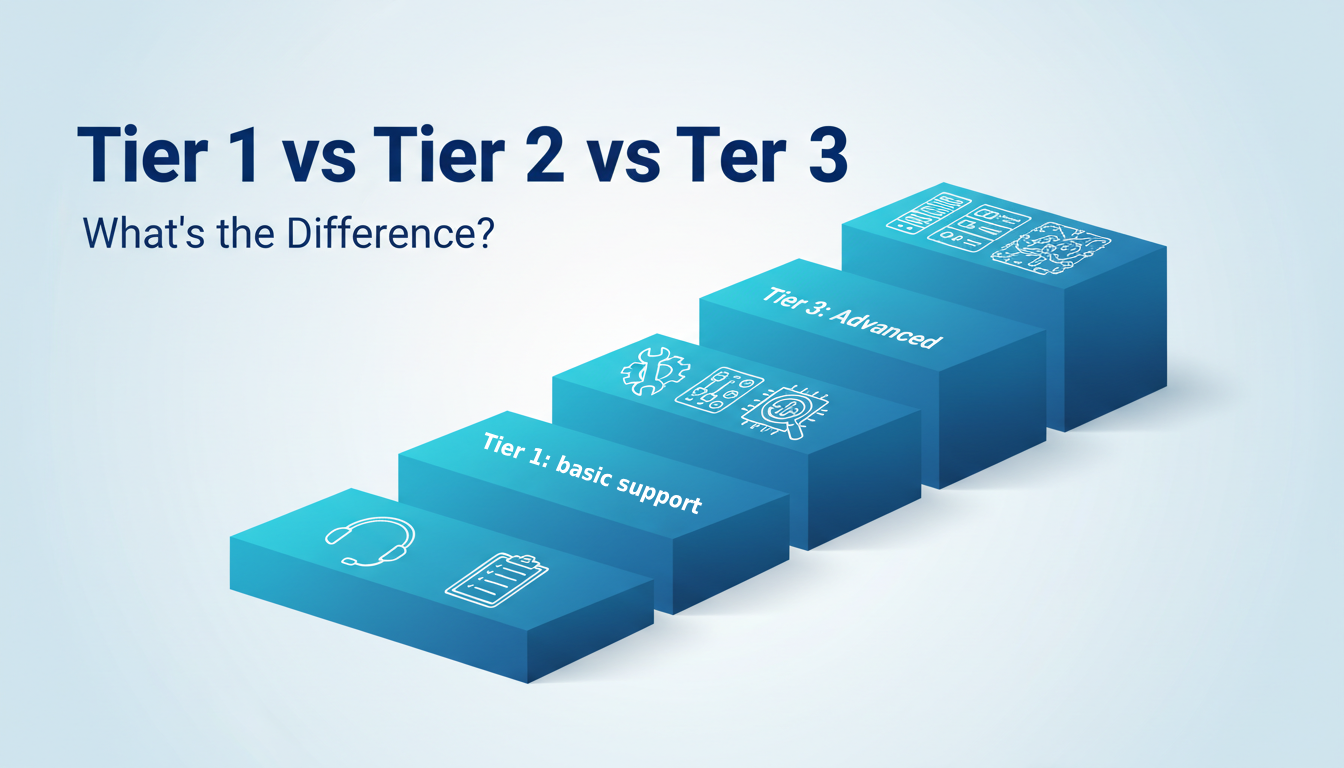
If you have ever called IT support, you have probably noticed that your first call does not always land you with the person who actually fixes the problem. Someone logs your issue, tries a few standard steps, and then — if they cannot sort it out — passes you along to someone else. That hand-off has a name: the tiered support model.
At TechMonarch, we run a structured support model for all our Managed IT Services clients across Ahmedabad. Understanding how tiers work — and what actually separates them — helps businesses make better decisions about the support they are buying, and helps IT professionals understand where they stand in their career.
So let’s break it down clearly. No fluff, no over-complicated definitions. Just a real, honest look at what each tier does, who sits in it, and why the distinction matters.
Why Does IT Support Use a Tiered Model?
The tiered support model — also sometimes called the escalation ladder — exists for one simple reason: efficiency. Not every IT problem needs the same level of expertise to solve, and it would be absurdly wasteful to have your most senior infrastructure engineer resetting forgotten passwords all day.
The model routes tickets to the right level of expertise. Simpler, high-volume issues get handled quickly at Tier 1. More complex problems escalate upward. This keeps resolution times low, costs manageable, and senior engineers free to focus on genuinely hard problems.
According to HDI (Help Desk Institute), organisations that implement structured tiered support resolve over 70% of issues at Tier 1, reducing escalation costs significantly and improving overall customer satisfaction scores.
Think of it like a hospital triage system. A sprained ankle and a cardiac event both need medical attention — but they go to very different people with very different tools.
Quick Reference: The Three Tiers at a Glance
| Attribute | Tier 1 | Tier 2 | Tier 3 |
| Role focus | User support & triage | Diagnosis & fixes | Deep engineering |
| Experience | 0 – 2 years | 2 – 5 years | 5+ years |
| Escalation | Escalates to Tier 2 | Escalates to Tier 3 | Final resolution |
| Tools | Ticketing, remote assist | Diagnostic, AD, MDM | Servers, firewalls, cloud |
| Certifications | CompTIA A+, ITIL v4 | Network+, MCSA | MCSE, CCNP, Azure |
| Resolution rate | ~70–80% of tickets | ~15–20% of tickets | ~5% of tickets |
Tier 1 — The First Responder
Tier 1 is your front line. These are the technicians who answer the phone, pick up the chat request, or acknowledge the ticket first. Their job is to gather information, provide immediate relief where they can, and ensure the right next step happens quickly when they cannot.
This does not mean Tier 1 technicians are just message-takers. A good Tier 1 engineer resolves a significant chunk of issues — roughly 70 to 80% in a well-run MSP environment. The key is that the problems they handle are well-defined and have known solutions.
Typical tasks: Password resets, software installations, printer issues, basic email configuration, Wi-Fi connectivity troubleshooting, account unlocks, standard onboarding setup
Who sits here: Entry-level IT professionals, fresh graduates, junior helpdesk analysts, often pursuing or holding CompTIA A+ or ITIL v4 Foundation certifications
Tools they use: Ticketing systems (ServiceNow, Freshdesk, Jira Service Management), remote desktop tools (AnyDesk, TeamViewer, Remote Desktop), knowledge base documentation
Skills focus: Communication, patience, following SOPs, documentation, and the ability to quickly distinguish between what they can fix and what needs to go up the ladder
One thing that is often underestimated about Tier 1: the documentation discipline required. A good Tier 1 technician does not just fix and close. They document clearly so that when the same issue comes up again — and it will — it can be resolved faster. This institutional knowledge is genuinely valuable.
A Tier 1 technician who communicates well and documents thoroughly is more valuable than a technically brilliant one who closes tickets with vague notes. The former builds the organisation’s knowledge base; the latter just burns time for the next person who sees the same issue.
Tier 2 — The Diagnostician
Tier 2 is where things start getting technically interesting. These are the engineers who receive escalations from Tier 1 — the issues that are either too complex, too environment-specific, or require deeper access and understanding than the front line is equipped to handle.
A Tier 2 technician typically has two to five years of hands-on experience and a broader understanding of how systems interact with each other. They are not just following a script; they are investigating root causes.
Typical tasks: Active Directory user management, Group Policy troubleshooting, network connectivity deep-dives, server performance issues, application errors, VPN configuration, hardware diagnostics, backup and recovery support
Who sits here: Mid-level IT engineers, systems administrators, technicians with CompTIA Network+, Microsoft Certified Associate (MCA/MCSA) level qualifications, or 2-5 years practical experience
Tools they use: Active Directory, Group Policy management, MDM platforms (Intune, Jamf), network diagnostic tools (Wireshark, PingPlotter), event log analysis, backup and monitoring tools
Skills focus: Root cause analysis, system interdependencies, ability to work without a script, communication with both end users and Tier 3 engineers
Tier 2 is arguably the most operationally demanding tier. These engineers need enough breadth to investigate across systems and enough depth to actually resolve them. They are also the ones who often end up writing the runbooks and documentation that make Tier 1 more effective over time.
In a Managed IT Services context like TechMonarch’s, Tier 2 engineers are the backbone of day-to-day client service delivery. They own the bulk of the resolution work and carry significant accountability for client satisfaction.
The jump from Tier 1 to Tier 2 is not just about technical skills — it is about thinking differently. Tier 1 asks: ‘What is the fix?’ Tier 2 asks: ‘Why did this happen, and how do we stop it happening again?’
Tier 3 — The Architect
Tier 3 is where specialists live. These are the people who get called in when Tier 2 has exhausted their diagnostic toolkit and the problem is genuinely complex — or when the solution requires infrastructure-level changes that go beyond configuration.
Tier 3 engineers typically have five or more years of deep specialisation in specific domains: server infrastructure, network architecture, cybersecurity, cloud platforms, or enterprise application environments. They often hold advanced certifications and have a level of systems thinking that comes only with years of hands-on exposure to complex, real-world environments.
Typical tasks: Server architecture design and troubleshooting, enterprise firewall configuration (FortiGate, Cisco, Palo Alto), cloud infrastructure management (Azure, AWS, GCP), advanced security incident response, disaster recovery planning, virtualisation (VMware, Hyper-V), and vendor escalations
Who sits here: Senior infrastructure engineers, network architects, cloud solution architects, cybersecurity engineers — typically with MCSE, CCNP, Azure Solutions Architect Expert, or equivalent certifications
Tools they use: Enterprise firewall and SIEM platforms, hypervisors, cloud management consoles, advanced network analysis tools, vulnerability scanners, infrastructure-as-code tooling
Skills focus: Systems architecture thinking, vendor management, documentation of complex systems, mentorship of Tier 2, business impact assessment
Tier 3 engineers rarely interact directly with end users. Their “customers” are typically the Tier 2 engineers they support, the organisation’s infrastructure itself, and — in the MSP world — the service delivery leadership who need to understand and sign off on major changes.
In our experience at TechMonarch, Tier 3 involvement is also deeply tied to strategic IT planning. When a client wants to migrate to a hybrid cloud environment, redesign their network, or implement a zero-trust security architecture — that work is led by Tier 3 thinking, even if much of the execution involves all three tiers.
There is a particular satisfaction to Tier 3 work that is hard to describe to outsiders. You are rarely solving a problem that has a known answer. You are often the first person to encounter this specific combination of systems behaving this specific way. It requires deep patience and genuine intellectual curiosity.
What Does the Career Path Actually Look Like?
One of the most common questions we get from IT professionals — especially those earlier in their careers — is how long they should expect to spend at each tier, and what it takes to move up.
There is no universal timeline, but here is a realistic picture based on the industry and our own team’s experience:
- Tier 1 to Tier 2: Typically 1.5 to 3 years. The triggers are usually a combination of certifications (Network+, associate-level Microsoft or Cisco), demonstrated root-cause analysis skills, and a track record of going beyond the script.
- Tier 2 to Tier 3: Typically 3 to 5 years from Tier 2 entry. Requires deep specialisation in at least one domain (networking, cloud, security), advanced certifications, and — critically — the ability to mentor and document at a high level.
- Beyond Tier 3: Senior engineers often move into IT architecture, solutions consulting, or management tracks. Some of the best IT managers we know spent meaningful time at all three tiers.
One important note: certifications matter, but they are not the whole picture. The engineers who advance fastest are the ones who are genuinely curious, document their work well, and actively seek out the problems that are just slightly beyond their current comfort zone.

What This Means for Businesses Choosing IT Support
If you are a business owner or operations head evaluating IT support options — whether in-house or through a Managed IT Services provider — understanding this framework helps you ask better questions.
- Does your provider clearly define what is handled at each tier, and who your escalation path is?
- What percentage of issues does their Tier 1 resolve, and what is the average time to escalation when needed?
- Is there genuine Tier 3 depth in the organisation, or is everything labelled ‘senior engineer’?
- How does knowledge flow between tiers — is documentation actually maintained and used?
At TechMonarch, we are transparent about this structure with every client. You deserve to know who is handling your issues, at what level, and what happens when something genuinely complex comes up. That clarity is part of what we mean when we talk about Managed IT Services done right.
Final Thoughts
The tiered support model is not just corporate organisational structure — it is a thoughtfully designed system that matches expertise to problems efficiently. Every tier has genuine value. A world-class Tier 1 engineer who communicates brilliantly and resolves 80% of issues is arguably more impactful on client satisfaction than a Tier 3 engineer who works on five tickets a month.
What makes a great IT support operation is not just the depth of any individual tier, but the quality of the handoffs between them — the documentation, the communication, and the shared commitment to actually solving the client’s problem.
Whether you are an IT professional figuring out where you sit in this framework, or a business owner evaluating your support options, we hope this gave you a clearer picture. And if you want to talk about what tier of support your business actually needs — our team at TechMonarch is happy to have that conversation.
Recent Posts
- Why IT Vendors in Ahmedabad Take Days to Respond — And What "Managed" Should Actually Mean
- Why More Ahmedabad Companies Are Switching From Freelance IT Support to Managed Partners
- What Ahmedabad Businesses Get Wrong About IT Compliance Under India's DPDP Act
- A Look Inside How We Manage IT Infrastructure for Ahmedabad Businesses Across Industries
- Why Gandhinagar's Growing IT/ITES Sector Needs Local Managed Support, Not Remote-Only Vendors
Recent Comments
- No comments to show