
-
Vijit
- August 6, 2026
- No categories assigned.
- No Comments
What Happens When Businesses Delay IT Infrastructure Upgrades Too Long
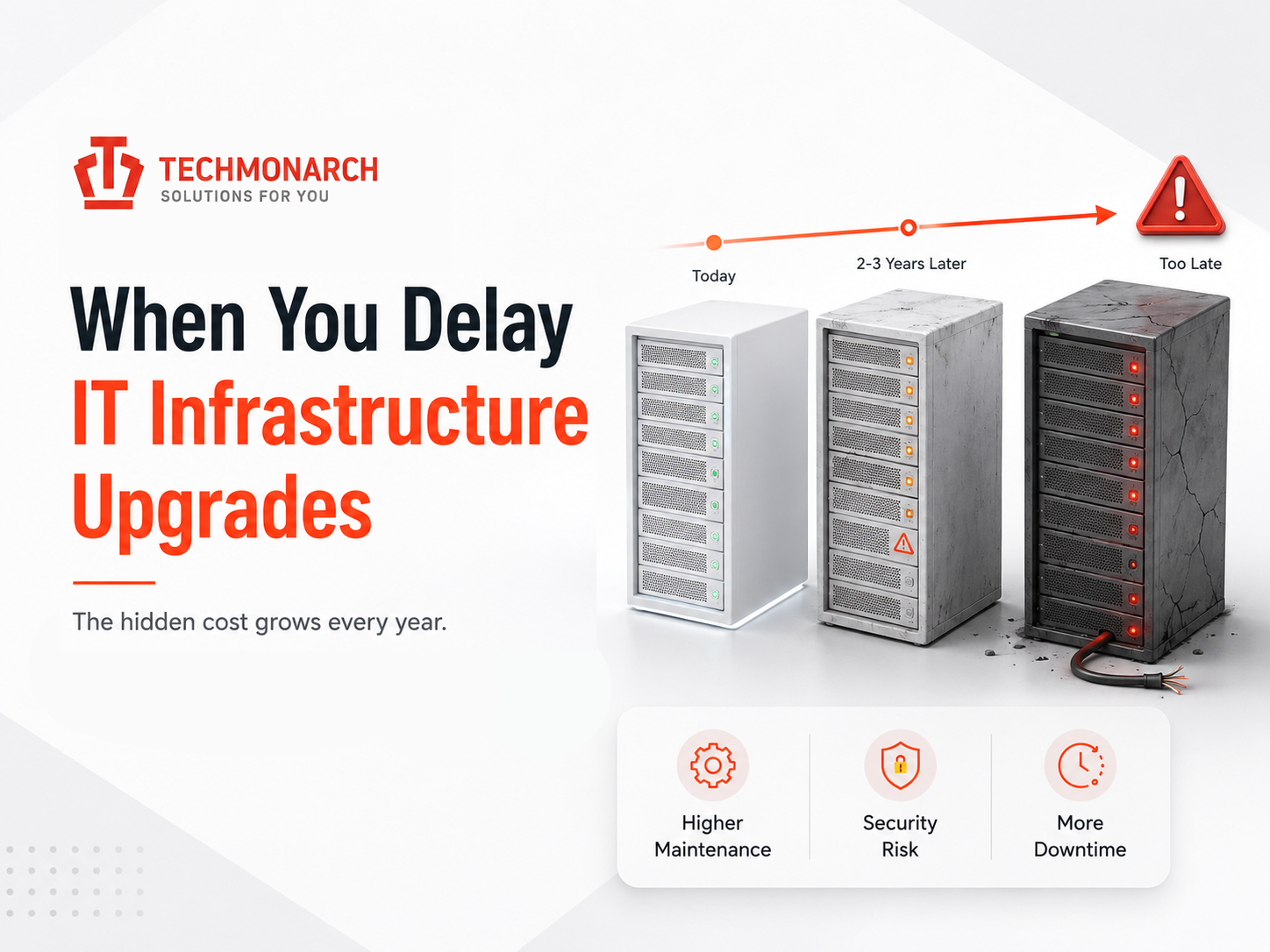
Almost every business that puts off an infrastructure upgrade has a good reason for doing it. The budget is tight this quarter, the current setup is “still working,” or nobody wants the disruption of a migration during a busy season. Taken on its own, each of these is a reasonable call. The problem is what happens when that reasonable call gets made every year for four or five years in a row.
By the time most companies in Ahmedabad or Gandhinagar actually sit down to upgrade, the decision usually isn’t being driven by planning anymore — it’s being forced by a failure. A server that finally gives up, a vendor that stops supporting a version, a client audit that flags something nobody had looked at in years. What was once a manageable, budgeted project turns into an emergency, and emergencies are always more expensive than plans.
None of this is about chasing the newest technology for its own sake. Plenty of infrastructure can run well past its original expiry date without causing problems. The issue isn’t age by itself — it’s age without a plan. A business that knows exactly how long its systems have left, and has already budgeted for what comes next, is in a completely different position from one that’s simply hoping nothing breaks this year.
The Maintenance Tax Keeps Compounding
Older infrastructure doesn’t just sit still while everything around it moves forward — it actively gets more expensive to keep alive. Specialist support for ageing hardware and unsupported software versions typically costs significantly more than standard support, simply because fewer vendors and engineers are willing to work on it. Add in productivity loss from systems that slow teams down, and the true cost of “just maintaining what we have” often runs two to three times higher than what actually shows up on the infrastructure line of the budget.
This is what makes the delay so easy to justify in the short term and so costly in the long run. The visible maintenance bill looks manageable. The invisible cost — engineer hours lost to workarounds, tickets that take longer to resolve, workflows built around a limitation rather than a fix — never gets tallied anywhere, so leadership keeps comparing the wrong numbers when deciding whether to act.
Security and Compliance Exposure Grows Every Year You Wait
Every year a system runs without a proper refresh, its attack surface gets a little larger. Vendors eventually stop patching older software and hardware, which means known vulnerabilities stop getting fixed while attackers keep finding new ones. For businesses handling client data, financial records, or anything that falls under a compliance requirement, this isn’t a theoretical risk — it’s the kind of gap that turns into a very expensive problem the moment a client audit, a regulator, or an attacker finds it first.
The uncomfortable part is that this risk accumulates whether or not anything actually goes wrong. A business that delays an upgrade for three years without incident hasn’t avoided the cost — it has simply been carrying an unmeasured liability that could surface at any point, usually at the worst possible time.
Finding People to Support Old Systems Gets Harder and Pricier
There’s a talent dimension to this that a lot of business owners don’t think about until they’re stuck. As IT infrastructure ages, the pool of people who know how to work with it shrinks. Younger engineers are trained on current tools, not on whatever your company happened to be running six or seven years ago. That means the few people who can still support an outdated environment know it, and they price their time accordingly.
This shows up as higher hourly rates for specialist support, longer wait times when something breaks, and a growing dependency on one or two people who understand the system well enough to keep it running. That’s a fragile position for any company to be in — if that person leaves, retires, or simply isn’t available the day something fails, the business is left with very few options.

The Productivity Drain That Never Reaches the P&L
Analysts have pointed out that organisations running on outdated tools can see efficiency drop by roughly a quarter compared to businesses using current, well-maintained systems. That gap shows up as slower response times, more manual workarounds, and staff who quietly build habits around a system’s limitations instead of asking why the limitation exists in the first place. None of it appears as a line item, but it adds up across every team that touches the system every single day.
For companies whose staff or clients expect fast turnaround — which describes most service businesses in Gujarat’s competitive market — this drain is often the real reason a company starts losing ground to a newer, better-equipped competitor, even when nobody can point to a single cause.
Why Waiting Longer Makes the Eventual Bill Bigger, Not Smaller
Here’s the part that catches most business owners off guard: the longer an upgrade is postponed, the more it costs to eventually do it. Systems that go years without documentation updates or architecture review require far more discovery work before anyone can safely touch them. What could have been a planned, phased upgrade a few years earlier turns into a full rebuild under time pressure, usually right when the business can least afford the disruption.
Surveys of IT decision-makers have found average legacy technology upgrade costs running into the millions once a system has been left untouched for too long — a number that is almost always far higher than what a phased, proactive upgrade path would have cost across the same period. Delay doesn’t preserve the budget. It just moves the cost further out and makes it larger when it finally arrives.
What a Structured Upgrade Path Looks Like
The companies that avoid this trap treat infrastructure upgrades as a recurring planning exercise, not a one-time crisis response. They map out the expected lifespan of critical hardware and software, budget for replacement in phases rather than all at once, and review the environment at least annually to catch ageing components before they become emergencies.
This is usually where an outside perspective helps most. At TechMonarch, when we walk into a business that’s been delaying its infrastructure decisions, the conversation is rarely about persuading anyone that an upgrade is needed — most owners already sense it. It’s about building a realistic, phased roadmap that spreads the cost over time instead of forcing it into a single painful year, and making sure the plan accounts for what the business will actually need eighteen months from now, not just what’s failing today.
A Practical Way to Start
If your infrastructure decisions have been getting pushed back for a while, the simplest starting point is an honest inventory: what’s running past its supported lifespan, what would happen if each critical piece failed tomorrow, and what a phased replacement plan would cost spread across two or three budget cycles instead of forced into one. That single exercise usually turns an abstract fear into a concrete, manageable plan — and concrete plans are a lot easier to get approved than emergency requests.
Delaying an upgrade never actually avoids the cost. It just decides who pays it, when, and under how much pressure. Businesses that plan for infrastructure the way they plan for any other recurring investment tend to pay less overall, and they’re the ones not scrambling the day something finally gives out.
Recent Posts
- Why IT Vendors in Ahmedabad Take Days to Respond — And What "Managed" Should Actually Mean
- Why More Ahmedabad Companies Are Switching From Freelance IT Support to Managed Partners
- What Ahmedabad Businesses Get Wrong About IT Compliance Under India's DPDP Act
- A Look Inside How We Manage IT Infrastructure for Ahmedabad Businesses Across Industries
- Why Gandhinagar's Growing IT/ITES Sector Needs Local Managed Support, Not Remote-Only Vendors
Recent Comments
- No comments to show