
-
Vijit
- September 25, 2026
- IT
- No Comments
Why More Ahmedabad Companies Are Switching From Freelance IT Support to Managed Partners
For years, the standard IT arrangement for a mid-sized Ahmedabad company looked the same: a freelancer on WhatsApp who comes by when the printer stops working or the network goes down, paid per visit, no contract, no real accountability beyond a working relationship built on trust. It worked reasonably well when technology in the office meant a few desktops, a shared printer, and maybe a local billing system. That setup is becoming harder to justify, and a growing number of companies across SG Highway, Prahlad Nagar, and the older commercial pockets of the city are quietly moving away from it toward structured managed IT partnerships instead. This isn’t a fad borrowed from bigger cities. It reflects a real shift in what a company’s technology actually needs to do, and what happens when it doesn’t.
The Freelance Model Was Built for a Simpler Problem
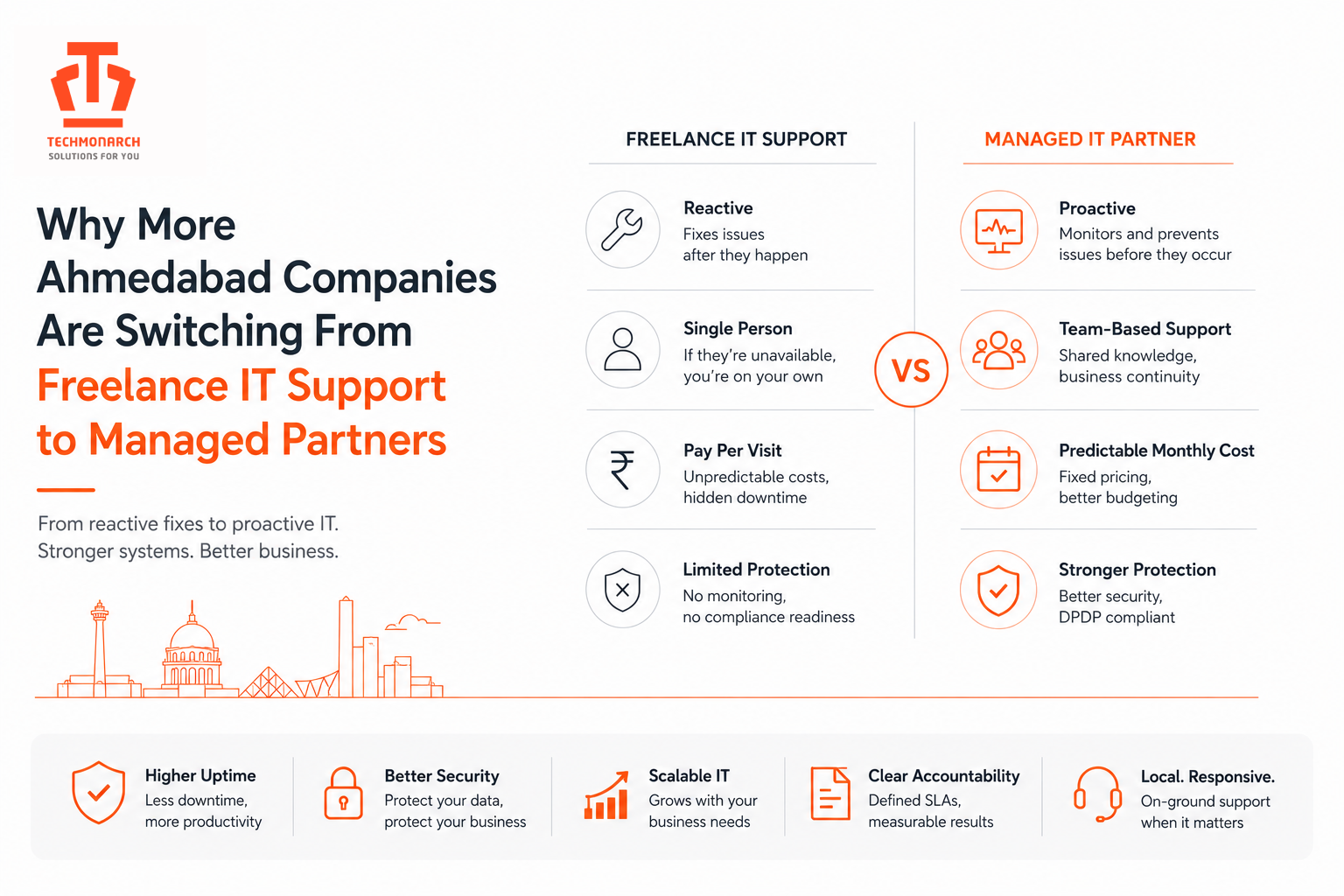
Freelance IT support, sometimes called break-fix support, is reactive by design. Something breaks, you call, someone comes and fixes it, you pay for that visit, and the relationship resets until the next issue. For a small office with low technical complexity, this can genuinely be the right call — there’s no point paying a retainer for infrastructure you barely have.
The trouble is that most companies’ technology footprint has quietly outgrown that model without anyone deciding to change how they support it. A business that once had one server now runs cloud applications, remote access for staff, a firewall that needs regular updates, backup systems that need to be tested, and probably a handful of vendor logins that only one person remembers the passwords to. None of that gets properly maintained under a model where the only trigger for attention is something visibly breaking.
What Actually Changes When You Move to a Managed Partner
The core difference isn’t really about who shows up when something fails — it’s about what happens before that point. A managed partner monitors the network, servers, and endpoints continuously, which means a failing hard drive or an unusual login attempt gets caught and addressed before it turns into downtime or a breach, rather than being noticed only after the damage is done. Patch management, backup verification, and basic security hygiene happen on a schedule instead of whenever someone remembers to do it, which in a freelance arrangement is often never, since there’s no one whose job it is to check.
There’s also a structural difference in accountability. A freelancer’s business continuity is tied to one person — if they’re unavailable, on vacation, or move on to something else, your company loses institutional knowledge about your own systems overnight. A managed partner is a team, with documentation, shared access records, and continuity that doesn’t depend on any single individual staying reachable.
The Cost Comparison Isn’t as Simple as It Looks
On paper, freelance support often looks cheaper — you’re only paying when something happens, rather than a fixed monthly fee. In practice, the real comparison isn’t hourly rate against retainer, it’s the cost of the incidents that a monitored setup would have caught early against the cost of the ones a reactive setup catches late. A server that fails during business hours because nobody was watching disk health isn’t just a repair bill — it’s lost productivity across the whole team while it’s down, and sometimes lost data if backups weren’t being tested regularly. Once a company has been through one of these incidents, the retainer for managed support tends to look a lot more reasonable in hindsight.
There’s also a quieter cost that rarely shows up in these conversations: the time a founder or ops head spends personally coordinating IT issues because there’s no structured point of contact. That’s usually time that should be going toward running the business, not chasing a freelancer’s availability.

Compliance Has Raised the Stakes
This shift isn’t happening in a vacuum. India’s Digital Personal Data Protection Act has moved from legislation to active enforcement territory, with the Data Protection Board now operational and penalties that can run into crores for serious lapses. Any Ahmedabad business holding customer data, employee records, or patient information — which is most of them — now has a genuine compliance obligation around how that data is secured, retained, and reported on in the event of a breach.
This is a different kind of requirement than “fix it when it breaks.” It calls for documented security practices, defined data retention policies, and someone who can demonstrate — not just claim — that reasonable safeguards are in place. A freelancer working informally, without documentation or a structured security process, isn’t set up to help a company meet that bar. A managed partner, by contrast, typically builds these practices into the engagement by default, because they’re now table stakes for running IT properly, not an optional add-on.
Where Freelance Support Still Makes Sense
None of this means freelance IT support is obsolete. A very small office with minimal infrastructure, no sensitive data to speak of, and low dependency on uptime can reasonably keep an informal arrangement going for a while longer. The shift tends to make sense once a company crosses certain thresholds: multiple locations or remote staff needing secure access, any handling of customer or financial data, a dependency on systems being available during business hours, or simply enough headcount that a half-day outage has a real cost attached to it. Most companies in Ahmedabad’s growth-stage bracket — past the very early days but not yet large enough for an in-house IT department — sit squarely inside that zone.
What the Transition Actually Looks Like
Companies making this switch usually don’t rip out their existing setup and start over. A sensible transition starts with an audit of what’s actually running — hardware, software licenses, network configuration, who has access to what — because a surprising number of businesses don’t have this documented anywhere, freelance-supported or not. From there, a managed partner typically layers in monitoring and backup verification first, since those catch the most common causes of downtime, followed by security hardening and a proper support process with defined response times instead of “whenever someone’s free.” Firms like Techmonarch that specialise in this kind of transition for Ahmedabad businesses tend to run this as a structured onboarding period rather than a single cutover, precisely because untangling years of informal arrangements takes a bit of time to do properly.
The Real Shift
What’s really changing isn’t that freelancers have gotten worse or that managed partners are new. It’s that the amount riding on a company’s IT — data, uptime, compliance exposure — has grown well past what an occasional-visit arrangement was ever designed to handle. For a growing number of Ahmedabad companies, moving to a managed partner isn’t about chasing a trend; it’s a fairly practical response to technology quietly becoming more central to the business than it used to be.
Questions Worth Asking Before You Switch
If this is a decision you’re weighing rather than one you’ve already made, a few honest questions tend to clarify things faster than a vendor pitch will. How many hours, realistically, did IT issues cost your team last quarter — not just repair time, but the time spent waiting for someone to become available? Do you actually know where your backups are stored, and has anyone verified in the last few months that they’d restore cleanly if needed? If your current freelancer became unreachable tomorrow, does anyone else in the company know your admin passwords, your network layout, or which vendor to call for what?
For a lot of business owners, it’s this last question that reframes the decision. A managed partnership isn’t just about faster fixes; it’s about not being one unavailable phone call away from losing visibility into your own systems.
Recent Posts
- Why IT Vendors in Ahmedabad Take Days to Respond — And What "Managed" Should Actually Mean
- Why More Ahmedabad Companies Are Switching From Freelance IT Support to Managed Partners
- What Ahmedabad Businesses Get Wrong About IT Compliance Under India's DPDP Act
- A Look Inside How We Manage IT Infrastructure for Ahmedabad Businesses Across Industries
- Why Gandhinagar's Growing IT/ITES Sector Needs Local Managed Support, Not Remote-Only Vendors
Recent Comments
- No comments to show