

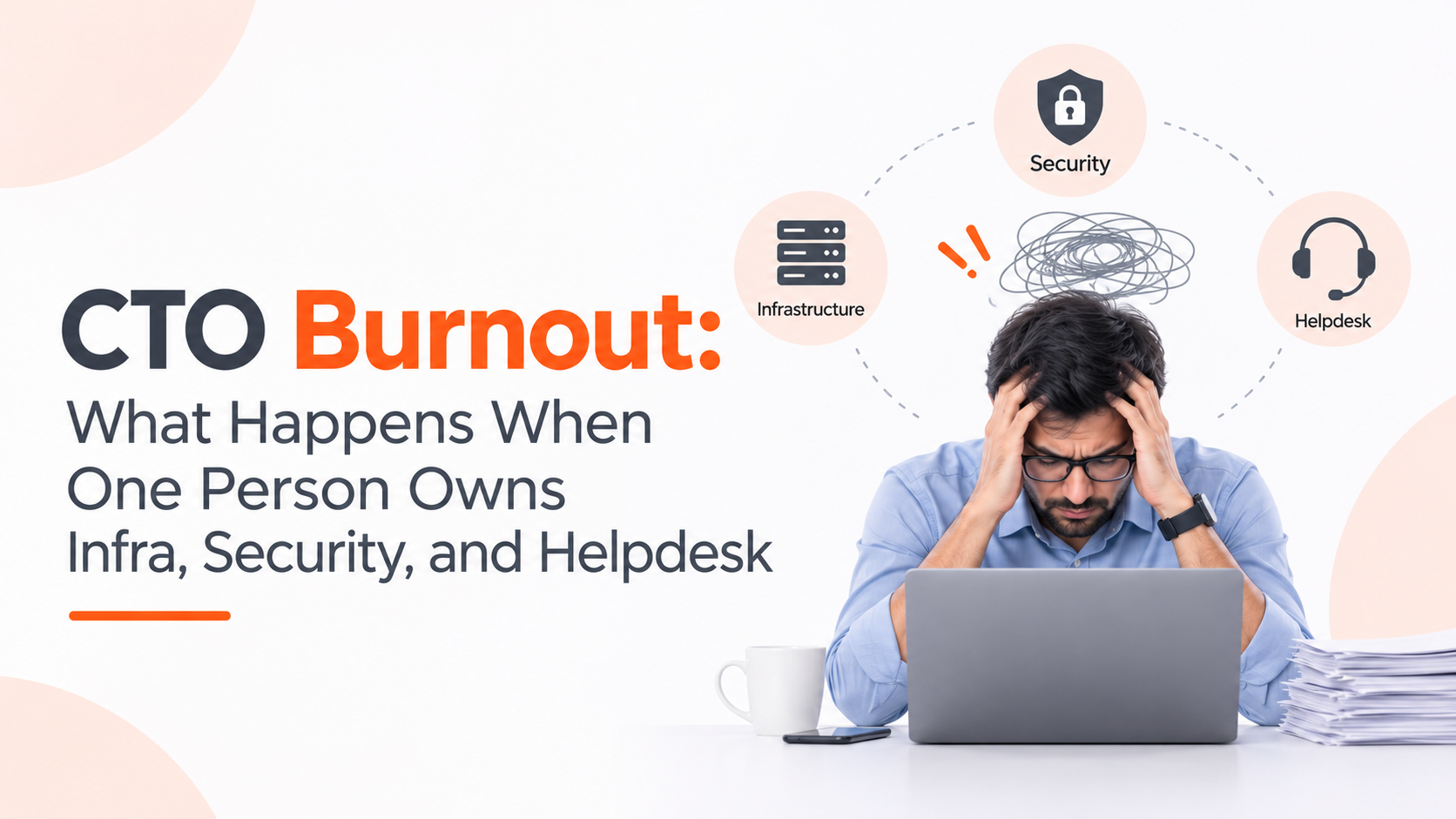
Picture the person. They approved firewall changes at 9 am, reset the CFO’s password at 10, rebuilt a laptop at noon, and are now being asked why nobody has checked the backup report in three weeks. They are your CTO, your IT head, or simply “the IT guy”, and they own infrastructure, security and the helpdesk, all at once.
In many Ahmedabad and Gandhinagar companies, that is just how IT works. It looks efficient on a salary sheet. It is also one of the most fragile setups a business can run.
This article is for CTOs who recognise themselves in that picture, and for owners who sign off on IT headcount. We will look at how the setup forms, what burnout looks like before it becomes a resignation letter, what it costs, and how to split the load without building a department you cannot afford.
How one person ends up owning everything
Nobody plans this. A company hires a capable engineer to set up the network and look after a few dozen laptops. Then the business grows: a cloud tenant, a CRM, a second office, a security questionnaire from a large client. Each addition lands on the same desk, because that person already “knows the systems”.
Headcount stays at one while scope keeps growing. The title moves from system administrator to IT manager to CTO, usually without the team, budget or hours that should come with it.
Two things keep the arrangement alive. First, when IT works, nobody sees the effort. Quiet IT is invisible IT. Second, the person is usually conscientious, so they absorb the overflow instead of raising a flag. They answer messages at night and fix outages on Sundays, and leadership reads that as proof the model works.
Meanwhile, the work has split into three jobs with different rhythms. Infrastructure needs planning and calm. Security needs vigilance and focus. The helpdesk needs an instant reply. One person can’t do all three well at the same time, and switching between them all day is where the damage starts.

What burnout looks like in IT, before anyone calls it that
The World Health Organization describes burnout as the result of chronic workplace stress that hasn’t been managed well, and points to three signs: exhaustion, growing mental distance or cynicism about the job, and reduced effectiveness. In IT, those show up in specific ways.
- Exhaustion. They are always on call, even on leave. Weekends go to patching because weekdays go to tickets.
- Cynicism. Replies get shorter. Users become “tickets”. Suggestions from other departments are met with a sigh.
- Slipping effectiveness. Documentation stops. Patches are deferred. The project that was “next month” last quarter is still next month.
- Hero dependence. Only one person knows the passwords, the vendor contacts and the odd setting on the old server.
- Quiet job hunting. An updated LinkedIn profile and sudden interest in certifications that don’t help the current role.
Most of these look like attitude or performance problems. They are usually workload problems. Give one person an impossible scope and something will fall through the cracks. That is not a surprise, it is arithmetic.
What it costs the business
Burnout is a cost even when the person never leaves. When they do, the bill gets bigger.
- A single point of failure. One resignation, illness or holiday and nobody knows how the environment works. Admin credentials, vendor contracts, renewal dates and the logic behind the firewall rules all live in one head.
- Slow response. When one person covers every ticket, users wait, then route around IT with unapproved apps and personal email.
- Stalled projects. Anything that isn’t on fire gets deferred. Migrations, hardware refreshes and documentation sit untouched.
- Costly replacement. Finding someone with this breadth takes time, and a new hire needs weeks to understand an undocumented setup. We covered the market side in why Ahmedabad’s IT talent shortage is pushing companies toward staff augmentation.
- A human cost. A good engineer worn down by a role that was never sized properly is a loss the company could have avoided.
Why security is the first thing to slip
Urgent work beats important work. A user who can’t open email gets attention in minutes. A vulnerability report nobody has time to read gets none.
Under constant load, the tasks that quietly drop off the list are exactly the ones that prevent incidents: patching on schedule, reviewing access rights, checking logs and alerts, testing backups, and removing accounts of people who have left. Security work needs clear thinking, and tired people make more mistakes. Research on security fatigue from NIST links weariness to avoiding decisions, impulsive choices and skipped procedures.
It becomes a loop. Unfinished security work leads to more incidents, incidents lead to more firefighting, and firefighting leaves even less time for security.
Compliance sharpens the problem. India’s DPDP Act puts real obligations on how companies handle personal data, and “we meant to get to it” is not a defence. Many owners underestimate the effort, which is why we wrote about what Ahmedabad businesses get wrong about IT compliance under India’s DPDP Act.
Why hiring one more person doesn’t fully fix it
A second hire is the obvious answer, and often a sensible first step. It is rarely the whole answer.
Two generalists covering three specialties still leaves gaps. Neither is a dedicated security person, and neither wants to spend all day on the helpdesk. You have halved the load without changing the structure. You have also added salary, tools, training and management time, plus the weeks it takes to hire, and there is a real chance the new person becomes the next “one who knows everything”.
Coverage is the other problem. Leave, sick days and after-hours incidents still land on a very small group.
Many companies get better results by mixing models: keep the CTO on architecture and decisions, and add a dedicated engineer for day-to-day work through staff augmentation. If you are doing that for the first time, our guide to IT staff augmentation in Ahmedabad for CEOs hiring their first outsourced engineer covers what to expect.
How to split the load
You don’t need a full department. You need the work divided so that no single failure takes the company down.
- Separate the three streams. Helpdesk, infrastructure operations and security each get a named owner or a defined service level, even if one person still holds two of them.
- Document everything. Keep credentials in a password vault, with network diagrams, runbooks and a vendor list. The test is simple: could someone else run IT for a week?
- Automate the repetitive work. Patching, backup monitoring and onboarding and offboarding checklists should not depend on anyone’s memory.
- Move first-line support elsewhere. The helpdesk is the biggest drain on focus. Handing it to a dedicated person or team gives your CTO their afternoons back.
- Set real hours. Define business hours, an on-call rota and an escalation path, so “always available” stops being the default.
- Review quarterly. Track tickets per week, after-hours work and projects deferred for more than a quarter. Those numbers show strain long before a resignation does.
This is where a managed partner fits. Our managed IT services are designed to sit alongside an internal lead, taking on the helpdesk, monitoring and routine security work while your CTO keeps hold of direction and decisions.
Questions to ask right now
Owners and CTOs can answer these in ten minutes. Be honest.
- If our IT person were unavailable for two weeks, what would break first?
- Does anyone else hold admin access and know how to use it?
- When were patches, backups and user access last reviewed?
- How many hours of IT work happened outside normal hours last month?
- Which projects have been deferred for more than a quarter?
- Would our IT lead tell us if they were struggling?
If the answers make you uncomfortable, that is useful information, and it costs far less to act on now than after someone resigns.
The bottom line
When one person owns infrastructure, security and the helpdesk, the company hasn’t built an IT function. It has built a dependency, and quietly bet that the person never gets tired, ill or tempted by a better offer.
The fix isn’t a large department. It is dividing the work, writing things down, automating the routine, and bringing in help for the parts that drain focus. Do that and your CTO goes back to doing what the title was meant for.
If you want to talk through how to share the load in your own setup, the Techmonarch team is happy to have that conversation.