
-
Vijit
- September 15, 2026
- IT
- No Comments
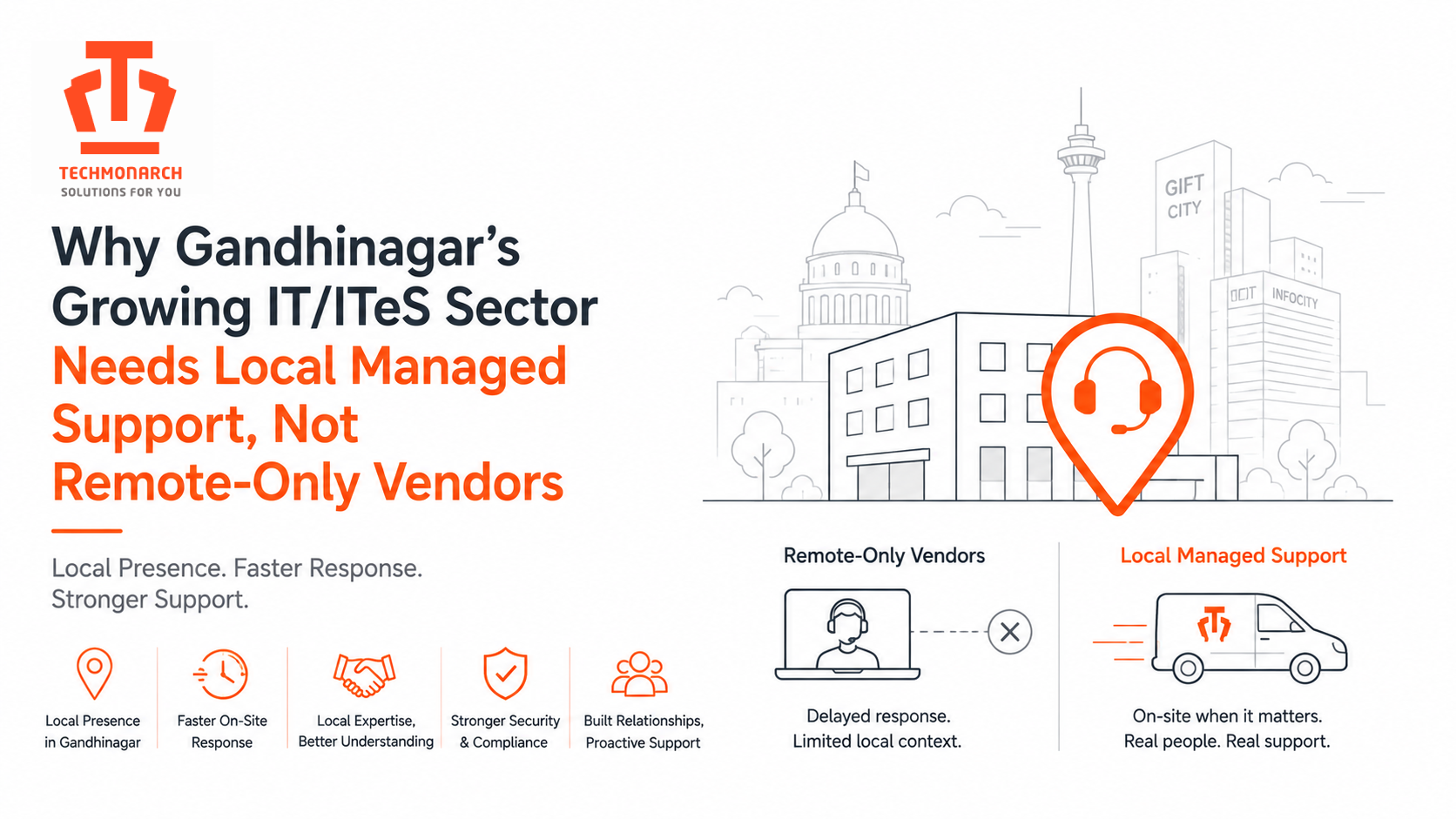
Why Gandhinagar’s Growing IT/ITES Sector Needs Local Managed Support, Not Remote-Only Vendors
Gandhinagar’s IT/ITeS story has quietly shifted over the last few years. What used to be a city known mainly for its government offices now has TCS running out of the Garima Park campus, GIFT City pulling in global tech and fintech names, and Infocity steadily filling up with mid-sized IT and BPO firms. The state’s IT/ITeS policy is chasing a lakh direct jobs by 2027, and hiring data through 2026 has shown BPO/ITES consistently among the faster-growing segments in the region. None of that growth is in question. What’s less discussed is that a lot of the IT support backing these companies is still coming from vendors who’ve never set foot in the building.
That gap matters more in Gandhinagar than it might elsewhere, mostly because of how this city’s IT footprint is actually structured — spread across a government-adjacent core, a fast-filling SEZ, and a set of IT parks that are still, in infrastructure terms, catching up to the pace of the companies moving in.
Remote-only support was built for a different kind of problem
There’s nothing wrong with remote support as a category. The honest number, backed up by most MSPs who track this, is that somewhere around 80 to 90 percent of routine IT issues genuinely can be resolved remotely — patching, monitoring, most software troubleshooting, account and access management. A remote-only vendor handles that slice perfectly well, often at a lower price than a provider who staffs local technicians.
Where it breaks down is the other 10 to 20 percent — the hardware failure in your server room, the network switch that needs physical replacement, the new office that needs someone on-site during a cabling job, or the incident where you genuinely need a technician standing in front of the affected machine rather than talking someone through it over a call. For a Gandhinagar IT/ITeS company, that gap isn’t hypothetical. It shows up during monsoon-related outages, during a GIFT City campus power event, or simply the day a new hire’s laptop refuses to join the domain and remote diagnostics run out of road.
Response time is a business number, not a comfort factor
A remote vendor several states away, or one running a shared queue across hundreds of clients nationally, is not going to reach your Gandhinagar office in the same afternoon. A local partner can. For an IT/ITeS company where downtime translates directly into missed SLAs with clients, that difference in response time isn’t a nice-to-have, it’s a number that shows up in your own service credits and client relationships. Companies operating out of GIFT City or Infocity, where uptime expectations are often set by international clients, feel this most acutely — a four-hour ticket queue doesn’t read the same when your own customer is expecting a two-hour resolution from you.
Local context isn’t optional in this specific market
Gandhinagar’s mix of government-adjacent offices, SEZ campuses, and traditional commercial buildings each come with their own quirks — different access and security norms, different vendor and contractor lead times, different power and connectivity realities depending on which part of the city you’re in. A remote-only vendor working off a generic playbook designed for a metro-city client base tends to miss these specifics entirely, or treats them as edge cases rather than the baseline. A partner actually operating in Ahmedabad and Gandhinagar already knows, for instance, that a secondary ISP link matters more here than it might in a city with denser fibre redundancy, or that GIFT City’s SEZ access norms need to be factored into how an on-site visit even gets scheduled.
This is a large part of why TechMonarch has stayed focused on Ahmedabad and Gandhinagar rather than trying to be a remote-first operation covering the whole country — the value in this market comes specifically from knowing the buildings, the vendors, and the access processes well enough that a support call doesn’t start with explaining the basics.
The relationship compounds in ways a ticket queue doesn’t
There’s also a slower, less measurable advantage to working with a local partner. A provider who visits your office periodically, meets your team, and understands how your specific systems are wired together tends to catch problems before they become tickets — an ageing switch that’s about to fail, a backup job that’s been silently erroring out, a compliance gap that only becomes obvious once someone’s actually looked at your setup in person. A remote-only vendor working purely off monitoring dashboards and ticket volume rarely builds that kind of familiarity, because nothing in their model rewards it. Familiarity like that isn’t something a service-level agreement can fully capture, but it’s usually the difference between a provider who reacts well and one who prevents the problem from reaching you at all.
For a growing IT/ITeS company, this matters at exactly the stage where headcount and client commitments are both increasing faster than internal IT capacity. A local managed partner who already understands your infrastructure can flag a coming problem in a conversation, rather than your team discovering it during an outage.

Compliance and client audits favour a partner who’s actually in the room
IT/ITeS companies in Gandhinagar increasingly deal with client-driven security audits, whether from a domestic BFSI customer or an international client operating out of GIFT City. These audits usually want more than a policy document — they want evidence that access controls, logging, and incident response actually function the way they’re described. A local managed partner who’s physically walked through your server room, checked your access control setup, and sat through a mock incident with your team can speak to that evidence directly. A remote-only vendor working from a dashboard several states away is often reduced to forwarding whatever generic compliance template they use for every client, which rarely survives a serious audit question.
This becomes even more relevant as more Gandhinagar-based IT/ITeS firms start serving clients who themselves operate under regulatory scrutiny. The support model backing your infrastructure ends up, indirectly, becoming part of your own sales pitch to those clients.
A hybrid model, not an either-or
None of this is an argument against remote support — a good local MSP still resolves the bulk of tickets remotely, because that’s genuinely the faster and cheaper path for routine issues. The point is that remote-only isn’t a complete answer for a company operating physical offices, servers, and client-facing SLAs in Gandhinagar’s specific mix of zones. What works is a provider who defaults to remote resolution but has a real, local on-site capability behind it — someone who can be at your office within hours, not days, when the issue actually needs hands on hardware.
As Gandhinagar’s IT/ITeS sector keeps adding companies through GIFT City, Infocity, and the corridor connecting to Ahmedabad, the support model backing these offices needs to keep pace with that growth rather than default to whichever vendor answers the phone fastest nationally. Local managed support, backed by an actual on-site presence in this specific market, tends to be the difference between IT that’s merely monitored and IT that’s genuinely looked after — and for a sector that’s still building its reputation with national and international clients, that difference is worth paying attention to now rather than after the first bad outage.
Recent Posts
- Why IT Vendors in Ahmedabad Take Days to Respond — And What "Managed" Should Actually Mean
- Why More Ahmedabad Companies Are Switching From Freelance IT Support to Managed Partners
- What Ahmedabad Businesses Get Wrong About IT Compliance Under India's DPDP Act
- A Look Inside How We Manage IT Infrastructure for Ahmedabad Businesses Across Industries
- Why Gandhinagar's Growing IT/ITES Sector Needs Local Managed Support, Not Remote-Only Vendors
Recent Comments
- No comments to show