
-
Vijit
- June 15, 2026
- No categories assigned.
- No Comments
A candid look at the structural, operational, and human gaps behind the promise — and what it actually takes to close them.
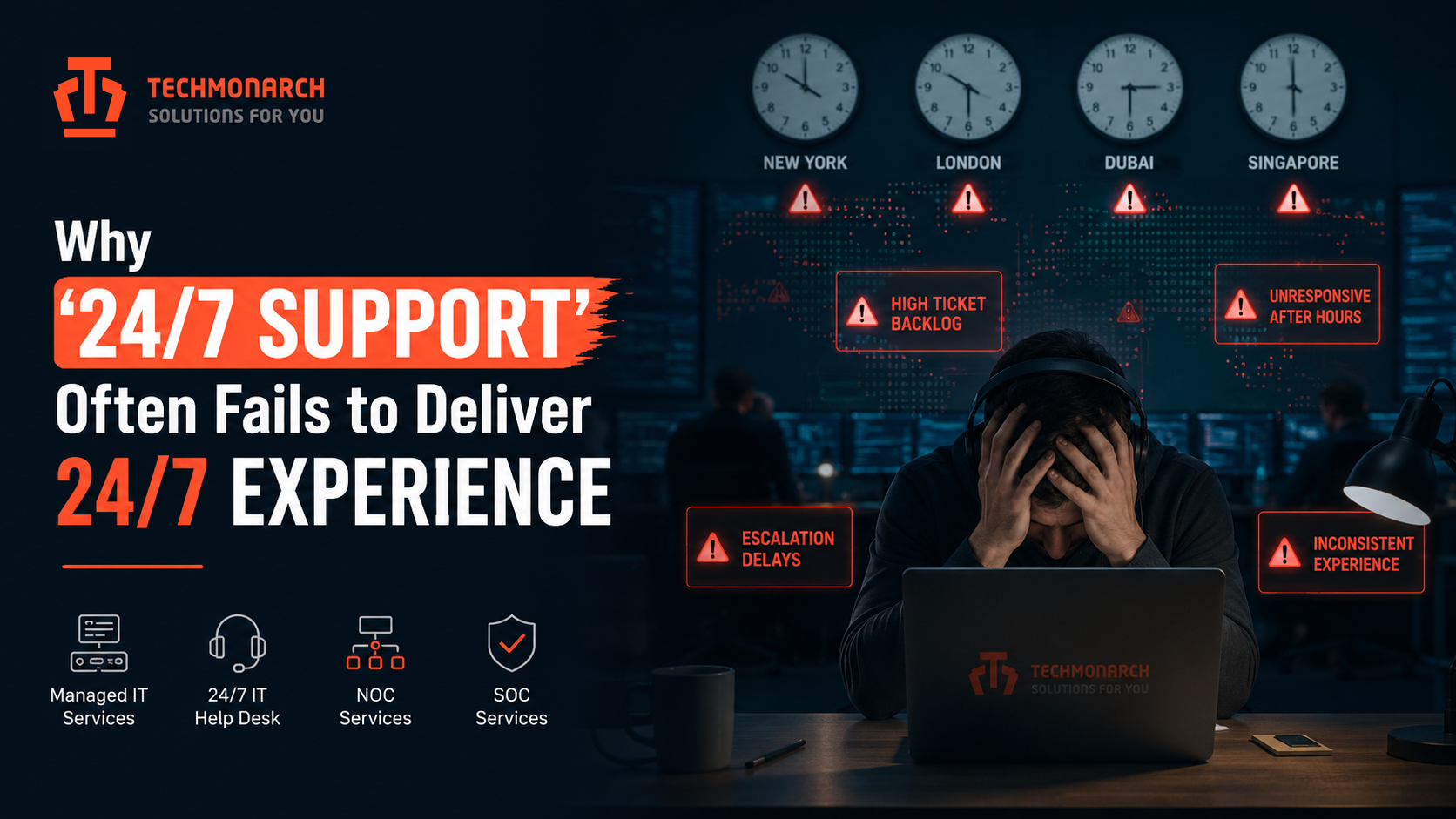
If you have spent any meaningful time in managed IT services, you already know the pitch. Every MSP website, every sales deck, every onboarding call leads with it: 24/7 help desk support, always available, always responsive. It has become the baseline expectation — almost a commodity statement. The problem is that many of the IT professionals who actually work inside these environments, or who sell these services to end clients, privately acknowledge a truth the industry rarely discusses out loud: the number on the page and the experience in practice are often two very different things.
This is not a piece written for the uninitiated. If you are an IT professional with five or more years under your belt — whether you run a help desk operation, manage NOC or SOC delivery, or oversee white-label service partnerships — you have probably already felt the friction this creates. A client calls at 2 AM. A ticket sits unresolved because the only engineer on shift cannot escalate it properly. An SLA clock runs while someone waits for the right person to come online. The promise of 24/7 is intact. The experience is not.
Let us get into why this gap exists, how it manifests operationally, and what distinguishes providers that actually close it from those that simply claim to.
The Availability Illusion: What ’24/7′ Is Usually Built On
The fundamental issue begins with how most MSPs operationalize after-hours coverage. The conventional model relies heavily on one of two approaches: on-call rotations or a reduced-capacity overnight team. Both carry inherent limitations that most service level agreements conveniently sidestep.
On-call rotations, on the surface, feel like a reasonable solution. Engineers take turns carrying the pager, and the promise is that a human being is always reachable. What this model fails to account for is the profound difference between being reachable and being effective. A senior engineer woken at 3 AM after a full shift the day before is not operating at peak capacity. Beyond the cognitive performance issue, there is also the career reality: your most experienced engineers — the ones with genuine diagnostic depth — are rarely willing to sustain overnight availability as a long-term arrangement. The people who end up on pager duty are often the ones who cannot yet push back.
The overnight staffing model presents a different set of problems. Finding qualified technicians who are both competent and willing to work consistent night shifts is genuinely difficult. The talent pool is thinner, turnover is higher, and the skill ceiling of the available candidates skews lower. This means that the complexity of issues that can be resolved after hours is structurally limited — not by policy, but by the reality of who is actually sitting at that desk.
For many mid-sized MSPs, the honest version of 24/7 is a combination of both: a low-tier technician on overnight shift with scripted responses and ticket-logging access, and an on-call senior who will only be contacted if things escalate past a threshold that is, more often than not, defined too conservatively to actually trigger meaningful intervention.
The Tier Problem: When Escalation Paths Are the Bottleneck
Escalation design is where many supposedly 24/7 operations quietly fall apart. The architecture of tiered support — Tier 1 handling intake, Tier 2 handling more complex resolution, Tier 3 or specialized engineers handling critical incidents — works reasonably well during business hours when the full team is present and handoffs are fast. After hours, the tier model begins to bend under its own weight.
Consider the scenario: a P2 incident comes in at midnight. The Tier 1 technician on shift identifies it correctly but lacks the access rights or technical depth to resolve it. The escalation to Tier 2 requires paging someone who may not respond within the SLA window, especially if that engineer has already been paged twice that night. The ticket ages. Automated reminders fire. The client sees a status update that reads “in progress” when nothing substantive is actually happening.
This is the gap between availability and capability. Availability means the phone line is open. Capability means the right person with the right knowledge and the right toolset is actively working on your problem. Most SLAs guarantee the former. The latter is far harder to systematize.
There is also the documentation continuity issue. When a technician who has been working a complex ticket for four hours logs off at shift change, the knowledge accumulated during that session — the diagnostic steps taken, the hypotheses tested, the partial fixes attempted — is rarely transferred with the fidelity it deserves. The incoming engineer starts from a ticket note that says “investigated, escalated” and has to reconstruct context from scratch. For the client, the experience is one of repetition and delay, even if the SLA clock technically shows an acceptable response time.
The Human Bandwidth Problem and What It Costs Everyone
It is worth being direct about the human cost embedded in broken 24/7 models, because this is not just a service quality conversation — it is a staffing and sustainability conversation that directly affects your ability to deliver at all.
Research consistently points to burnout as one of the primary drivers of attrition in IT service environments. When engineers are routinely pulled into after-hours escalations on top of their regular responsibilities, the degradation is predictable: documentation quality drops, response times creep up, proactive suggestions stop, and institutional knowledge walks out the door when people finally leave. More than half of IT professionals report feeling overwhelmed by their daily workload even without the additional pressure of overnight on-call duty. Add the unpredictability of an after-hours pager and the number goes up significantly.
For MSPs that white-label or resell IT services, this creates a compounding problem. If your upstream partner is struggling with staffing continuity, the quality degradation flows directly downstream to your clients — even if the SLA metrics technically hold. Metrics measure what they measure. They do not measure the tone of a midnight call handled by an exhausted technician, or the frustration of a client who got a resolution that was technically correct but communicated poorly.
SLA Language as a Shield, Not a Standard
If you have been on the vendor or client side of an SLA negotiation, you know exactly how flexible this language can be when it needs to be. Response time commitments are defined per severity tier. Severity tiers are defined by the provider. Escalation triggers are set at thresholds that conveniently align with operational limitations rather than client needs. An issue that a client would call “urgent” may be classified as P3 by the support system, meaning it sits in a queue until morning with no meaningful after-hours intervention.
This is not necessarily bad faith on the part of providers — it is often a pragmatic response to the real cost of delivering genuine 24/7 capability. But the disconnect between what clients expect when they sign a contract and what they actually experience when something breaks at 11 PM is one of the most consistent sources of relationship erosion in managed services.
For IT professionals managing client relationships on the front line, this puts you in an uncomfortable position. You are defending a service level that was designed to be defensible, not one that was designed to be excellent. There is a meaningful difference between those two things, and experienced clients eventually learn to tell them apart.
What Genuine Round-the-Clock Delivery Actually Requires
Closing the gap between 24/7 availability and 24/7 experience is not a technology problem — though technology is part of the answer. It is fundamentally a structural and operational challenge that requires deliberate architecture, not just headcount.
The follow-the-sun model, properly executed.
The most operationally sound approach to genuine 24/7 coverage distributes support responsibilities across geographic time zones so that each team is working during their local business hours. This is not the same as having an offshore call center fielding tickets overnight. It means having competent, empowered engineers in different regions who are each working a normal shift — bringing full cognitive capacity to the work because it is not the middle of their night. The challenge is integration: ensuring that knowledge transfers cleanly between regional teams, that tooling is unified, and that the client experience feels seamless regardless of which team is currently on.
Intelligent automation that actually reduces human load.
Automation in overnight support environments is only useful when it is tuned correctly. Alert fatigue — the condition where engineers become desensitized to notifications because the volume of non-critical alerts is too high — is a well-documented failure mode. When every monitoring trigger results in a page, humans start ignoring pages. The goal of automation in a real 24/7 operation is not to create more alerts; it is to intelligently suppress the noise so that human attention is reserved for situations that genuinely require it. RMM platforms that can self-remediate common failure patterns — restarting a service, clearing a disk threshold, cycling a connection — reduce the overnight ticket volume to the genuinely complex incidents that need human judgment.
Escalation paths with real teeth.
Escalation that works is escalation that is documented, enforced, and tied to actual access and authority. A Tier 1 technician who identifies a P1 incident should have a clear, frictionless path to a Tier 2 or Tier 3 engineer — not a suggestion to send an email and wait. Escalation protocols need to account for time-to-respond, not just time-to-notify. And senior engineers need to be part of an on-call structure that is fair enough to sustain without burning through your best people.
Documentation as an operational discipline.
Shift handoffs are one of the most underengineered aspects of 24/7 operations. If the engineer coming on at 8 AM cannot get fully up to speed on overnight activity within five minutes of sitting down, your documentation practices need work. Good ticket notes are not a soft skill — they are an operational requirement. Every handoff that requires a verbal briefing is a handoff that will sometimes fail because someone is not available or reachable at the exact moment they are needed.
For MSPs that want to stop building this infrastructure from scratch, white-label partnerships are increasingly the practical answer. Providers like Techmonarch (techmonarch.com) are built specifically to extend MSP delivery capability — offering white-label help desk, NOC, and SOC services that allow smaller and mid-market MSPs to offer genuine 24/7 coverage under their own brand without the overhead of building and maintaining a global staffing model themselves.
The Client Perception Layer Nobody Talks About
Even when the operational elements are reasonably well-constructed, there is a perception layer that most 24/7 discussions ignore entirely. A client who calls at 2 AM and reaches a competent engineer who resolves their issue in 20 minutes will have a fundamentally different experience from a client who calls the same number, reaches someone who sounds scripted, and hears the phrase “I’ve logged this for our team and you should hear back shortly” — even if both scenarios are technically within SLA.
This matters because managed IT relationships are trust relationships. Clients do not evaluate their MSP on a monthly metrics review — they evaluate it on the three or four moments when something went wrong and how it felt to get through it. A bad 3 AM experience, even a single one, can undo months of solid performance. And if that experience is repeated, the conversation shifts from service review to contract review.
The practitioners who understand this most clearly are usually the ones who have been on the receiving end — either as clients themselves, or as the person who had to apologize on Monday morning for what happened over the weekend. Experience does not let you abstract away the human element of a support failure.
Where the Industry Is Heading
The structural limitations of traditional 24/7 models are not new observations. What is new is the degree to which the market is forcing a reckoning with them. Client expectations have been recalibrated by consumer-grade service experiences. Remote work has expanded the window during which incidents can occur. Compliance requirements in sectors like healthcare and financial services are increasingly prescriptive about incident response timelines — and those timelines do not flex because it happens to be a Saturday.
The MSPs that will win the next several years are not those who offer 24/7 in the marketing material — everyone does that already. The ones who will differentiate are those who can demonstrate genuine operational depth after hours: consistent escalation quality, clean shift handoffs, engineers who actually know what they are doing at midnight, and the kind of client experience that does not distinguish between 9 AM on a Tuesday and 3 AM on a Sunday.
The path to that outcome runs through better operational design, smarter use of white-label partnerships, and an honest internal audit of where your current after-hours delivery actually stands — not where your SLA says it stands.
Closing Thoughts
The gap between a 24/7 promise and a 24/7 experience is real, it is widespread, and it is not primarily a technology problem. It is a problem of staffing models, escalation architecture, documentation discipline, and organizational honesty about what is actually being delivered after hours.
For IT professionals who have seen both sides of this — who have managed a help desk at 2 AM with one technician and a prayer, and who have also sat across the table from a client asking why their critical issue sat unresolved for four hours overnight — the question is not academic. It is operational, and it has a direct line to client retention, team sustainability, and the long-term credibility of your service delivery.
Promising 24/7 is easy. Delivering it — genuinely, consistently, at the quality level that actually builds client trust — requires a level of operational seriousness that the industry has not always demanded of itself. That is starting to change. The question is whether your operation is changing with it.
Recent Comments
- No comments to show