
-
Vijit
- July 16, 2026
- No categories assigned.
- No Comments
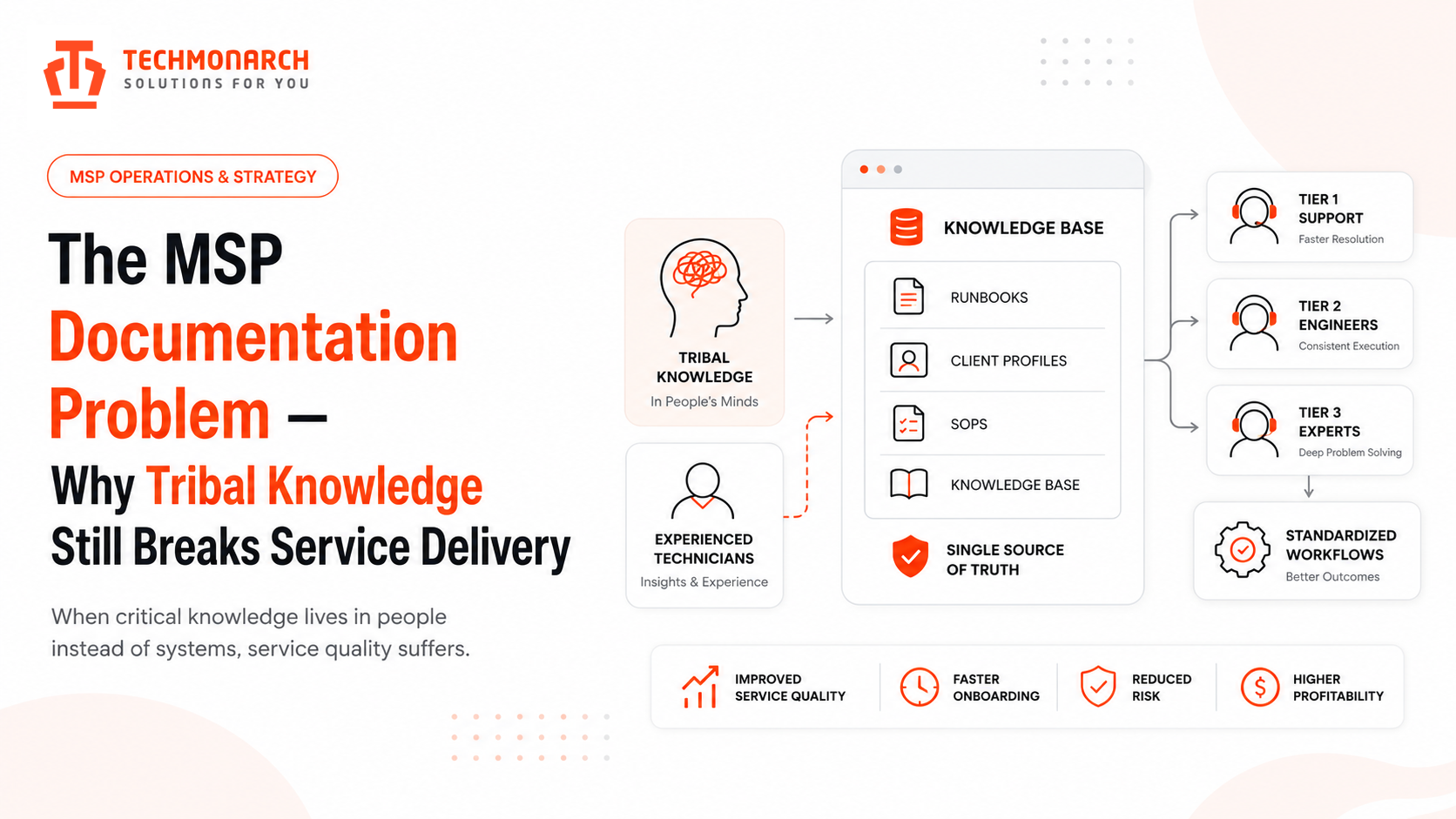
The MSP Documentation Problem — Why Tribal Knowledge Still Breaks Service Delivery
Every MSP that has been operating for more than three years has a documentation problem. The shape of that problem varies, but the core of it is almost always the same: critical operational knowledge is concentrated in a small number of people, and the organization has structured itself around those people rather than around systems that survive their absence.
This is what most of the industry refers to as tribal knowledge — the accumulated understanding of client environments, recurring issue patterns, escalation preferences, and configuration quirks that experienced technicians carry in their heads rather than in any retrievable format. It works well enough when those technicians are present, available, and engaged. It fails comprehensively when they are not.
The failure modes are well understood at a conceptual level. What is less understood — and what causes the problem to persist despite widespread acknowledgment — is why documentation efforts fail so consistently in MSP environments, and what the organizational conditions are that allow tribal knowledge to remain the operational default even in practices that have invested in documentation tooling. The answer is not a technology deficit. It is a structural one.
What Tribal Knowledge Actually Costs
The cost of undocumented knowledge in managed services is routinely underestimated because it distributes itself invisibly across multiple operational outcomes. It shows up in extended resolution times when the technician who knows a client environment is unavailable and a colleague has to reconstruct context from scratch. It shows up in inconsistent service quality when two technicians approach the same recurring issue differently because no standard resolution path exists. It shows up in extended onboarding timelines when new hires spend weeks or months shadowing colleagues rather than working from documented procedures. And it shows up most acutely when a senior technician leaves and takes an irreplaceable library of client-specific knowledge with them.
Research from IDC estimates that organizations collectively lose tens of billions of dollars annually from inadequate knowledge sharing — and that figure scales with headcount in ways that are particularly relevant to growing MSPs. A practice with 20 technicians where each spends 30 minutes per shift searching for or reconstructing information they should be able to look up is losing over 3,000 hours per year to documentation gaps alone. That is the equivalent of roughly one and a half full-time employees, consumed not by productive work but by the friction cost of knowledge inaccessibility.
The 2026 Kaseya State of the MSP Report documented a measurable year-over-year increase in the percentage of MSPs struggling to create and maintain consistent client documentation — from 10 to 17 percent in a single year. That directional trend matters because it suggests the problem is not being solved by the natural maturation of the industry. It is getting worse as client environments grow more complex and as the body of knowledge required to service them expands faster than documentation disciplines can capture it.
Why Documentation Efforts Fail Structurally
Most MSPs that struggle with documentation have tried to fix it. They have purchased documentation platforms, mandated knowledge base contributions, run documentation sprints, and assigned ownership to specific team members. The results are typically the same: initial improvement followed by gradual decay as operational pressure reasserts itself and documentation falls behind the pace of change in client environments.
The structural reason documentation efforts fail is that they treat documentation as a separate activity rather than integrating it into the resolution workflow. When a technician closes a ticket, the documentation step — if it exists at all — is something that happens after the work is done, when cognitive attention has already moved to the next task. That sequence produces sparse, low-quality documentation that captures the what of a resolution without the why, the edge cases, or the client-specific context that makes the documentation actually useful to the next person who encounters the same issue.
The second structural failure is ownership ambiguity. When documentation is everyone’s responsibility, it is effectively no one’s. Individual technicians contribute inconsistently because contribution is voluntary and the feedback loop between documentation quality and personal performance is invisible. There is no mechanism that connects a technician’s documentation behavior to downstream outcomes — the faster resolution time experienced by a colleague who found a well-written runbook, the shorter onboarding ramp for a new hire who had access to accurate client profiles, the incident that was contained quickly because the escalation procedure was written down clearly.
The third structural failure is staleness. Documentation that was accurate when it was written but has not been updated through infrastructure changes, configuration migrations, or client environment evolutions is not just unhelpful — it actively misdirects the technicians who rely on it. An outdated network diagram or a runbook that references deprecated tools creates false confidence and produces incorrect troubleshooting paths. A knowledge base that cannot be trusted is not used, and a knowledge base that is not used receives no updates, completing a cycle of decay that is very difficult to reverse once established.
The Tier Boundary Is Where Documentation Gaps Hurt Most
Documentation failures are distributed across MSP operations, but their most acute impact concentrates at the escalation boundary between Tier 1 and Tier 2 support. That boundary is where institutional knowledge is most frequently assumed and least frequently transferred, and where its absence produces the clearest operational consequence: extended time-to-resolution and client-visible inconsistency.
A Tier 1 technician handling a client issue is working from whatever context is available to them — the ticket notes, the client’s description of the problem, and whatever they can retrieve from the knowledge base or recall from previous experience. When the knowledge base does not contain a documented resolution path for the issue type, or when the client’s environment is not accurately profiled, that technician faces a choice: spend time reconstructing context independently, escalate earlier than they should and consume Tier 2 capacity unnecessarily, or make a decision based on incomplete information and risk an incorrect resolution.
All three outcomes produce worse results than a well-documented environment would have enabled. The first adds resolution time. The second misallocates senior engineer capacity. The third produces client-visible failures. And because these outcomes are not attributed to their root cause in any systematic way, they are experienced as technician performance issues rather than documentation infrastructure failures — which means the response tends to be coaching or staffing changes rather than the documentation investment that would actually address the problem.
Client Environment Documentation as Operational Infrastructure
The documentation that has the highest operational value in MSP environments — and the documentation that is most consistently inadequate — is client environment documentation. This includes network topology and device inventories, configuration baselines, recurring issue patterns and their documented resolutions, escalation contacts and preferences, SLA terms and their operational implications, and change history that allows technicians to understand why an environment is configured the way it is, not just how it is configured.
Most MSPs have some version of this documentation. The gap is not typically in the existence of client documentation but in its accuracy, completeness, and accessibility. A network diagram that was accurate at client onboarding two years ago and has not been updated through three infrastructure changes, a device inventory that reflects purchased hardware but not actual deployed configuration, a contact list with three email addresses that no longer route correctly — these are the documentation artifacts that exist in most MSP environments, and they create more operational confusion than no documentation would, because they establish false baselines that technicians rely on until a failure event reveals the inaccuracy.
The operational standard that mature documentation practices aim for is a client environment record that any technician in the organization — including one hired last week and one who has never worked on that client — can use to get productive on an incident within minutes, without requiring input from anyone who has previously worked on that environment. That standard sounds obvious. Achieving it requires a documentation discipline that most MSPs have not built into their operational workflow, because building it requires treating documentation not as a deliverable but as infrastructure that needs maintenance on the same cadence as the technical environments it describes.
Making Documentation Stick Operationally
The practices that produce durable documentation improvements share a common characteristic: they reduce the friction of contributing accurate documentation rather than increasing the expectation that technicians will overcome that friction through discipline alone.
The most effective mechanism is integrating documentation into the ticket closure workflow as a non-optional step. Not a checkbox — a structured completion requirement. If a technician resolves an issue using a resolution path that is not currently documented, closing the ticket requires either creating or updating the relevant knowledge base article. If they resolved it using an existing article, the workflow should capture whether the article was accurate and useful, which generates feedback on documentation quality without requiring a separate review process. This mechanism is not new — it mirrors practices that have proven effective in software development and ITIL-aligned service management — but it is inconsistently implemented in MSP environments where ticket closure pressure tends to override documentation quality requirements.
The second effective practice is explicit documentation ownership at the role level. Client environment documentation should have an assigned owner who is accountable for its accuracy. That owner is not responsible for writing every document — they are responsible for ensuring that documentation is updated when environments change and that staleness is flagged and corrected. This is a meaningful accountability shift from the common model where documentation ownership is collective and therefore functional.
Review cadence is the third component. Operational SOPs and runbooks should be reviewed at minimum quarterly. Client environment documentation should trigger a review after every infrastructure change, major incident, or client migration. The strongest version of this practice builds documentation review into the post-incident workflow — after any Tier 3 escalation or P1 incident, part of the resolution process is auditing the relevant documentation for accuracy and updating it to reflect what was learned. That post-incident discipline is where the most valuable institutional knowledge gets captured, because high-severity incidents tend to expose precisely the knowledge gaps that matter most.
Documentation and the White-Label Partner Relationship
For MSPs that leverage white-label NOC, help desk, or SOC services, documentation quality has an additional dimension: it directly determines how effectively a partner team can service client environments without constant escalation back to the MSP’s internal staff. A white-label NOC operating with incomplete client environment documentation is not just less effective — it generates more escalations, longer resolution times, and more client-visible service inconsistency than a well-documented engagement would produce.
The documentation handoff at the start of a white-label engagement is therefore one of the highest-leverage operational investments an MSP can make. Client environment profiles, escalation procedures, SLA terms, known issue libraries, and network documentation that is accurate and maintained should be a deliverable in the onboarding process, not an aspiration. Providers like Techmonarch operationalize this expectation from the engagement outset — the partner documentation transfer is a structured milestone, not a background assumption — because both parties’ operational performance depends on the quality of the knowledge that flows across the organizational boundary.
MSPs that treat documentation investment as something that primarily benefits their internal team are leaving a significant portion of that investment’s value unrealized. Well-maintained client documentation compounds in value every time a new technician joins the team, every time an escalation is avoided because a resolution path was findable, and every time a partner team can service a client environment without requiring internal engineering involvement for context they should already have.
The Organizational Discipline Beneath the Tool Choice
The documentation platform an MSP chooses matters far less than the operational disciplines built around it. A practice with strong documentation habits will produce useful, maintained knowledge assets on a basic shared drive. A practice with weak documentation habits will produce an expensive, underutilized knowledge management platform full of stale articles that nobody trusts.
The disciplines that matter are the ones described above — workflow integration, role-based ownership, mandatory review cadence, and post-incident capture. None of them are technically complex. All of them require organizational commitment to maintaining them under the operational pressure that is the normal state of a growing MSP. That pressure is the real reason tribal knowledge persists. It is not because MSP operators do not understand the value of documentation. It is because documentation quality degrades faster than it is maintained when documentation is treated as optional work, and the organizational pressure to make it non-optional has not been applied consistently enough to overcome the default.
The practices that produce durable improvement all share the same underlying logic: make the correct behavior the path of least resistance, not a discipline that competes with operational urgency. When documentation is embedded in the workflow rather than appended to it, and when accuracy is maintained by assigned owners rather than hoped for from the collective, the knowledge base becomes the asset it is designed to be — not a repository of what was once true, but a living record of what is currently known.
Recent Comments
- No comments to show