
-
Vijit
- June 22, 2026
- No categories assigned.
- No Comments
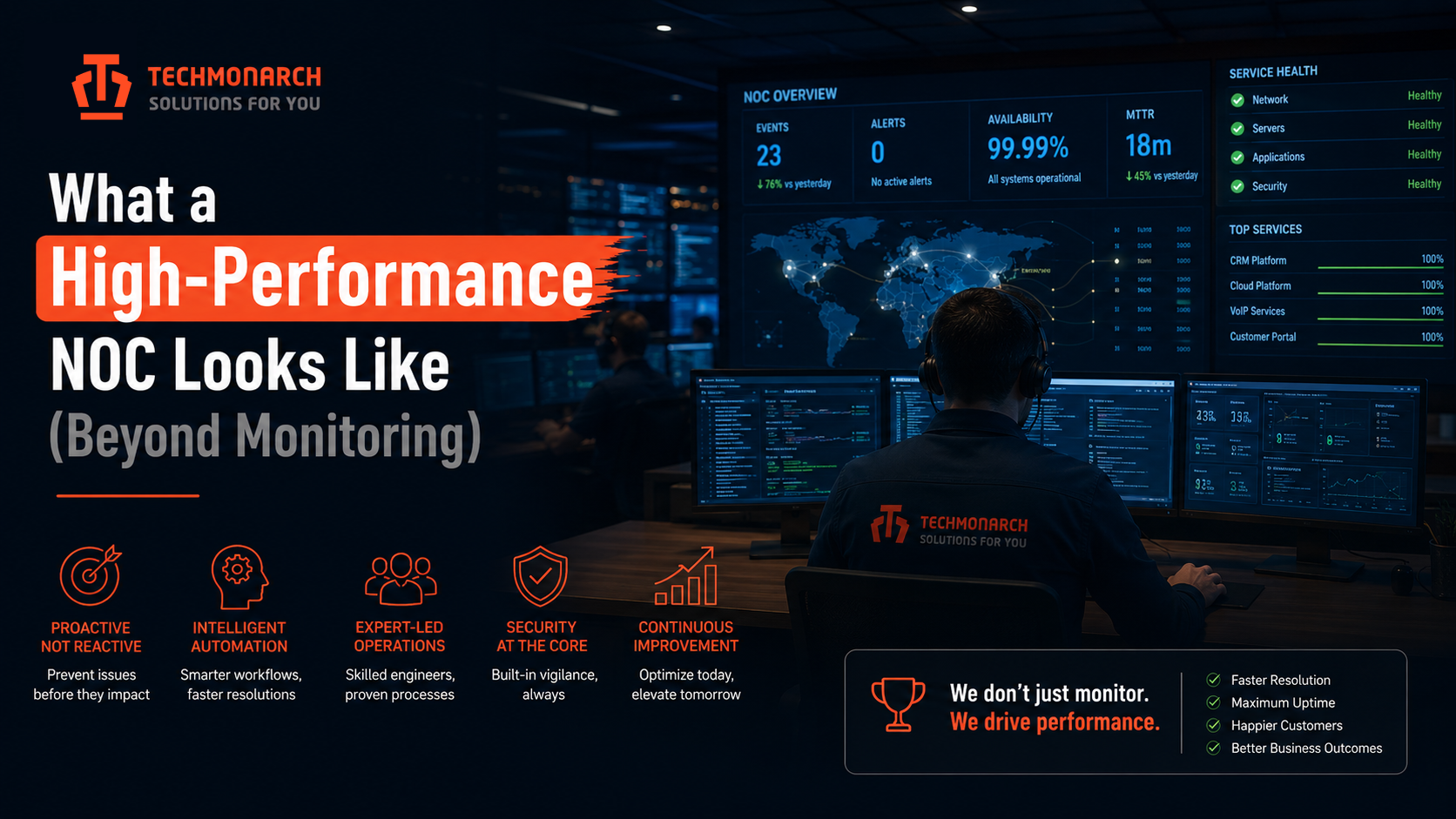
The monitoring dashboard is the starting point, not the finish line. Here is what separates a NOC that watches infrastructure from one that actually protects it.
If you ask most IT leaders what a NOC does, the answer is some variation of the same thing: it monitors the network. Watches the dashboards. Responds to alerts. Keeps things running. That description is accurate, and it is also insufficient. Because a NOC that only monitors — one whose operational identity begins and ends with watching dashboards and fielding tickets — is running at a fraction of the value it could be delivering.
For IT professionals with serious time in this field, the distinction between a NOC that monitors and a NOC that performs is not subtle. You can feel it in the escalation patterns, in the shift handoffs, in the post-incident reviews, and in the quiet absence of problems that never became incidents because someone saw them coming three days before they arrived. High-performance NOC operations share a set of characteristics that extend well past the monitoring layer — and understanding those characteristics is the difference between building something that sustains and building something that treads water.
Reactive Versus Predictive: The Fundamental Operating Mode Difference
The baseline NOC operates reactively. Something breaks, an alert fires, a technician investigates. This is the floor — the minimum viable version of network operations. It is also the most expensive version, because every incident that reaches the reactive stage has already cost someone something: downtime, degraded user experience, engineering hours, client trust.
High-performance NOCs operate with a fundamentally different posture. They are looking for the conditions that precede failures, not just the failures themselves. Disk utilization trending upward at a rate that will cross the threshold in 72 hours is not an alert — it is a signal. A network interface error rate that has doubled over four consecutive overnight monitoring windows is not an incident — it is a pattern. The ability to read those signals and act on them before the downstream event occurs is what separates proactive operations from reactive ones, and it requires two things that monitoring dashboards alone cannot provide: historical context and the process discipline to act on trends rather than waiting for thresholds.
This is not primarily a technology gap. Most modern RMM and monitoring platforms surface trending data. The gap is operational: teams that have embedded a review process for trend analysis — who looks at it, how often, and what the decision criteria are for acting on a trend — versus teams that react to what the dashboard shows in the present moment.
Incident Management as an Engineering Discipline
The way a NOC handles incidents — from detection through resolution and post-incident review — reveals more about its operational maturity than any toolset configuration. In mediocre NOC operations, incident management is a workflow. Ticket opens, engineer investigates, ticket closes. In high-performance operations, it is a discipline with engineering depth at every stage.
The triage stage matters more than most teams give it credit for. The quality of initial triage — the speed and accuracy with which an incoming incident is classified by severity, mapped to a client environment, matched against known patterns, and routed to the appropriate resource — determines almost everything that follows. Poor triage sends a P1 incident through a P3 queue. It routes a storage issue to a network engineer. It fails to correlate a new ticket with an open incident from the same root cause. The accumulative cost of triage errors over a week of NOC operations is significant, and it is almost never measured.
Root cause analysis — proper RCA, not the abbreviated post-mortem that gets filed so the ticket can close — is another marker of operational maturity. A NOC that resolves an incident without understanding why it occurred will resolve the same incident again next month. Teams that treat RCA as an operational obligation rather than optional documentation build institutional knowledge that compounds over time. Known failure patterns get documented. Runbooks get written and maintained. Engineers at Tier 1 close issues that previously required Tier 3 intervention because the knowledge transfer actually happened.
Capacity Planning and Infrastructure Foresight
A high-performance NOC contributes meaningfully to infrastructure planning conversations — not just infrastructure maintenance conversations. This requires the NOC to own and analyze utilization data in a way that produces forward-looking insight rather than backward-looking reports.
Bandwidth utilization trends, storage consumption curves, CPU load growth patterns over rolling 90-day windows — these are the data points that allow a NOC to surface a capacity constraint before it becomes a service degradation event. For MSPs serving clients who are scaling, this is genuinely valuable input into account management conversations. A NOC that can tell a client’s account manager, six weeks in advance, that their primary file server will need additional storage capacity before the end of the quarter is not just avoiding a problem — it is demonstrating operational depth that strengthens the service relationship.
This level of contribution requires two operational prerequisites: a NOC that is empowered to communicate findings upward into account management and engineering teams, not just downward into the ticket queue; and the analytical process infrastructure to actually review utilization trends on a meaningful cadence rather than waiting for a threshold to fire.
Knowledge Management as a Competitive Differentiator
Institutional knowledge is the most undervalued asset in most NOC operations, and the most poorly managed. The typical pattern: a senior engineer develops deep familiarity with a specific client environment over months of working incidents. That knowledge lives in their head. When they leave — and in IT operations, turnover is a reality — the knowledge leaves with them. The next engineer assigned to that client starts from near-zero context and spends weeks reconstructing what should have been documented.
High-performance NOCs treat knowledge management as an operational responsibility, not an administrative one. Every incident resolved contributes something to the knowledge base. Every runbook reflects the current state of the client environment it covers. Every post-incident analysis produces documentation that the next engineer can actually use. This does not happen accidentally — it requires explicit process expectations, time allocated for documentation, and a culture that treats the act of capturing knowledge as professionally equivalent to the act of resolving the incident.
The downstream effects of mature knowledge management are visible at every tier. Tier 1 resolution rates improve as documented procedures become comprehensive enough to handle a wider range of incidents without escalation. Mean time to resolve improves as engineers spend less time reconstructing context and more time acting on it. Onboarding time for new engineers compresses when the knowledge base is genuinely useful rather than aspirationally maintained.
Communication Architecture Inside and Outside the NOC
The internal communication quality of a NOC operation is a reliable proxy for its overall maturity. How shift handoffs are conducted, how escalations are structured, how engineering context is transferred between tiers — these are communication design problems as much as they are technical ones.
Shift handoff is the most chronically underengineered process in NOC operations. In practice, it is often a brief verbal exchange between a departing engineer and an arriving one, supplemented by ticket notes of variable quality. The incoming engineer is then expected to reconstruct the state of overnight operations from whatever residue those notes contain. In environments handling dozens of concurrent incidents across multiple client environments, the information fidelity of this process is rarely adequate. High-performance operations have formalized handoff procedures: a structured summary of open incidents, active investigations, and time-sensitive items; documented context on anything that has not reached resolution; and a clear transfer of ownership that both parties can confirm.
External communication — client-facing status updates during incidents — is the other dimension where NOC operations either build or erode trust. A client who receives a clear, factual update fifteen minutes into an incident, followed by another at the one-hour mark with an updated estimated resolution time, experiences a fundamentally different service interaction than a client who hears nothing until the ticket closes. The content of these updates matters less than the consistency and clarity of the communication cadence. Most clients understand that complex incidents take time to resolve. What damages relationships is the silence that makes them feel like an afterthought during the critical window.
For MSPs that want to extend the capabilities described above without building an entirely new operational layer, white-label NOC partnerships offer a practical path. Techmonarch (techmonarch.com) provides white-label NOC services purpose-built for the MSP channel — handling monitoring, triage, first-level remediation, and escalation management under the partner’s brand, with the documentation discipline and client communication protocols that high-performance operations require.
Metrics That Reveal Operational Health, Not Just SLA Compliance
SLA compliance metrics tell you whether you are meeting the contractual floor. They do not tell you whether your operation is healthy, improving, or quietly accumulating risk. High-performance NOCs track a wider set of metrics — and more importantly, they review them with enough analytical depth to distinguish between a metric that looks acceptable and one that is trending toward a problem.
Tier 1 resolution rate is one of the most informative operational metrics available. If your Tier 1 engineers are closing 35% of incidents without escalation, and that number has held steady for six months, you have a knowledge management problem — the runbooks and documented procedures are not keeping pace with the incident types landing in the queue. If that number is 65% and climbing, you have a training and documentation model that is working. First-contact resolution rate tells a similar story for client-facing interactions: how often does the issue get resolved in the initial engagement versus requiring a follow-up?
Mean time to detect is often overlooked in favor of mean time to respond and resolve, but MTTD is where many NOC operations have their largest unexamined gap. The time between when an infrastructure condition becomes problematic and when the NOC first identifies it is the window during which client environments are degrading without intervention. Monitoring configurations that are too coarse, thresholds that are set too conservatively, or gaps in coverage of certain infrastructure types all show up in MTTD before they show up anywhere else.
Utilization metrics — the distribution of incident types, the peak load windows, the client environments generating disproportionate ticket volume — are the data that drive staffing decisions, process improvements, and client-level conversations about infrastructure investment. Without them, NOC operations are making resourcing decisions based on intuition rather than evidence.
The Human Layer: Skill Development and Retention
Every characteristic of a high-performance NOC described above depends, ultimately, on people who are capable, engaged, and present. This is obvious in the abstract and consistently underinvested in practice. The staffing model for a NOC operation is not just a headcount calculation — it is a deliberate decision about what skill levels are required at each tier, how engineers will develop from one tier to the next, and what the organization is doing to make the work sustainable enough that experienced people stay.
Structured tier progression — clear criteria for what it means to advance from Tier 1 to Tier 2, with training pathways and mentorship that make that advancement realistic — reduces attrition and builds internal capability. Engineers who can see a professional development path are more likely to remain in the role long enough to accumulate the contextual knowledge that makes them genuinely valuable. Engineers who feel like they are running in place — handling the same categories of tickets indefinitely with no path toward more complex work — leave, and the institutional knowledge goes with them.

The Operational Identity Question
There is a question worth asking of any NOC operation, including your own: does this function see itself as a monitoring function or as a protection function? The distinction sounds semantic but it shapes almost everything downstream — what the team measures, what it prioritizes, how it communicates, how it uses the data it generates, and how it thinks about its own value within the broader service delivery organization.
A monitoring function watches. A protection function acts — proactively, with foresight, with the kind of institutional knowledge and communication discipline that keeps clients from ever having to feel the full weight of an infrastructure failure. The tools for both are largely the same. The operational culture, the process architecture, and the professional standards are not.
High-performance NOCs are protection functions. Building one requires engineering the operation with the same deliberateness you would bring to designing the infrastructure it monitors. That investment pays back in client retention, in reduced escalation burden on senior engineers, in fewer after-hours incidents, and in the kind of service delivery reputation that generates referrals rather than renewal anxiety.
Recent Comments
- No comments to show