
-
Vijit
- August 6, 2026
- NOC
- No Comments
Serving Multi-Time-Zone Clients — How National MSPs Structure Follow-the-Sun Support
Why coverage on the org chart and coverage in practice are two different problems.
Most MSPs don’t set out to build follow-the-sun support. It arrives by accretion — a client opens a second office in a different time zone, another acquires a company three hours west, a third starts hiring remote staff on the opposite coast, and suddenly your single-shift help desk is fielding after-hours tickets nobody scheduled for. By the time leadership decides to formalize “24/7 coverage,” the informal version has usually already been running for months, badly.
This isn’t a piece on why round-the-clock support matters — you’ve lived the 2 a.m. page. What’s worth examining is the distinction between two things that look identical from a staffing chart but behave very differently in production: distributed coverage, where someone is technically online at every hour, and true follow-the-sun, where ticket ownership actively transfers between regional teams with context intact. Most MSPs think they’re running the second one. Most are actually running the first, and the gap between them is exactly where SLAs quietly fail.
Coverage theater vs. the real thing
It’s worth being precise about the difference, because the two get conflated constantly. Distributed collaboration — multiple regions working in parallel with largely independent queues — isn’t follow-the-sun. Neither is a straightforward night-shift rotation, nor an on-call layer that pages a single engineer for emergencies. Those are all legitimate coverage strategies, but they solve a different problem than follow-the-sun does. Follow-the-sun is specifically about single-owner, daily baton-passing: a ticket has one accountable owner at any given moment, and that ownership transfers deliberately, with an evidence packet, at defined handoff points. If your model amounts to “whoever’s awake picks it up,” you have availability, not follow-the-sun — and the failure modes are different enough that it’s worth knowing which one you’re actually running before you promise a client 24/7 continuity.
Where the model actually breaks
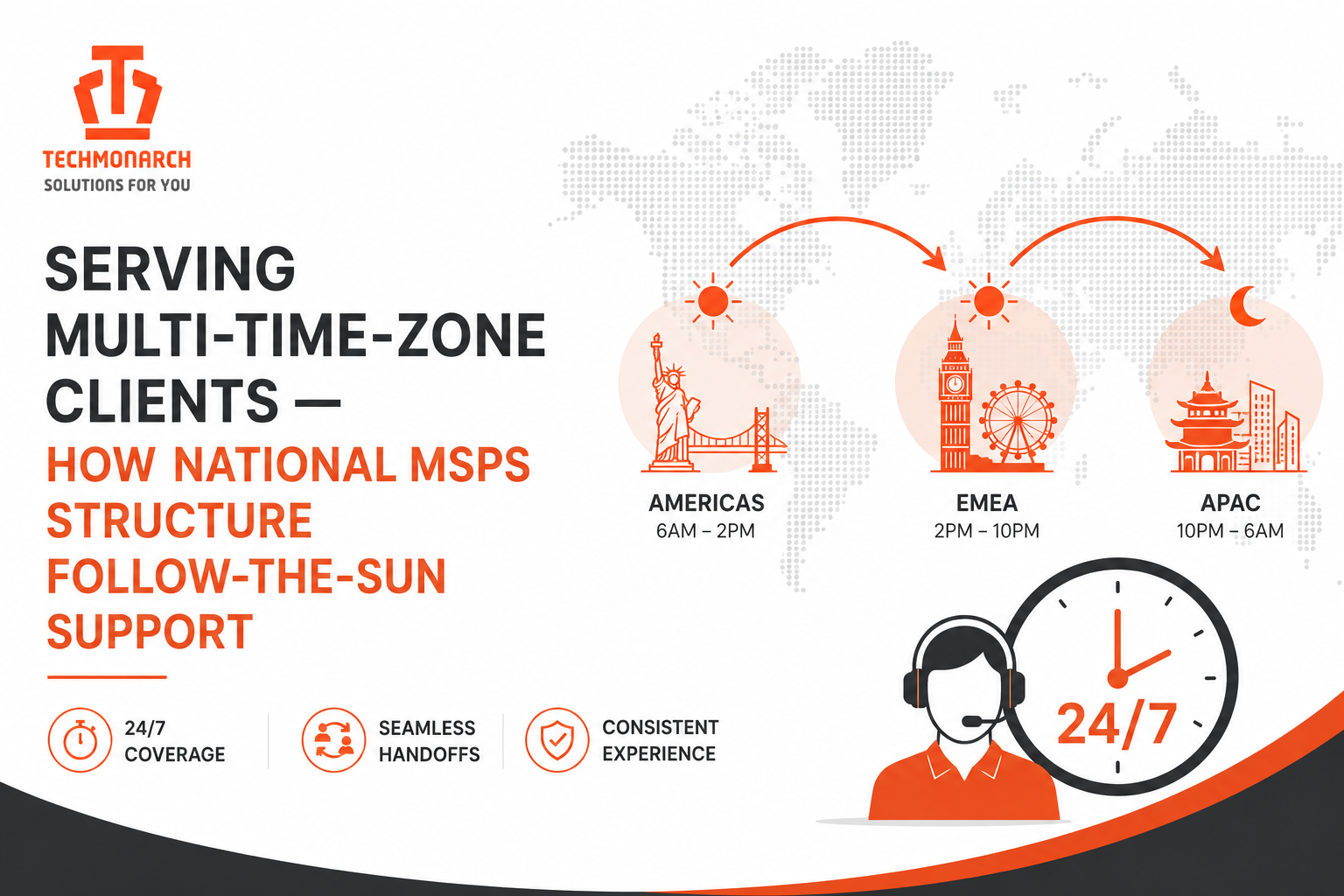
The mapping exercise — Americas, EMEA, APAC, staggered eight-hour blocks — is the easy part. Every MSP that’s tried this has the time zone spreadsheet. What separates the shops that run this well from the ones that generate a steady trickle of client complaints is almost never the shift map. It’s the handoff.
The handoff packet, not just the handoff meeting
A verbal sync between outgoing and incoming shift leads feels like due diligence, but it doesn’t scale past a handful of tickets, and it leaves zero audit trail for the tickets that don’t get mentioned. What holds up under volume is a structured handoff packet attached to every open ticket at shift boundary: current status, actions already taken, what’s been ruled out, and — critically — a single explicit next action with an owner. Teams that skip the “next action” line are the ones where a ticket sits untouched for six hours because each incoming engineer assumed someone else had already picked it up. That one line is disproportionately responsible for whether a handoff actually works.
Overlap windows are not optional buffer time
A 30-to-60-minute overlap between outgoing and incoming shifts is standard practice for a reason: it’s the only point in the cycle where a live conversation can happen instead of a documentation review. Cutting this window to save headcount hours is one of the most common false economies in follow-the-sun design — it looks like a cost saving on a staffing model and shows up two weeks later as a spike in reopened tickets and duplicate troubleshooting, because the incoming team is reconstructing context from notes instead of asking a question directly.
One ticketing system, full stop
This one is almost too obvious to state, and yet it’s still the most common structural failure in MSPs that inherited follow-the-sun through acquisition or rapid regional hiring: a PSA instance in one region, a different helpdesk tool in another, and a manual export-and-reimport process bridging them at shift change. Every field that doesn’t map cleanly between systems is a piece of ticket history that quietly disappears at the handoff. If a regional team can’t see the full case history in real time, in the same platform, follow-the-sun degrades into three separate support desks that happen to share a client.
Escalation paths that survive a time zone crossing
A severity-1 escalation that lands eleven minutes before shift change is the scenario that actually tests a follow-the-sun model, and it’s the one most coverage plans never simulate. Escalation rules, paging hierarchies, and decision rights need to be defined explicitly enough that they don’t depend on which region happens to be online when the incident starts. If your EMEA team routinely hesitates to take ownership of an escalation that your Americas team considers routine, that’s not a personnel problem — it’s a sign the escalation matrix was never actually standardized, just assumed to be understood.
Sizing the model to the demand, not the org chart
Before building out a third region, it’s worth pulling the actual hourly ticket volume data rather than assuming global clients mean globally distributed demand. If ninety percent of a client base’s tickets land inside a six-hour window, a full three-site follow-the-sun rollout is solving a problem that mostly doesn’t exist and adding handoff risk for no operational return. A two-site model — fewer handoffs, simpler governance — is often the better fit for MSPs whose client footprint spans two or three time zones rather than a genuinely continuous global spread. The honest first question isn’t “where do we already have staff,” it’s “when does demand actually require someone online, and what kind of response does it require at that hour.”
Where automation actually earns its keep
AI-assisted case summarization has become genuinely useful for this specific problem — not as a novelty, but because it removes the single biggest point of handoff failure: an outgoing engineer who’s tired at the end of a shift writing a rushed, incomplete note. Auto-generated structured summaries — issue, status, actions taken, next step — give the incoming team something more reliable than a hand-typed note under time pressure, and they create a consistent format regardless of which engineer is closing out the ticket. Automated routing based on skill tags and current regional load helps too, but it’s worth remembering that automation formalizes a process — it doesn’t replace the underlying decision about who owns what, when.
This is the layer where a white-label NOC and SOC partner tends to add the most practical value for MSPs building out multi-region coverage without standing up three separate physical desks — TechMonarch’s model leans on exactly this kind of standardized, always-on shift structure so partner MSPs can offer continuous coverage under their own brand without absorbing the overnight staffing and retention costs directly.
The holiday calendar nobody plans around until it bites
One planning gap shows up constantly in MSPs that adopted follow-the-sun quickly: regional holiday calendars aren’t cross-referenced against each other. An EMEA team out for a national holiday and an APAC team observing a different regional observance in the same week can quietly collapse a three-region model down to one team covering two regions’ worth of volume, with no one having flagged it in advance. This is a scheduling exercise, not a crisis — but only if it’s done ahead of time, cross-referenced across every region’s calendar, not just the headquarters one.
None of this is exotic. Follow-the-sun support is, at its core, a workforce planning and documentation discipline dressed up as a staffing map. MSPs that treat it as primarily an org-chart exercise tend to discover the gaps the hard way — during the incident that lands right at a handoff boundary. The ones that treat it as an execution system, with ownership, evidence, and escalation rules that hold regardless of which region is awake, are the ones whose clients genuinely can’t tell that the person on the other end of the ticket changed at 6 p.m.
Recent Comments
- No comments to show