
-
Vijit
- July 6, 2026
- IT
- No Comments
How Mature MSPs Build Escalation Engineering, Not Just Escalation Chains
Most MSPs have an escalation chain. Very few have escalation engineering. The difference sounds like semantics until you watch both handle the same P1 incident at 1 AM — one recovers in 40 minutes with clean documentation and a revised runbook, the other recovers in four hours with a relieved engineer, an irritated client, and nothing changed for next time.
An escalation chain is a routing diagram. It tells your team who to call when something breaks. Escalation engineering is the operational infrastructure that surrounds that chain — the intake quality controls, the handoff protocols, the feedback mechanisms, the institutional learning systems that mean your organization gets slightly better at handling incidents every time one occurs.
The distinction matters because MSPs that only invest in the chain end up with the same escalations, at the same frequency, consuming the same senior capacity, month after month. The incidents get resolved. The patterns never do.
Why Escalation Chains Fail at Scale
The classic escalation model works under two conditions: low ticket volume and high technician familiarity with each other’s work. When both of those conditions hold, informal knowledge transfer fills the gaps. A Tier 1 tech escalates verbally, explains the context out loud, and the Tier 2 engineer has enough ambient awareness of the client environment to pick up where the other left off.
As MSPs grow, both conditions erode simultaneously. Volume increases. Team sizes expand. Engineers who once sat near each other are now on different shifts, different time zones, or operating through a white-label support partner. The informal channels that once carried critical context no longer exist, and nothing formal has replaced them.
What follows is predictable: Tier 2 engineers receive escalated tickets with incomplete notes. They spend the first 15 minutes reconstructing context that the Tier 1 tech already had. The same issue pattern surfaces three times before anyone documents it. Senior engineers become de facto first responders for issues that should never reach them, because nobody defined the threshold clearly enough or gave Tier 1 the tools to handle it independently.
This is not a people problem. It is an architecture problem. And the architecture that needs to change is not the org chart — it is the operational framework governing how information moves between tiers.
The Three Pillars of Escalation Engineering
Mature MSPs approach escalation as an engineering discipline rather than a management policy. That framing shift produces three concrete operational changes.
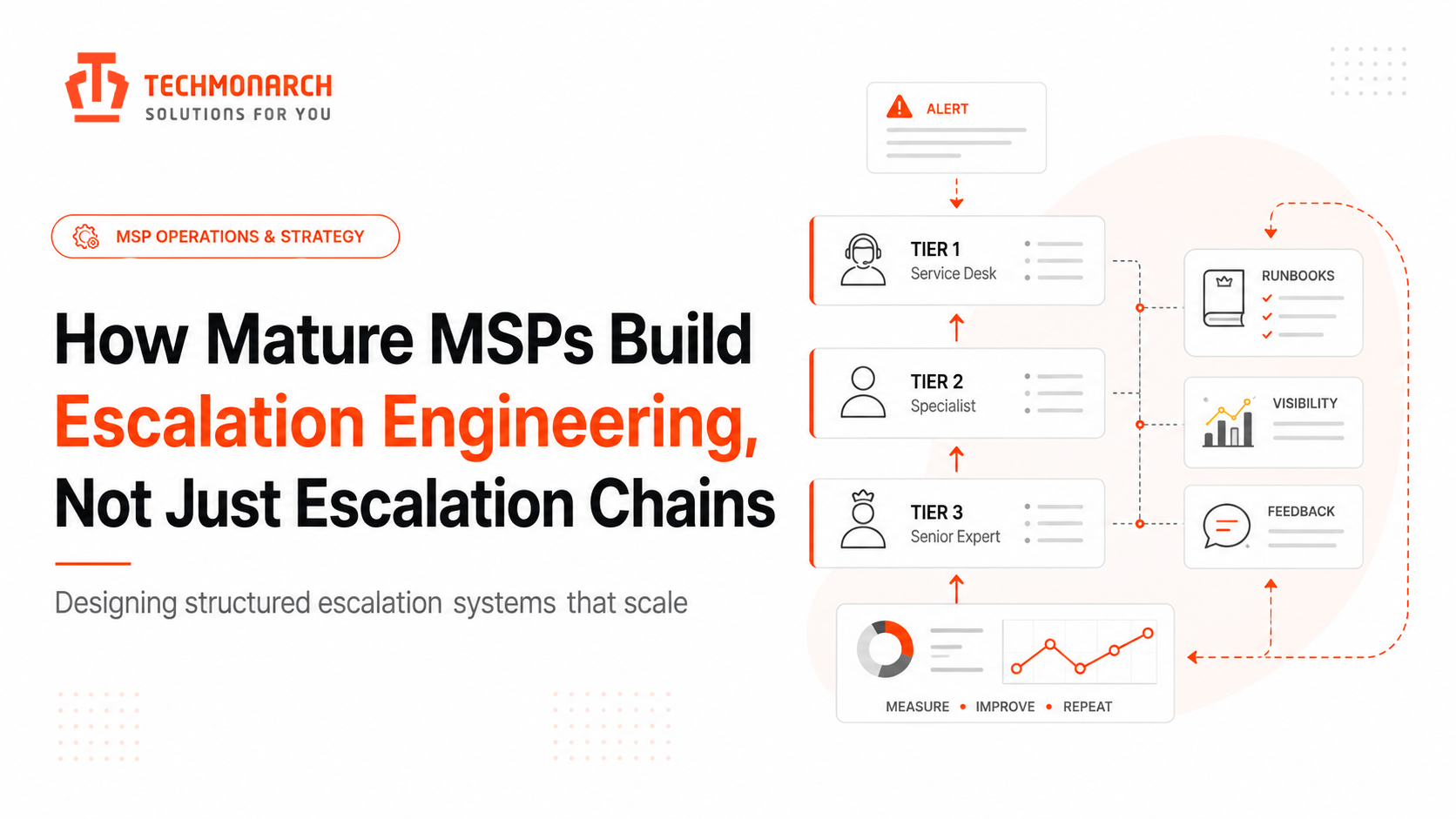
The first is structured intake. Every escalation that moves between tiers carries a mandatory information payload — not guidelines, not suggestions, but required fields that the ticketing system enforces before the handoff can complete. That payload includes the symptoms observed, the steps already taken, the client environment context relevant to the issue, the hypotheses that were ruled out, and the specific reason the ticket is being escalated rather than resolved at the current tier. A technician in the middle of a high-stress incident does not have time to remember what to document. The system should make it impossible to forget.
The second pillar is explicit tier boundaries. “Escalate if you cannot resolve it” is not a trigger definition — it is an abdication of process design. Mature escalation frameworks define specific, objective conditions for escalation at each tier: issue types, time thresholds, client priority classifications, and system impact criteria. These conditions are documented, trained, and audited. When a Tier 1 technician escalates because of elapsed time rather than genuine complexity, that is a process signal that either the time threshold is miscalibrated or the Tier 1 toolkit is insufficient.
The third pillar is the feedback channel — the mechanism by which resolution knowledge flows back down the tier stack. This is the piece most MSPs omit entirely. Tier 3 resolves a complex issue, documents it in a ticket, closes it, and moves on. No one updates the Tier 1 runbook. No one publishes a known-issue article. The next time that issue pattern appears, it climbs the entire chain again. Escalation engineering treats the post-resolution documentation as a non-optional step in the resolution workflow, not an optional addendum.

Runbooks as Living Infrastructure, Not Static Documents
The operational backbone of escalation engineering is the runbook — but not the version most MSPs maintain. The typical MSP runbook is a document created during onboarding, accurate for the first 90 days, and progressively less useful as client environments evolve and incident patterns shift. It exists in a shared drive somewhere. Engineers know it exists. They rarely consult it.
A runbook that functions as escalation engineering infrastructure has four characteristics. It is written for the tier that will use it, not the tier that created it — which means Tier 1 runbooks use plain language, include decision trees for common ambiguous scenarios, and are short enough to reference mid-incident. It is version-controlled, with a documented owner responsible for updates. It is linked directly from the ticketing system so that the runbook appears in context when a technician is working a relevant ticket type. And it is treated as a measurable artifact: if a Tier 1 technician followed the runbook and still could not resolve the issue, that is data about the runbook, not just about the technician.
MSPs that maintain runbooks this way typically see measurable improvement in first-call resolution rates within two to three quarters. Not because the engineers got better, but because institutional knowledge that was previously locked in senior engineers’ heads became accessible at the tier where it was needed.
Escalation Rate as an Operational Metric
Most MSPs track resolution time and client satisfaction scores. Fewer track escalation rate — the percentage of tickets that move up at least one tier before resolution — and almost none use escalation rate as a diagnostic tool for specific technicians, issue categories, or client environments.
Escalation rate, when analyzed at sufficient granularity, tells you things that CSAT scores and resolution time cannot. A high escalation rate for a specific technician often indicates either a training gap or a knowledge base gap — and distinguishing between the two determines whether the solution is coaching or documentation. A high escalation rate for a specific client environment usually indicates that onboarding documentation was incomplete and that client’s systems are not well represented in Tier 1 runbooks. A high escalation rate for a specific issue category — say, authentication failures or backup job exceptions — often means that the alert routing that generates those tickets is misconfigured and producing noise at Tier 1 that should either be automated or pre-categorized differently.
Tracking escalation rate at this level of granularity requires clean ticket data and consistent categorization disciplines, both of which are downstream investments. But the operational insight they unlock justifies the overhead significantly.
The Knowledge Siloing Problem and How Engineering Solves It
One of the most persistent operational risks in mature MSPs is the senior engineer who has accumulated years of client-specific knowledge and carries it exclusively in their own memory. They resolve issues faster than anyone else because they have pattern-matched against hundreds of incidents. They are also a single point of failure. When they leave — or burn out, or go on leave — that knowledge does not transfer. It disappears.
Escalation engineering addresses knowledge siloing structurally, not through aspirational documentation policies that no one enforces. The mechanism is simple: every time a senior engineer resolves an issue that a junior engineer could not, the resolution path becomes an artifact. A decision tree. A runbook addendum. A known-issue entry in the knowledge base. The senior engineer’s time investment in creating that artifact is modest. The organizational value of making that knowledge accessible without requiring that specific person to be online is substantial.
Some MSPs operationalize this through a formal post-incident review process for any ticket that escalated to Tier 3. The review is not about blame — it is about asking whether the outcome could have been achieved at a lower tier with better tooling or documentation, and if so, what would need to change. That question, asked consistently, produces a continuous improvement loop that compounds over time.
Where White-Label NOC Partners Fit Into the Engineering Model
For MSPs that leverage white-label NOC or help desk partners, escalation engineering becomes even more critical because the handoff now crosses an organizational boundary. The informal knowledge transfer mechanisms that work within a single team — verbal briefings, ambient awareness, hallway conversations — do not exist between an internal team and an external partner.
The escalation interface between an MSP and its white-label NOC partner needs to be designed with the same rigor applied to internal tier transitions. That means documented escalation triggers that both teams understand identically. It means ticket templates that the NOC partner fills out before escalating to internal engineers. It means agreed-upon response windows, escalation paths within the partner organization, and a regular operational review cadence where escalation patterns are examined and runbooks are updated collaboratively.
MSPs working with providers like Techmonarch benefit from a partner infrastructure already built around these disciplines — NOC teams that operate within client ticketing systems, follow client-specific runbooks, and escalate with documented context rather than raw alerts. The white-label model only delivers its full value when the escalation interface is engineered, not assumed.
Measuring Maturity: What Good Looks Like
Escalation engineering maturity is not binary. MSPs move through recognizable stages, and understanding where you sit helps prioritize the next investment. At the early stage, escalations are ad hoc, intake documentation is inconsistent, and resolution knowledge lives with individuals. At the intermediate stage, tier definitions exist, some runbooks are in place, and escalation rate is tracked but not routinely analyzed. At the mature stage, escalation triggers are objective and enforced by the ticketing workflow, runbooks are version-controlled and linked in context, escalation rate is tracked by technician and issue category, and post-incident reviews feed directly into runbook updates on a defined cycle.
The distinction between intermediate and mature is primarily one of discipline rather than tooling. Most MSPs already have the PSA platforms capable of supporting mature escalation workflows. What they lack is the operational design layer — the decisions about what gets enforced, what gets measured, and what happens to the data after it is collected.
That design layer is where the investment pays off. Not in new tools, and not necessarily in additional headcount. In the operational architecture that makes the team and the tools you already have perform significantly better.
The Long-Term Argument
MSPs that invest in escalation engineering rather than just escalation chains build something that compounds. Each incident handled well produces slightly better documentation. Each documented resolution reduces the frequency of the next similar escalation. Senior engineers spend less time on issues below their capability level. Clients experience more consistent service quality across the board — not because every individual engineer is exceptional, but because the system they work within is well-designed.
That compounding effect is the difference between an MSP that grows by adding headcount proportionally to client volume and one that grows with meaningful operational leverage. It does not happen overnight. It happens through the steady, unglamorous work of treating escalation as a discipline worth engineering — not just a process worth documenting.
Recent Comments
- No comments to show