
-
Vijit
- June 8, 2026
- No categories assigned.
- No Comments
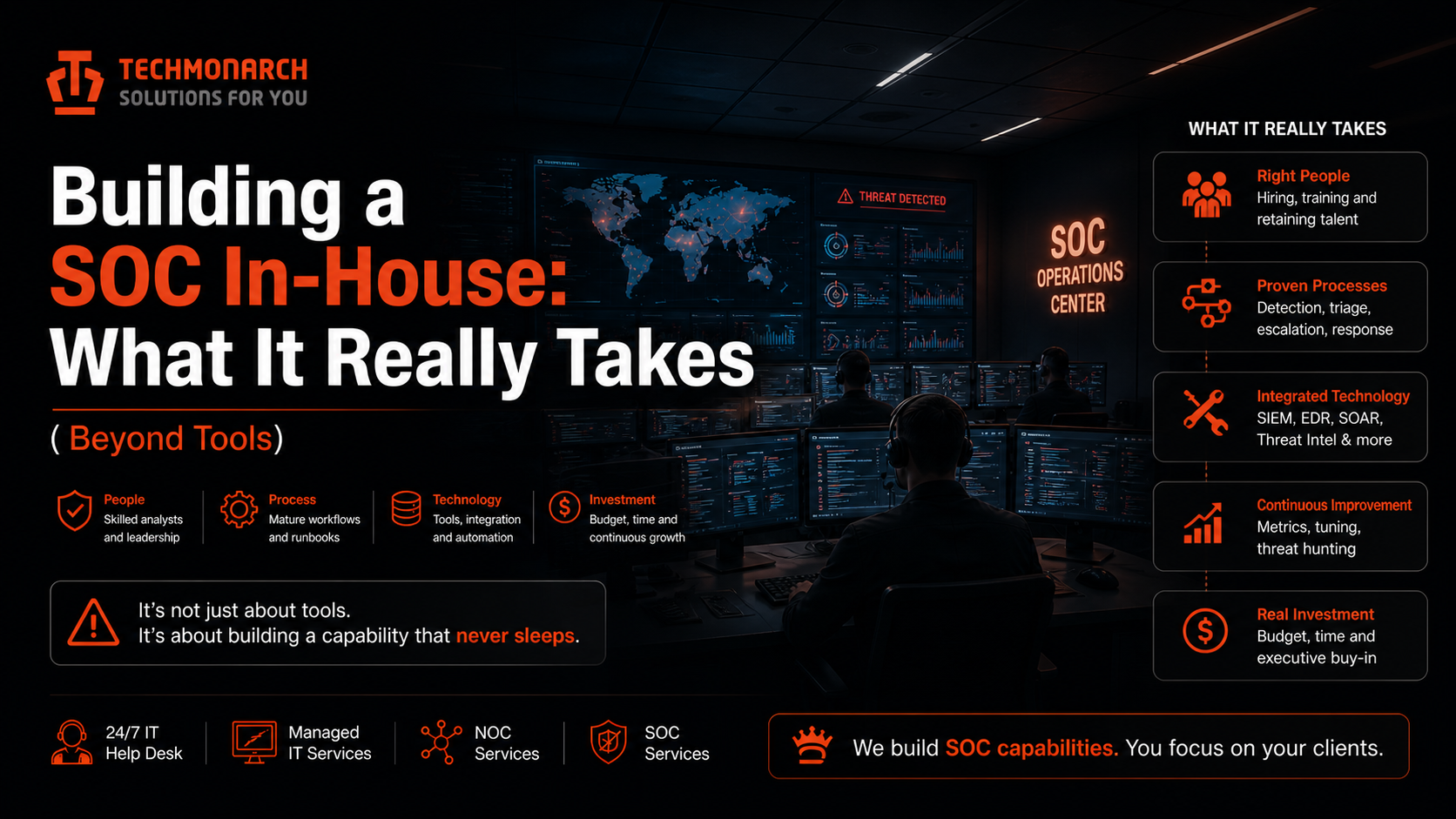
What It Really Takes (Beyond Tools)
The conversation usually starts the same way. An MSP has grown to a point where they want to offer genuine security services — not just monitoring, but real detection and response. Someone proposes building a SOC. The initial planning conversation focuses on tools: which SIEM, which EDR, which threat intelligence platform, how much storage. A budget is put together. It looks manageable.
Six months later, the tools are purchased and partially configured. The SIEM is generating thousands of alerts a day, most noise. Two analysts have left — one to a better-paying role, one burned out by the shift schedule. Detection quality is inconsistent depending on who is on duty. Clients receive monthly reports with metrics but no narrative about what was actually found or stopped.
The tools are there. The SOC is not.
Building a genuine security operations centre is one of the most commonly underestimated projects in managed IT. It is not a tools problem. It is a people, process, and time problem — and most MSPs discover this the expensive way. This post is an honest look at what it actually takes, so the decision to build, buy, or partner can be made with clear eyes.
1. The Cost Reality — Numbers Worth Knowing Before You Start
The most useful thing to understand upfront is that SOC cost is dominated by people, not technology. The tools are the smaller line item. The analysts, engineers, threat hunters, and SOC leadership are where the budget actually goes — and those costs are ongoing, not a one-time investment.
Netsurion’s detailed breakdown of in-house SOC cost tiers gives a grounded view of what different capability levels actually cost to staff and run:
| SOC Tier | Annual Staff Cost | Annual Tech Cost | What You Get |
| Basic SOC (Detection only, limited investigation, no hunting) | $1.2M (~12 staff, wages + benefits) | $300K | Alerts reviewed, basic triage, escalation to you for anything complex. 3-6 months to reach steady-state. No proactive threat hunting. |
| Intermediate SOC (SIEM + UEBA, L1/L2/L3 analysts, limited hunting) | $2.1M (12+ analysts, escalation staff) | $400K | Better detection coverage, some proactive effort, multi-tier investigation. 6-12 months to full maturity. Still reactive-dominant. |
| Advanced SOC (Full hunting, red team, AI-assisted automation) | $3.9M (Larger team + specialised roles) | $1.1M | Proactive threat hunting, red team exercises, advanced automation. 12-18 months to build. This is the level most clients actually need to be meaningfully protected. |
In-house SOC cost tiers — staffing and technology costs by capability level (Netsurion, 2023 / Visiontech 2026)
The Ponemon Institute puts the average annual cost of operating an in-house SOC at $2.84 million. Todyl’s MSP-specific research puts the minimum viable 24/7 operation at $750,000–$1.2 million in personnel costs alone — before technology. Building a fully functional, enterprise-grade in-house SOC typically requires $1–2 million in initial infrastructure investment, followed by $1.5 million or more per year in ongoing staffing.
These are not worst-case estimates. They are the numbers that come out of organisations that have actually built SOCs and tracked their costs honestly. Most MSPs building their first SOC are working from a spreadsheet that is missing half of these line items.
2. The People Problem Is the Real Problem
Here is the thing that experienced SOC leaders will tell you if you ask them directly: the hardest part of building a SOC is not choosing the SIEM. It is hiring the right people, keeping them, and building a team that performs consistently across all hours and all shifts.
The Talent Market Is Genuinely Brutal
There is a global cybersecurity workforce gap of over 4 million professionals. In practice, this means: 84% of organisations struggle to find qualified security talent. The analysts you want have multiple offers. The ones willing to accept your salary are often at the beginning of their careers, which means significant training investment before they are producing independently.
Continuous training is not optional in security operations — it is the price of staying relevant. SANS courses and certifications like OSCP and CISSP cost $5,000 to $8,000 per course per employee. For a team of twelve, the annual training budget alone is substantial. And if you do not invest in it, your analysts leave for organisations that do.
Shift Coverage Creates Structural Tension
Genuine 24/7 coverage requires a minimum of 8-10 full-time security professionals just for shift rotation — more when you factor in leave, sickness, and turnover. Most MSPs building a first SOC staff well below this level, which means the on-call engineers are working too many hours, covering too many shifts, and making decisions about critical alerts while fatigued.
This is not hypothetical. It is the most consistent finding in post-mortem reviews of SOC quality failures: the engineer who missed the alert was on their fourth overnight shift, or on-call through a weekend, or covering double the usual load while colleagues were on leave.
Retention Is as Hard as Hiring
Replacing an experienced SOC analyst costs 1.5 to 2 times their annual salary when you factor in recruitment, onboarding, and the productivity gap during ramp-up. They also take institutional knowledge with them — detection logic they built, client-specific nuances that never made it into the runbooks. Every departure is a capability regression as well as a cost.
3. The Process Gap — What Tools Cannot Substitute For
The assumption most MSPs make when building a SOC is that the right tooling will handle most of the work. In practice, tools handle the data collection and alert generation. Everything after that is process.
| What a SOC Actually Needs Beyond a SIEM Detection engineering: Someone has to write, test, validate, and continuously improve the correlation rules. A SIEM out of the box fires on everything. Detection engineering is what makes it fire on the right things. Alert triage playbooks: For every alert type, a documented procedure for what to investigate first, what to look for, how to escalate, and how to close. Without this, quality depends entirely on which analyst picks up the ticket. Incident response runbooks: What happens when the alert is confirmed as a real threat? Step-by-step procedures for containment, evidence collection, client communication, and escalation — per incident type. Threat hunting cadence: Proactive searches for threats that are not yet generating alerts, based on threat intelligence and known adversary TTPs. This does not happen automatically and requires dedicated analyst time. Quality review: Regular review of closed tickets, false positive rates, analyst decision quality, and detection coverage gaps. Without oversight, quality drifts invisibly. Client reporting workflow: Translating SOC activity into client-facing narrative — what was detected, what action was taken, what it means for the client’s risk posture. |
Building all of this takes time — typically 6 to 18 months before a new SOC reaches full operational maturity, depending on starting capability. During that ramp-up period, the organisation the SOC is supposed to be protecting is carrying the risk of an operation that is not yet performing at design standard.
4. The Honest Decision Framework
None of this is an argument that in-house SOC is always wrong. There are scenarios where it is the right answer:
- Large MSPs with significant revenue from security services: where the client volume and contract value justify the investment and the economics eventually work.
- Regulated client environments: where data residency or contractual requirements prevent third-party access to client telemetry.
- Organisations with a genuine security-first identity: where building an in-house SOC is a strategic differentiator, not just a service add-on.
For most MSPs — particularly those under 200 clients, without dedicated security revenue that could sustain a multi-million annual SOC budget — the economics of a fully in-house SOC do not work. The minimum viable 24/7 in-house team is more expensive than the revenue it can support.
The alternative is not ‘do not offer security services.’ It is a hybrid model: build internal expertise and client relationships, partner with a specialist SOC for the operational delivery. You retain control of the client relationship, the strategy, and the service design. The partner handles the continuous monitoring, detection engineering, and overnight coverage that is operationally and financially prohibitive to build internally.
In this model, building a SOC is still the right long-term goal — but the sequence matters. Partner to deliver the capability now. Build the internal capability as the revenue base justifies it. The MSPs that try to build first and sell after tend to find the economics never quite converge.
The Bottom Line
Building a SOC is not about buying a SIEM licence and hiring two analysts. It is about building a functioning operation — with staffing depth to cover all hours, process discipline to produce consistent quality, and the time to reach genuine maturity. The tools are the easy part. They are also the smallest part.
If the honest answer after reviewing the real costs and requirements is that in-house is not viable right now, that is not a failure. It is good strategic thinking. The clients who need SOC-grade security need it to actually work — and a well-partnered managed SOC that works is worth considerably more than an in-house operation that looks right on paper but delivers inconsistently at 3am.
| About TechMonarch TechMonarch provides white-label SOC and NOC services to MSPs who want to offer genuine security operations under their own brand — without the multi-million annual investment that a fully in-house SOC requires. We handle the detection engineering, the overnight coverage, the analyst triage, and the threat hunting. You handle the client relationship and the strategy. If you want to talk about what that model looks like in practice, we are easy to reach. Get in touch: www.techmonarch.com |
Recent Comments
- No comments to show