
Industry: Financial Services / Credit Union Region: Oregon, United States Engagement Model: White-label delivery for an MSP partner Core Services: RMM infrastructure monitoring, managed SOC, security & compliance reporting
Quick Summary
A community-based credit union serving roughly 28,000 members across six branches was running IT monitoring entirely reactively — issues surfaced only after staff or members noticed something was broken. Firewall logs went unreviewed, failed login attempts went uninvestigated, and regulators had already flagged the lack of security monitoring as a compliance deficiency ahead of their next examination.
TechMonarch was engaged through the credit union’s MSP partner to implement a layered RMM and managed SOC monitoring solution. The result: unplanned outages dropped 78%, 14 real security incidents were detected and neutralized in the first six months, and the credit union walked into its next regulatory examination with zero IT monitoring findings.
Meet the Client
This client is a community-based financial institution serving about 28,000 members across six branch locations, with 95 employees managing more than $400 million in assets. Their IT environment supported core banking, online and mobile banking, ATMs, branch workstations, and the regulatory reporting that comes with all of it.
For an environment this critical, monitoring was surprisingly thin. It relied on basic antivirus alerts and sporadic email notifications that, in practice, nobody actively watched. Most issues were only discovered after they’d already impacted staff or members — not exactly where a regulated financial institution wants to be.
(Note: client details have been anonymized at the customer’s request. This is a real engagement delivered through one of TechMonarch’s MSP partners.)
The Challenge: Reactive Monitoring in a Regulated, Zero-Tolerance Environment
Here’s what “reactive monitoring” actually looked like in practice:
Preventable outages kept happening. A production server crashed from low disk space during peak business hours — the kind of thing proactive monitoring catches days in advance. Separately, a failed backup system went completely unnoticed for three weeks before anyone realized it wasn’t working.
Security visibility was essentially nonexistent. Firewall logs were never reviewed. Failed login attempts went uninvestigated. There was no centralized threat detection tying any of these signals together. Regulators had already flagged the lack of security monitoring as a significant compliance deficiency.
The internal team had no room to be proactive. With only three internal IT staff, the team was fully consumed by daily support tasks, leaving zero bandwidth for the kind of monitoring and log review a financial institution actually needs.
Regulatory pressure was mounting. With their next examination approaching, examiners were expecting immediate, demonstrable improvement in monitoring, logging, and incident response — not promises, but evidence.
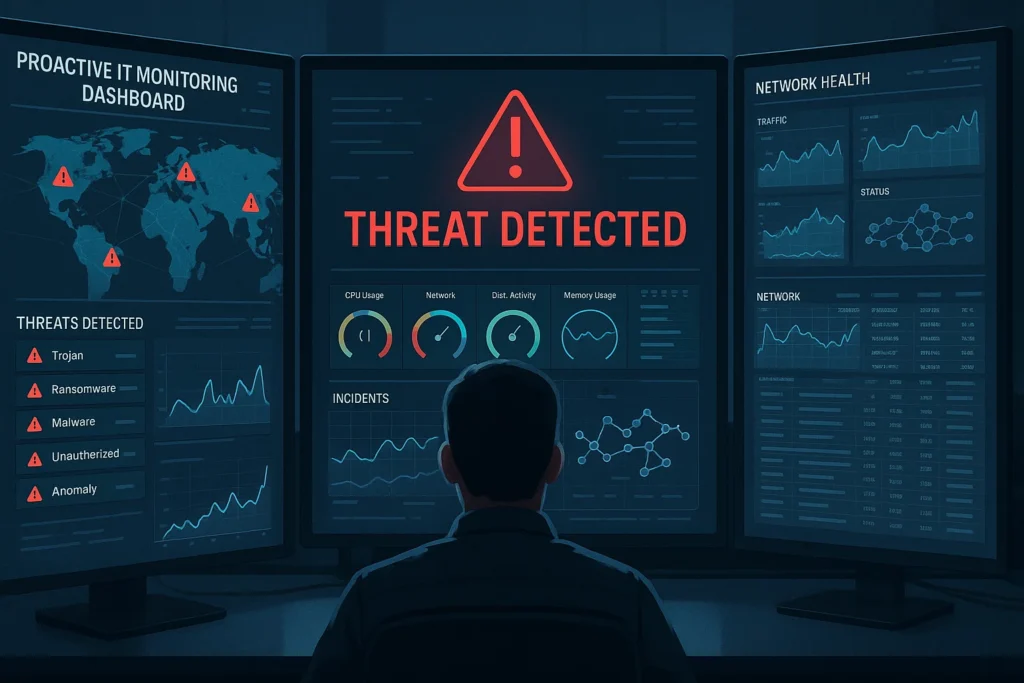
The credit union’s MSP partner brought in TechMonarch to implement a comprehensive proactive monitoring solution built on RMM and managed SOC tools, with the regulatory clock already running.
The Solution: A Layered Monitoring Architecture Combining RMM and 24/7 Managed SOC
We designed the solution around two complementary layers: infrastructure monitoring to catch operational problems before they become outages, and 24/7 managed security operations to catch threats before they become incidents.
Phase 1: Monitoring Design & Assessment
We assessed every system that needed coverage — 12 servers, 95 workstations, network devices across all six branches, core banking infrastructure, backup systems, and online banking platforms — and defined monitoring requirements across infrastructure, security, application performance, and compliance logging. We selected Datto RMM for infrastructure monitoring and Arctic Wolf for managed SOC services.
Phase 2: RMM Implementation
We deployed RMM across every server and endpoint, configured monitoring for servers, workstations, network devices, and backups, and built in automated remediation for disk space issues, service failures, and patching. Tiered alerting was configured specifically to eliminate noise while still escalating genuinely critical events — the difference between useful alerts and alert fatigue.
Phase 3: SOC Integration
Arctic Wolf sensors were deployed at each of the six branches, with centralized log ingestion from firewalls, domain controllers, VPNs, and endpoints feeding into 24/7 threat detection and behavioral analysis. We also documented clear incident response workflows connecting the SOC, TechMonarch, and the credit union’s own IT team — so everyone knew exactly who did what when something fired.
Phase 4: Dashboards & Reporting
We built executive dashboards covering system health, backups, and security posture, plus operational dashboards for real-time IT visibility. Automated daily, weekly, monthly compliance, and quarterly executive reports meant leadership and examiners alike always had current, accurate documentation on hand.
Phase 5: Process Integration & Training
Monitoring alerts were integrated directly into the credit union’s existing ticketing system. Daily review procedures, staff training, and standardized response runbooks made monitoring part of daily operations — not one more dashboard someone had to remember to check.
Phase 6: Continuous Optimization
Monthly tuning reviews reduced false positives, expanded coverage as systems changed, and refined alert thresholds over time to keep the signal-to-noise ratio high — monitoring that actually gets better the longer it runs.
The Results
- Downtime reduction: A 78% decrease in unplanned outages
- Faster resolution: Average issue resolution dropped from 4–6 hours to under 90 minutes
- Security improvements: 14 real security incidents detected and neutralized in the first 6 months
- Regulatory compliance: Zero IT monitoring findings in the most recent examination
- Operational shift: The internal IT team now spends ~60% of their time on proactive projects, up from just 20% previously
- Cost avoidance: Incidents prevented in the first quarter alone avoided an estimated $50K+ in losses
- Data-driven planning: Infrastructure upgrades and storage expansion are now guided by real performance data, not guesswork
Why the MSP Chose TechMonarch
The credit union needed a partner that understood both financial services infrastructure and regulatory compliance — not a generic monitoring tool bolted onto a banking environment that has its own rules.
The hybrid model combined RMM-driven infrastructure monitoring with genuine SOC services delivering 24/7 threat detection and behavioral analysis — enterprise-grade visibility and security monitoring without the cost of building an in-house SOC from scratch. A sharp focus on actionable alerting meant alerts drove real outcomes rather than becoming background noise the team learned to ignore.
The white-label model let the credit union keep their trusted MSP relationship intact while leveraging TechMonarch’s deep monitoring and security expertise behind the scenes. Most importantly, compliance-ready documentation and reporting gave examiners exactly what they were looking for — turning what had been a source of audit stress into a genuine strength.
Frequently Asked Questions
Why is proactive IT monitoring especially important for credit unions and banks? Financial institutions face regulatory examinations that specifically evaluate monitoring, logging, and incident response capabilities. In this case, the lack of proactive monitoring had already been flagged as a compliance deficiency, and after implementation, the credit union passed its next examination with zero IT monitoring findings.
What’s the difference between RMM monitoring and managed SOC services? RMM (Remote Monitoring & Management) focuses on infrastructure health — servers, workstations, backups, and network devices. A managed SOC (Security Operations Center) focuses on threat detection and security incident response, ingesting logs from firewalls, domain controllers, and endpoints to catch malicious activity. This engagement combined both layers, since operational monitoring and security monitoring solve different problems.
How many security incidents does a typical financial institution catch once real monitoring is in place? It varies widely by environment and prior exposure, but in this case, the credit union’s new SOC integration detected and neutralized 14 real security incidents in the first six months alone — activity that had previously been invisible.
Can proactive monitoring implementations like this be delivered white-label for an MSP’s clients? Yes — this entire engagement was delivered white-label, with TechMonarch handling the monitoring architecture and SOC integration while the MSP retained full ownership of the client relationship.
Ready to move from reactive IT to proactive control? TechMonarch specializes in proactive IT monitoring using RMM and SOC tools, helping MSP partners deliver enterprise-grade visibility, security, and compliance for regulated organizations nationwide. Let’s talk.
Recent Comments
- No comments to show