
-
Vijit
- May 25, 2026
- No categories assigned.
- No Comments
The Gap MSPs Overlook
There is a conversation that happens a lot in MSP sales. A prospect asks: ‘Do you offer 24/7 coverage?’ The answer is yes. Everyone’s answer is yes. And in most cases, that answer is technically true — there is someone watching, there is an alert system running, there is a phone that will ring if something catches fire badly enough.
What the prospect is actually asking is a different question: ‘If something breaks at 2am, will it be fixed before my team shows up at 8am?’ That answer depends entirely on something most MSPs do not clearly distinguish: the difference between 24/7 monitoring and 24/7 resolution.
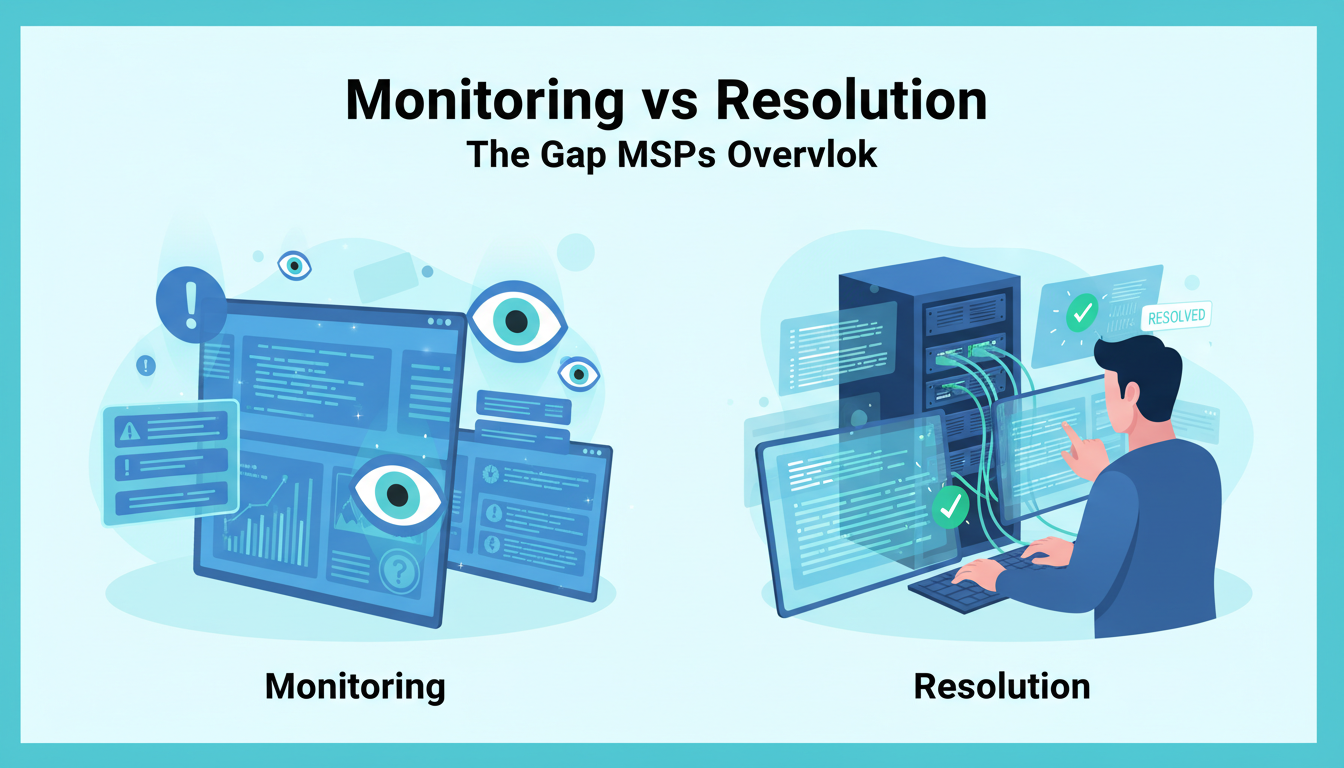
Monitoring means someone will know. Resolution means someone will act. These are not the same thing. And confusing them — either in how you build your service delivery model or in how you describe it to clients — is one of the more consequential gaps in managed IT services.
1. Why the Distinction Matters More Than It Seems
Most RMM platforms fire alerts within seconds of a threshold being crossed. A server goes offline at 2:12am — the alert fires at 2:12am. The ticket is created. A notification goes out. In a monitoring-only model, that is where the automation ends. What happens next depends on who picks up the phone, when they pick it up, and whether they have the access and runbook to actually fix the problem.
In a resolution model, the engineer who receives that alert at 2:12am has pre-authorised access to the affected environment, a documented runbook for common failure scenarios, and the capability to restart services, free up disk space, or isolate a compromised endpoint without waking anyone up. The server is back online by 2:45am. The client’s team arrives at 8am to find a ticket marked resolved, with a root cause note.
The gap between those two outcomes — an alert at 2:12am and resolution at 2:45am versus an alert at 2:12am and a senior engineer dealing with it at 8:15am after several missed call notifications — is the gap clients are actually paying to close when they sign up for managed services.
| The Statistic That Makes This Concrete Over 90% of businesses estimate the cost of downtime at more than $300,000 per hour (ExtnNOC, 2025). 55% of businesses experience IT outages on a weekly basis, and 8% are hit daily (Cockroach Labs State of Resilience 2025). For most clients, a six-hour delay between alert and resolution — the difference between a monitoring-only and a resolution-capable NOC — is not a minor inconvenience. It is potentially a half-day of lost productivity, revenue impact, and eroded trust. When a client says they want 24/7 coverage, they mean they want to avoid that cost. Monitoring alone does not avoid it. |
2. The Spectrum — From Alerting to Full Resolution
It is worth mapping out what actually exists in the market, because ‘NOC service’ and ’24/7 monitoring’ get applied to a wide range of operational models:
- Alert forwarding: The platform fires an alert, which is forwarded via email or SMS to an on-call engineer. Someone is nominally reachable, but the responsiveness and resolution capability depends entirely on whether they pick up.
- Monitoring with triage: A NOC team receives the alert, evaluates severity, and either resolves simple issues autonomously or escalates based on a defined matrix. Escalation still happens, but it is targeted — not everything goes to the on-call engineer.
- Managed NOC with remediation: Pre-authorised engineers handle a defined set of remediation actions autonomously — restarting services, clearing disk space, running backup jobs, isolating endpoints — without needing to escalate. The engineer’s first call to you is when the issue is outside their pre-authorised scope.
- Full resolution NOC: Engineers have deep environment knowledge, broad pre-authorisation, and documented runbooks for the vast majority of incident types. Escalation to the MSP is genuinely rare.
Most clients who believe they have 24/7 coverage are in the first or second category. What they usually need — and what most of them assume they have — is the third.
3. What the Gap Looks Like in Practice
Here is the same set of overnight scenarios played out through both a monitoring-only model and a resolution-capable NOC. The difference is not abstract.
| Scenario | What 24/7 Monitoring Catches | What 24/7 Resolution Actually Does |
| Server goes offline at 2am | Alert fires within seconds. Ticket created. On-call engineer is notified. | Engineer logs in, diagnoses root cause, restarts services or escalates. Server is back online before the morning shift starts. |
| Disk space approaching 95% threshold | Alert fires when threshold is crossed. Ticket created. Someone is notified. | Engineer identifies what is consuming space, archives or clears safely, adjusts thresholds, and documents the action. Prevents the actual outage. |
| Backup job fails overnight | Failure alert fired. Ticket created. Engineer notified. | Engineer investigates cause, reruns or reschedules the job, confirms successful completion before the next business day. Client’s data protection is intact. |
| Suspicious authentication anomaly at 11pm | SIEM or EDR alert fires. Analyst is notified. | Analyst investigates, determines whether it is a genuine threat, contains if necessary, and escalates appropriately. The window between detection and action is minutes, not hours. |
| Network latency spike affecting a branch site | Monitoring platform records the degradation. Alert fires. | Engineer checks the link, identifies the affected path, and either resolves directly or engages the carrier with the diagnostic data already gathered. Client users experience minimal disruption. |
Five common overnight scenarios — what monitoring catches vs. what resolution delivers
In every row of that table, monitoring and resolution both start with the same alert. The difference is entirely in what happens next. And what happens next is determined not by the monitoring platform — which is often identical — but by the people, runbooks, access, and authorisation behind it.
4. Why MSPs Get This Wrong — And Why It Matters for Their Clients
There are a few reasons this gap persists, and none of them are malicious.
The Sales Language Problem
’24/7 monitoring’ is a marketable phrase. It is concrete, easy to explain, and satisfies the surface-level question. ’24/7 resolution’ requires explaining pre-authorisation frameworks, runbook depth, escalation matrices, and staff-to-client ratios — none of which fit neatly into a bullet point on a service brochure. So monitoring becomes the shorthand for both, and the distinction never gets drawn.
The Cost Problem
Monitoring is cheap to set up. An RMM platform, a few alert policies, and an on-call rotation — the infrastructure cost is relatively low. Resolution requires trained engineers with appropriate access, documented runbooks for dozens of common scenarios, and enough staffing depth to act at 3am without burning out the team. Those are real costs, and they are why some providers advertise 24/7 coverage at a price that should raise questions.
The Client Understanding Problem
Most clients do not know to ask the distinction. They assume ‘monitoring’ means their problems will be handled. The first time they discover otherwise is usually the worst possible moment — arriving Monday morning to a weekend’s worth of unresolved alerts and a server offline since Saturday at 11pm.
That moment is expensive twice over: the direct cost of extended downtime, and the cost to the client relationship. Clients rarely leave after one big incident. They leave when the pattern becomes clear — and this is often the pattern that makes it clear.
5. Asking the Right Questions — Evaluating Any NOC Model
Whether you are evaluating a white-label NOC partner for your MSP or reviewing your own service delivery model, these questions expose whether you are in the monitoring category or the resolution category:
| Question to Ask | Why It Matters |
| When an alert fires at 3am, what is the first action your engineer takes — and what is the first action that requires escalating to us? | This reveals whether the NOC resolves independently or escalates everything to you. A monitoring-only operation will not have a clear answer about the resolution step. |
| Can you show me an example of a recent incident where your team resolved an issue without waking up the MSP? | Specific examples expose the reality. Vague answers about ‘comprehensive remediation’ without concrete cases suggest the team is primarily alert-forwarding. |
| What is your pre-authorised action list — what can your engineers do autonomously? | Resolution requires authorisation boundaries. A partner without a defined list of pre-approved remediation actions is not set up to resolve — only to report. |
| How do you handle an alert that escalates from monitoring to active remediation mid-incident? | Good NOCs have a documented triage flow. Gaps in this answer reveal whether resolution is a genuine capability or an afterthought. |
| What is your mean time to resolution (MTTR) for common incident types? | MTTR is the resolution metric. If a partner tracks MTTA (mean time to acknowledge) but cannot quote MTTR, they are measuring the wrong thing. |
Five questions to distinguish monitoring from genuine resolution capability
The metric that separates a monitoring operation from a resolution operation is MTTR — mean time to resolution. If a partner tracks MTTA (mean time to acknowledge) but cannot speak confidently to MTTR, they are measuring the wrong thing. Acknowledgement has no value to a client whose server has been down for six hours.

The Bottom Line
When a client signs up for managed services, they are buying an outcome: confidence that their systems will be looked after when their team is not there. Monitoring delivers awareness. Resolution delivers that outcome.
The gap between the two is where client expectations meet service delivery reality. Closing it requires investment — in runbooks, engineer training, pre-authorisation frameworks, and staffing models that support overnight action. That investment is exactly what justifies the managed services fee.
If your 24/7 offering is primarily monitoring, be honest about that — with your team, and with your clients. If it should be resolution but the model is not there yet, that is a solvable problem. The first step is simply distinguishing the two clearly enough to know which one you have.
| About TechMonarch TechMonarch’s white-label NOC operates on the resolution side of this distinction. Our engineers work with pre-authorised runbooks inside your tools, handle common overnight issues autonomously, and escalate to you only when the situation genuinely requires it. The first call you get from us is not ‘we saw an alert’ — it is ‘we resolved this, here is what happened.’ If that is the model you want to offer your clients, let’s talk. Get in touch: www.techmonarch.com |
Recent Comments
- No comments to show