
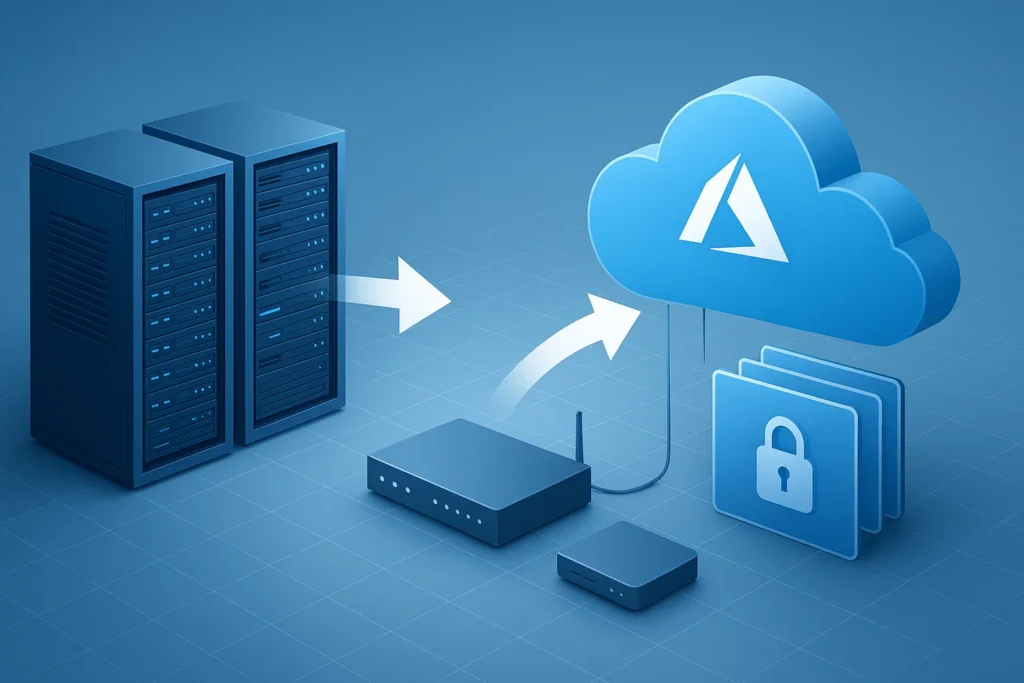
Industry: Healthcare Technology (Patient Management & EHR Platforms) Region: Rocky Mountain, United States Engagement Model: White-label delivery for an MSP partner Core Services: Azure cloud migration, HIPAA-aligned security and compliance, disaster recovery
Quick Summary
A healthcare technology provider serving 45+ hospitals and medical practices was running its entire operation on 15-year-old, on-premise infrastructure. Backup hardware was failing, disaster recovery took days instead of hours, and two new hospital contracts were about to add 800 users the old servers simply couldn’t handle.
TechMonarch partnered with the client’s MSP to run a phased, zero-disruption migration to Microsoft Azure. The result: 47 minutes of total production downtime, a 40% jump in database performance, disaster recovery time cut from days to under 90 minutes, and 35% lower infrastructure costs over three years — all delivered white-label, under the MSP’s own brand.
Meet the Client
This client is a healthcare technology company that builds and operates patient management and EHR (electronic health records) platforms. Their systems handle everything from appointment scheduling and billing to clinical documentation for more than 45 hospitals and medical practices across the Rocky Mountains.
They’d been running on the same on-premise setup since 2008. It had served them well for a long time — but “well” was starting to run out.
(Note: client details have been anonymized at the customer’s request. This is a real engagement delivered through one of TechMonarch’s MSP partners.)
The Challenge: When Legacy Infrastructure Becomes a Liability
Here’s the situation the client’s team was living with every day:
The database was struggling. Their primary SQL Server 2012 database was running on hardware from 2014. Peak-hour reporting was slow enough that users noticed — and complained.
The backup server was on borrowed time. It had come close to failing twice in 18 months. In healthcare IT, that’s not a “someday” problem — it’s a ticking clock.
Disaster recovery was stuck in the past. Weekly offsite tape backups meant Recovery Time Objectives (RTO) and Recovery Point Objectives (RPO) were measured in days, not hours. For an organization holding patient data, that’s a real compliance and operational exposure.
HIPAA compliance was eating up hours. Encryption, audit trails, and access controls were all managed manually. Every audit cycle meant scrambling to pull evidence together.
Growth was outpacing the hardware. Two new hospital contracts were set to add roughly 800 users within six months. Supporting that on-prem would have meant a $150K+ hardware investment — just to keep the lights on, let alone modernize.
The client’s MSP partner brought in TechMonarch to design and run a cloud migration that couldn’t afford to go wrong — this was a 24/7 healthcare operation, after all.
The Solution: A Six-Phase, Zero-Disruption Migration to Azure
We didn’t approach this as a “lift and shift and hope for the best” project. Healthcare has zero tolerance for downtime, so every phase was built around reducing risk before adding speed.
Phase 1: Assessment & Architecture Design
Using Azure Migrate, we assessed the full environment: four physical servers, roughly 8TB of data, Windows Server 2012 R2/2016 workloads, and about 3.2TB of SQL databases.
The target architecture included:
- Azure Virtual Machines for application workloads
- Azure SQL Managed Instance for production databases
- Azure Site Recovery for disaster recovery and migration
- Azure Backup for retention
- Azure Virtual Network with Network Security Groups (NSGs)
- Azure Key Vault for encryption key management
- Azure Monitor & Log Analytics for compliance logging
HIPAA alignment was built directly into the architecture using Azure Policy, Security Center, role-based access control (RBAC), and encrypted storage — cutting down on the manual compliance work the client had been stuck doing.
Phase 2: Azure Landing Zone & Connectivity
We built a secure landing zone following Microsoft’s Cloud Adoption Framework, including:
- Segmented resource groups for Production, Staging, and DR
- ExpressRoute as primary connectivity, with site-to-site VPN as failover
- Azure Firewall and NSGs mirroring the client’s existing security rules
- Private Link to isolate SQL traffic
- Azure AD Connect for hybrid identity
Phase 3: Database Migration
This was the part everyone was watching closely. Using Azure Database Migration Service, we ran a near-zero-downtime SQL migration. After validating everything in non-production and fixing compatibility issues, we cut over production during a weekend maintenance window.
Total production downtime: 47 minutes.
Phase 4: Application Server Migration
Application VMs were replicated with Azure Site Recovery and tested in parallel for two weeks before the final failover. DNS was updated and workloads cut over during a planned window — no surprises.
Phase 5: Optimization & Backup
Once the migration was live, we focused on making the new environment lean and resilient:
- Right-sizing VMs
- Auto-scaling the application tier
- Setting up Cost Management alerts
- Tuning SQL performance
On the backup and disaster recovery side, we implemented hourly SQL log backups, daily VM backups with 30-day retention, weekly long-term retention, and geo-redundant storage. RPO improved to under one hour, and full environment RTO dropped to under two hours.
Phase 6: Documentation & Knowledge Transfer
We handed over complete operational documentation, DR runbooks, security guidelines, and cost models, plus ran knowledge transfer sessions so the MSP partner’s team could run day-to-day operations confidently on their own.
The Results
- 40% faster average database performance, with some reports improving by nearly 60%
- 99.9% Azure SLA, eliminating hardware-related outages
- Full DR failover in ~90 minutes, down from multi-day recovery
- Audit prep cut from days to hours thanks to automated compliance logging
- 35% cost savings over three years compared to a hardware refresh or colocation
- 800+ new users onboarded seamlessly, with zero capital hardware investment
The infrastructure went from being a daily risk to a platform the organization can actually grow on.
Why the MSP Chose TechMonarch
The client’s MSP partner brought TechMonarch in for three reasons: our track record with regulated healthcare migrations, a proven zero-downtime methodology, and deep hands-on Azure expertise.
Because we deliver everything white-label, the MSP kept full ownership of the client relationship from start to finish — the client never knew another vendor was involved. Our phased, low-risk approach matched what a 24/7 healthcare operation actually needs, and the documentation and training we left behind meant the MSP’s team wasn’t dependent on us once the project wrapped.
This kind of project is exactly what our cloud migration services are built for — de-risking complex, compliance-heavy migrations so MSPs can offer enterprise-grade cloud expertise under their own brand.
Frequently Asked Questions
How long did the healthcare cloud migration take? The full six-phase migration — from assessment through documentation and knowledge transfer — was completed with a total production downtime of just 47 minutes during the database cutover, and a planned cutover window for application servers.
What made this migration HIPAA-compliant? The architecture used Azure Policy, Security Center, role-based access control, Azure Key Vault for encryption, and Azure Monitor for audit logging — reducing what used to be manual HIPAA compliance work into automated, auditable processes. Compliance monitoring like this is core to our security and compliance reporting capabilities.
Why does downtime matter so much in a healthcare IT migration? Healthcare platforms often run scheduling, billing, and clinical documentation around the clock. Even short outages can disrupt patient care and create compliance exposure, which is why this migration was planned around minimizing downtime rather than just minimizing project time.
Can this kind of migration be delivered white-label for an MSP’s clients? Yes — this entire engagement was delivered white-label. TechMonarch worked behind the scenes as the technical delivery partner, while the MSP retained full ownership of the client relationship.
Planning a cloud migration for one of your clients? TechMonarch delivers white-label cloud migration and infrastructure modernization for MSP partners across the United States. Let’s talk about your next project.
Recent Comments
- No comments to show