
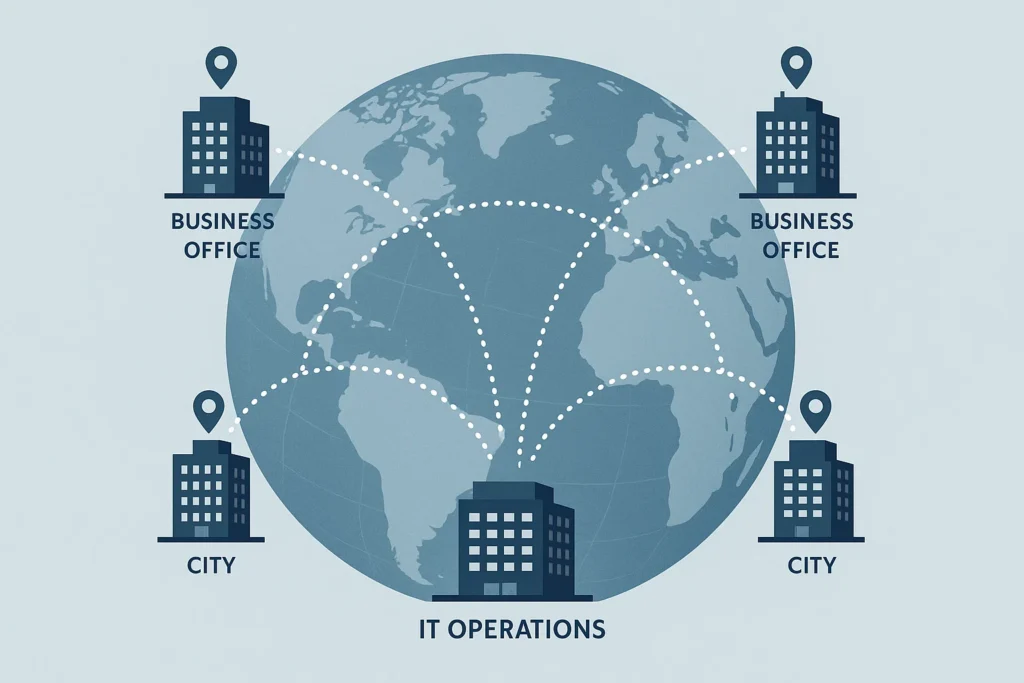
Industry: Specialty Retail Region: Georgia, Tennessee & North Carolina, United States Engagement Model: White-label delivery for an MSP partner Core Services: IT operations outsourcing, RMM deployment, tiered helpdesk support
Quick Summary
A regional specialty retail chain with 28 stores across three states had outgrown its three-person internal IT team years earlier — the business just hadn’t noticed yet. Store issues took 4–6 hours to get a response, IT staff spent nearly 40% of their time on the road, PCI compliance was at risk, and the one IT manager holding it all together was burned out and close to quitting.
TechMonarch implemented a full outsourced IT operations model through the retailer’s MSP partner. The result: response times dropped from 4–6 hours to under 15 minutes, POS availability climbed to 99.7%, the company passed its next PCI audit with zero findings, and e-commerce revenue grew 45% year-over-year once IT stopped being a constraint on growth.
Meet the Client
This client is a regional specialty retail chain operating 28 stores across three states, with about 450 employees supported by IT systems running everything from point-of-sale and inventory management to e-commerce and corporate operations.
For years, three people handled all of it. That worked fine when the company had 15 locations. But the business grew to 28 stores in three years, and the IT team never grew to match — geographic dispersion, inconsistent infrastructure, and slow response times all compounded until the model simply collapsed under its own weight.
(Note: client details have been anonymized at the customer’s request. This is a real engagement delivered through one of TechMonarch’s MSP partners.)
The Challenge: Three IT Staff, 28 Stores, Three States
The math alone explains most of the problem, but here’s the full picture:
Travel was eating nearly half of IT’s time. Store issues often required staff to physically drive or fly to a location, consuming close to 40% of IT time and costing $4,000–$5,000 a month in travel expenses alone — money spent just getting someone in the room, before any actual troubleshooting began.
Response times were unacceptable for retail. Average response time for store issues ran 4–6 hours. In a retail environment, POS downtime doesn’t just annoy IT — it directly costs revenue, every minute a register is down.
Infrastructure was wildly inconsistent. Different firewall models, varying POS hardware, thin documentation, and uneven security controls across locations — the kind of patchwork that happens naturally when stores get added faster than standards get enforced.
PCI compliance was genuinely at risk, with several audit findings still outstanding. Centralized monitoring and standardized patching simply didn’t exist across the store footprint.
The one person holding institutional knowledge was about to walk. The IT manager was burned out and considering leaving — which would have been catastrophic given how much undocumented knowledge lived in his head alone.
Growth was being held back by IT, not enabled by it. Leadership wanted to open 8–10 more stores, but the existing IT model couldn’t have supported that expansion without falling apart entirely. All of this was happening on an annual internal IT budget of roughly $380K — and service quality was still declining.
The retailer’s MSP partner proposed a full IT operations outsourcing model, with TechMonarch providing the execution framework to actually deliver it.
The Solution: A Scalable, Retail-Focused Outsourced IT Operations Model
We built this around the reality of multi-location retail: issues need to be resolved fast, remotely, most of the time — with reliable local backup for the moments that genuinely require hands on hardware.
Phase 1: Assessment & Standardization Planning
We assessed all 28 stores individually, then designed a standardized network, security, POS, and backup architecture, backed by a three-year technology roadmap tied to the company’s own growth plans.
Phase 2: Infrastructure Standardization
- Enterprise-grade networking with VLAN segmentation
- A unified security stack with centralized monitoring and EDR
- Standardized POS systems with offline failover, so a connectivity blip doesn’t stop a sale
- Local and cloud-based backups at every single site
Phase 3: Remote Management
We deployed RMM across more than 200 endpoints, servers, and network devices, established secure remote access with centralized monitoring dashboards, and built complete store-level documentation into a centralized knowledge base — replacing the tribal knowledge that had lived in one person’s head.
Phase 4: Support Delivery Model
We built a tiered support structure designed around actual urgency:
- Tier 1: 24/7 centralized helpdesk
- Tier 2: Advanced remote technical support
- Tier 3: Field services via vetted local technicians, with 2–4 hour response times for anything requiring hands-on work
- Account Management: A dedicated vCIO handling quarterly planning and budget forecasting
Phase 5: Retail-Specific Operations
We formalized POS escalation protocols, new store deployment checklists, peak-season readiness procedures, and inventory system integration — the operational details that generic IT outsourcing tends to miss.
Phase 6: Transition & Knowledge Transfer
The existing IT manager transitioned into a strategic coordinator role rather than being pushed out, knowledge transfer was completed thoroughly, and store managers were trained on the new support procedures they’d be interacting with day to day.
The Results
- Response times: Initial response dropped from 4–6 hours to under 15 minutes
- Remote resolution: 85%+ of issues resolved without an on-site visit
- Downtime reduction: A 67% decrease in unplanned outages
- POS availability: Improved to 99.7%, down from 40+ hours of annual downtime previously
- Full PCI compliance: Zero audit findings
- Predictable costs: ~$28,500/month, versus ~$380K annually in-house — with worse outcomes
- Growth enabled: 5 new stores opened seamlessly, with deployments now taking days instead of weeks
- Improved retention: IT leadership burnout eliminated entirely
- Business impact: E-commerce revenue grew 45% year-over-year, once IT stopped constraining it
Why the MSP Chose TechMonarch
The retailer needed retail-specific IT expertise, not a generic outsourcing arrangement. TechMonarch’s experience with multi-location retail, PCI compliance, POS environments, and peak-season operations made the execution reliable from day one.
The hybrid model — centralized remote support backed by fast local field services — solved the exact geographic challenge that had been grinding the internal team down. At the core of that model was proper RMM deployment across all 28 stores, giving the team real visibility and control over 200+ endpoints instead of flying blind between site visits. Layered on top was a genuine tiered IT helpdesk support structure, so the vast majority of issues could be resolved remotely in minutes rather than waiting hours for someone to drive out.
A strict standardization approach — one network architecture, one security stack, one POS deployment model — created long-term stability and made future store growth genuinely repeatable rather than a one-off project every time. The white-label partnership let the MSP retain the client relationship while TechMonarch delivered the operational execution behind the scenes.
Most importantly, the phased transition and respectful change management preserved institutional knowledge, protected employee morale — including the IT manager who could easily have been pushed out instead of promoted — and kept business operations running without interruption throughout.
Frequently Asked Questions
How does outsourced IT support work for a multi-location retail business? Typically through a tiered model: a centralized 24/7 helpdesk handles most issues remotely, advanced technical support resolves more complex problems, and local field technicians handle anything genuinely requiring hands-on work. In this engagement, that structure got 85%+ of issues resolved remotely, with field response times of 2–4 hours for the rest.
What’s a realistic response time improvement when outsourcing multi-location IT? It depends on the starting point, but the gains can be dramatic. In this case, moving from a strained three-person internal team to a properly staffed outsourced model dropped initial response times from 4–6 hours to under 15 minutes.
Can outsourced IT actually cost less than an internal team for a growing retail chain? Sometimes, yes — especially when the internal model has stopped scaling. In this engagement, outsourced IT operations ran about $28,500/month (roughly $342K annually) compared to ~$380K in-house, while delivering dramatically better response times, uptime, and compliance outcomes.
Can a multi-location IT outsourcing project like this be delivered white-label for an MSP’s clients? Yes — this entire engagement was delivered white-label, with TechMonarch handling the operational execution while the MSP retained full ownership of the client relationship.
Want to discuss your multi-location IT strategy? TechMonarch specializes in IT operations outsourcing for multi-location businesses nationwide, helping MSP partners deliver scalable, reliable IT support for distributed organizations. Let’s talk.
Recent Comments
- No comments to show