
Industry: Wholesale Distribution / Logistics Region: Indiana, United States Engagement Model: White-label delivery for an MSP partner Core Services: Infrastructure risk assessment, endpoint protection, patch management
Quick Summary
A regional wholesale distributor running a $65M operation across four locations had 25 years of organically-grown IT infrastructure — servers added as needed, networks expanded piecemeal, applications deployed to solve whatever problem was in front of them at the time. Leadership had no real picture of their actual risk until a cyber insurance renewal demanded documentation they couldn’t provide.
TechMonarch delivered a full-scope infrastructure, security, and business continuity audit through the distributor’s MSP partner. The outcome: high and critical vulnerabilities dropped from 37 to 3, unplanned downtime fell 68% year-over-year, and cyber insurance renewed at just an 8% premium increase instead of the carrier’s projected 30%+.
Meet the Client
This client is a regional wholesale HVAC distributor supporting a $65M annual operation across a main warehouse, three satellite distribution centers, and a corporate office — 125 employees relying on reliable order processing, inventory systems, and logistics to keep the business running.
Over 25 years, the IT environment had grown the way most SMB environments do: organically. Servers got added when something needed more capacity. Networks expanded piecemeal as locations were added. Applications got deployed to solve whatever immediate problem was in front of someone. Operations kept functioning — but nobody in leadership actually knew how much risk had quietly accumulated underneath that functioning surface.
(Note: client details have been anonymized at the customer’s request. This is a real engagement delivered through one of TechMonarch’s MSP partners.)
The Challenge: 25 Years of Organic Growth, Zero Formal Risk Visibility
The catalyst was a cyber insurance renewal — the insurer wanted detailed documentation of security, backup, and disaster recovery controls, and the distributor simply couldn’t confidently produce it. Digging in revealed exactly why:
The hardware was aging out. Physical servers were 10–12 years old, with some still running unsupported operating systems.
The network had real single points of failure. Mixed hardware from different eras, with multiple spots where one failure could take down critical systems.
Backups weren’t reliable. An inconsistent backup strategy included failed test restores — meaning nobody actually knew if recovery would work until it was too late to matter.
There was no formal disaster recovery plan. If something major happened, the response would have been improvised, not executed.
Security controls were thin across the board. No MFA, no EDR (endpoint detection and response) — just consumer-grade antivirus — and weak patch management leaving critical updates months behind.
Access hygiene had lapsed. Former employee accounts were still active long after those employees had left.
Documentation was minimal, and IT processes were informal enough that institutional knowledge lived mostly in one person’s head. That one-person IT team kept the lights on, but simply didn’t have the time or enterprise-level experience to systematically assess risk across four locations.
The warning signs were already there: a 6-hour outage from a server failure, a ransomware infection that was contained but still real, and a network outage from a failed core switch. Each incident reinforced the same growing concern — the business was one significant failure away from a prolonged, financially damaging disruption.
The Solution: A Full-Scope Infrastructure, Security & Business Continuity Audit
We assessed all four locations across seven phases, moving from discovery through prioritized, budgeted remediation.
Phase 1: Discovery & Documentation
We built a physical inventory of every server, network device, and endpoint, mapped the network topology, inventoried 23 distinct business systems, and reviewed existing operational procedures and vendor documentation.
Phase 2: Infrastructure & Performance Assessment
The findings here were sobering: unsupported Windows Server systems still in production, virtualization and storage platforms with no redundancy, an ERP database routinely operating at capacity, expired warranties on 75% of server hardware, and internet bandwidth constraints paired with unreliable wireless coverage.
Phase 3: Security & Vulnerability Assessment
We identified 37 external vulnerabilities, including exposed RDP services — a common ransomware entry point. The firewall was running outdated firmware with an unreviewed ruleset of 443 rules. Consumer-grade antivirus stood in for real EDR, patching was inconsistently applied with critical updates months behind, and 23% of passwords were set to never expire. A phishing simulation drove the point home further: a 47% click rate.
Phase 4: Business Continuity & Disaster Recovery
There was no formal DR plan or documented recovery procedure. Backups were failing silently on multiple systems without anyone noticing. Single points of failure existed across the network core, servers, and internet connectivity. We quantified the actual business cost of this exposure: order processing downtime was estimated at roughly $12,000 per hour.
Phase 5: Operations & Compliance Review
Change control was informal, governance and roadmapping were minimal, and the PCI DSS environment had real gaps in segmentation, logging, and vulnerability scanning — a meaningful exposure for any business processing payment cards.
Phase 6: Risk Scoring & Prioritization
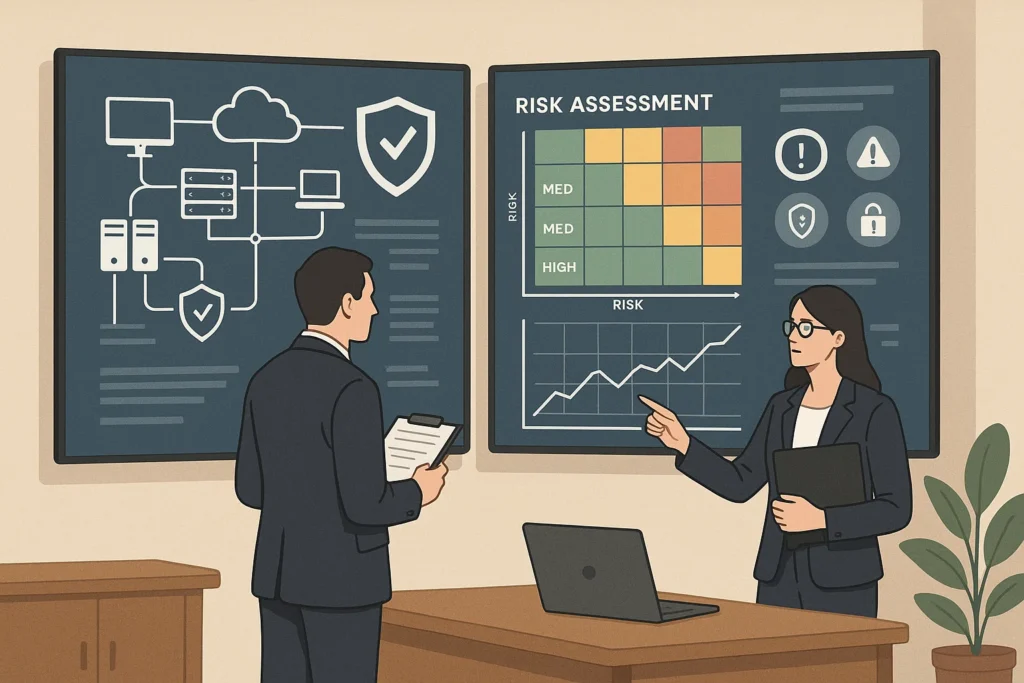
In total, the audit surfaced 67 findings: 8 Critical, 19 High, 24 Medium, and 16 Low. Every finding was scored by both likelihood and business impact, so remediation could be prioritized by what actually mattered most — not just technical severity in a vacuum.
Phase 7: Phased Remediation Roadmap
We delivered a cost-justified, 18-month remediation plan structured around realistic timelines:
- Immediate (30 days): Eliminate unsupported servers, fix silent backup failures, close critical vulnerabilities
- Short-term (90 days): Replace aging servers, add core network redundancy, deploy EDR, segment the network
- Mid-term (6–12 months): Virtualization upgrades, centralized patching, full DR implementation
- Ongoing: Security awareness training, quarterly vulnerability scans, annual infrastructure audits
Total projected investment came to roughly $185K — a real number, but a modest one next to the six-figure ransomware and downtime risks it was designed to close.
The Results
- Unplanned downtime reduced 68% year-over-year
- ERP system uptime improved to 99.8%
- Unsupported systems fully eliminated
- Backup restores tested and verified — no more silent failures
- High and critical vulnerabilities reduced from 37 to 3
- Two ransomware attempts blocked by the new EDR platform
- Phishing click rate dropped from 47% to 12%
- PCI DSS environment brought into compliance
- Disaster recovery procedures fully documented and tested
- A recent server room flood incident was resolved calmly with zero data loss — the DR plan working exactly as designed
- Cyber insurance renewal completed with only an 8% premium increase, compared to the carrier’s projected 30%+ without documented controls
Beyond the numbers, the distributor’s IT coordinator moved from reactive firefighting to proactive infrastructure management, backed by real documentation, tooling, and governance. Leadership now plans technology budgets based on quantified business risk — not in response to whatever just broke.
Why the MSP Chose TechMonarch
The distributor needed more than a technical checklist — they needed infrastructure risk analysis framed around actual business impact, not just a list of things to fix.
Two of the most consequential remediation items were endpoint protection and patch management — replacing consumer-grade antivirus with real EDR (which went on to block two ransomware attempts) and closing the months-long patching gaps that had left critical vulnerabilities exposed. Together, those two fixes accounted for a meaningful share of the drop from 37 vulnerabilities down to 3.
What set the engagement apart was translating every finding into revenue, downtime, insurance, and compliance impact — leadership didn’t just see “37 vulnerabilities,” they saw what those vulnerabilities meant in dollars and business risk. The holistic scope covered infrastructure, security, operations, and business continuity in a single engagement, backed by an actionable, budgeted roadmap rather than an overwhelming flat list. Delivered white-label through the distributor’s trusted MSP, the engagement also left internal IT genuinely enabled — documentation, training, and self-sufficiency, not ongoing dependency.
Frequently Asked Questions
What does an IT infrastructure risk assessment typically cover? A thorough assessment covers physical infrastructure and performance, security and vulnerability scanning, business continuity and disaster recovery readiness, and operational and compliance gaps — usually scored and prioritized by both likelihood and business impact rather than treated as a flat checklist.
How does infrastructure risk affect cyber insurance renewal? Insurers increasingly require documented security, backup, and disaster recovery controls before renewing coverage, and they price risk accordingly. In this case, the distributor’s carrier had projected a 30%+ premium increase without documentation; after the audit and remediation, renewal came in at just 8%.
What’s a realistic vulnerability reduction from a structured remediation roadmap? It depends heavily on the starting environment, but meaningful reduction is achievable with the right prioritization. In this engagement, high and critical vulnerabilities dropped from 37 to 3 over the course of an 18-month phased remediation plan.
Can an infrastructure audit and remediation project like this be delivered white-label for an MSP’s clients? Yes — this entire engagement was delivered white-label, with TechMonarch handling the audit, risk scoring, and remediation roadmap while the MSP retained full ownership of the client relationship.
Want to assess your infrastructure risk? TechMonarch specializes in IT infrastructure audits and risk assessments for SMBs, working with MSP partners nationwide to help mid-market companies understand technology risk and build practical improvement roadmaps. Let’s talk.
Recent Comments
- No comments to show