
Industry: Legal Services Region: North Carolina, United States Engagement Model: White-label delivery for an MSP partner Core Services: Centralized backup, disaster recovery, compliance reporting
Quick Summary
A regional law firm with 85 staff across three offices was managing highly sensitive legal data — contracts, court filings, client records — on a patchwork of local NAS devices, USB drives, and ad-hoc cloud accounts. Their last restore attempt had failed, and when leadership asked whether the firm could operate the next day if the main office burned down, the honest answer was “probably not.”
TechMonarch designed and deployed a centralized Veeam + Wasabi backup architecture through the firm’s MSP partner. The result: 100% of critical systems now protected, full office recovery tested at under 4 hours, and cyber insurance renewal approved with documentation to back it up — all at a lower, more predictable monthly cost than the fragmented setup it replaced.
Meet the Client
This client is a regional law firm with 85 staff spread across three offices, handling exactly the kind of data where “we’ll figure it out later” isn’t an acceptable backup strategy — contracts, court filings, and client records that carry real legal and confidentiality obligations.
Their backup environment, though, told a different story: local NAS devices, external drives, and ad-hoc cloud accounts, with no one holding clear visibility across any of it. Their most recent restore attempt had already failed once.
(Note: client details have been anonymized at the customer’s request. This is a real engagement delivered through one of TechMonarch’s MSP partners.)
The Challenge: Three Offices, Three Different Backup “Strategies”
The clearest way to describe the risk here is the question leadership actually asked: could we operate tomorrow if the main office burned down? The honest answer was no.
Here’s why:
Every office was doing its own thing. Charlotte relied on outdated NAS hardware with restores that had never been properly tested. Raleigh was backing up to USB drives and Dropbox. Greenville had no real backup at all beyond RAID redundancy — which protects against a drive failure, not against fire, theft, or ransomware.
There was no offsite protection. If anything happened to the physical office, the backups likely went with it.
RPO and RTO were undefined. Nobody could say with confidence how much data they’d lose or how long recovery would take in an actual incident — which is a hard thing to explain to a client, a regulator, or an insurer.
They’d already had a ransomware scare. Close enough to make the risk feel real, not hypothetical.
Compliance and cyber insurance renewal were adding pressure. Their insurer wanted encryption, documentation, and provable recovery capability — none of which the existing setup could demonstrate.
The firm’s MSP partner needed an enterprise-grade backup and disaster recovery solution that could still fit comfortably inside an SMB budget. That’s where TechMonarch came in.
The Solution: A Centralized Veeam + Wasabi Architecture, Built Hub-and-Spoke
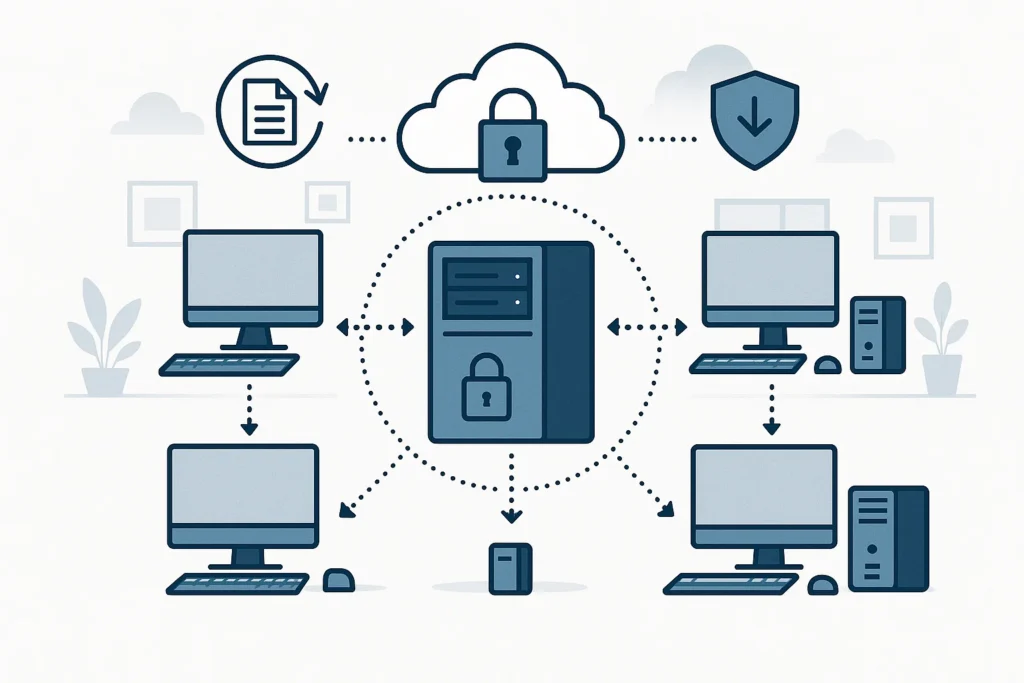
We designed a centralized backup solution using a hub-and-spoke model — one strong, well-protected core, with every office and workstation feeding into it.
Architecture
- A dedicated 12TB backup server in Charlotte running Veeam Backup & Replication
- Wasabi cloud for immutable offsite storage — protected against deletion or ransomware encryption
- Veeam agents deployed on remote servers and workstations, connecting over the firm’s existing VPNs
Data Protection
With roughly 8TB of total data to protect, we implemented a full 3-2-1 backup strategy: three copies of data, on two different media types, with one copy offsite. On top of that:
- Hourly backups for critical servers, daily backups for workstations
- Monthly backups retained for 7 years, matching legal industry retention expectations
- Application-aware SQL backups for database consistency
- Full encryption, both in transit and at rest
Testing & Documentation
A backup nobody has tested is really just a hope. So testing wasn’t an afterthought — it was built into the implementation itself: full server, file-level, and SQL restore testing, plus Instant VM Recovery validation. We backed that up with complete DR runbooks, restore procedures, encryption key management documentation, and hands-on training for the MSP and the firm’s internal IT staff.
Monitoring
Ongoing visibility came from Veeam ONE monitoring and alerting, daily success/failure reports, and monthly executive compliance reports — giving firm leadership the kind of documentation their cyber insurer was asking for.
The Results
Summit-style firms like this one moved from uncertainty to full visibility and control:
- 100% of critical systems now protected
- Cyber insurance renewal approved, with documentation in hand and a modest premium reduction
- File restores now take minutes instead of hours
- Full office recovery tested and confirmed at under 4 hours
- Backup-related support tickets dropped ~80%
- Predictable monthly cost of ~$850, replacing a fragmented ~$600/month setup that offered vastly inferior protection
The math is worth sitting with for a second: paying a bit more each month, for backup that’s actually been tested and proven to work, versus paying less for a setup that had already failed a restore.
Why the MSP Chose TechMonarch
The firm’s MSP partner chose TechMonarch for our proven Veeam experience in SMB environments and, just as importantly, for making restore testing mandatory rather than optional as part of the implementation. A backup solution that’s never been tested isn’t really disaster recovery — it’s a guess.
The white-label delivery model strengthened the MSP’s own service offering, letting them present enterprise-grade disaster recovery and incident management capability under their own brand. Our understanding of legal industry compliance and retention requirements — including the 7-year retention window this firm needed — meant the solution was built around their actual obligations, not a generic template.
Ongoing monitoring and event management through Veeam ONE and daily success/failure reporting gave both the firm and their MSP partner continuous confidence that backups were actually running — not just configured and forgotten.
Frequently Asked Questions
What does a 3-2-1 backup strategy mean? It means keeping three total copies of your data, stored on two different types of media, with at least one copy offsite. In this engagement, that meant local backups on a dedicated Veeam server plus immutable offsite copies in Wasabi cloud storage.
How long should disaster recovery actually take for a small or mid-sized firm? It depends on the environment, but it should be a known, tested number — not a guess. In this case, full office recovery was tested and confirmed at under 4 hours, a dramatic improvement from an environment where the last restore attempt had failed outright.
Why do cyber insurance renewals increasingly require backup documentation? Insurers want proof that a business can actually recover from ransomware or data loss, not just an assurance that backups exist. Encryption, tested restore procedures, and documented RPO/RTO are increasingly standard requirements — and in this engagement, that documentation helped the firm secure renewal with a modest premium reduction.
Can a backup and DR project like this be delivered white-label for an MSP’s clients? Yes — this entire engagement was delivered white-label, with TechMonarch handling the architecture and implementation while the MSP retained full ownership of the client relationship.
Want to discuss your next backup project? TechMonarch delivers enterprise-grade backup and disaster recovery for SMBs through MSP partners across the U.S. Let’s talk.
Recent Comments
- No comments to show