
-
Vijit
- April 23, 2026
- No categories assigned.
- No Comments
And Why Do Your Clients’ Clients Keep Asking for One?
| $4.88M avg. cost of a data breach globally in 2024 (IBM) | 53% of breaches involved customer PII (IBM 2024) | Type 2 gold standard — what enterprise buyers require | 12 mo Type 2 validity before re-audit is needed |
Picture this: your client — a mid-sized SaaS company you’ve been supporting for three years — finally lands a serious enterprise prospect. Due diligence kicks in. The prospect’s procurement team sends over a vendor security questionnaire, and buried on page 4 is a line that stops your client cold: ‘Please provide your most recent SOC 2 Type 2 report.’
Your client calls you. They have no idea what a SOC 2 report is, they definitely don’t have one, and the deal closes in 60 days. What do you tell them?
This plays out constantly across the MSP ecosystem. And it’s not just enterprise procurement anymore — insurance carriers are requiring it, investors ask for it during due diligence, and regulated industries are making it a contractual prerequisite. SOC 2 has shifted quietly from a differentiator to a table-stakes expectation for any technology company that handles client data.
1. What SOC 2 Actually Is — And What It Isn’t
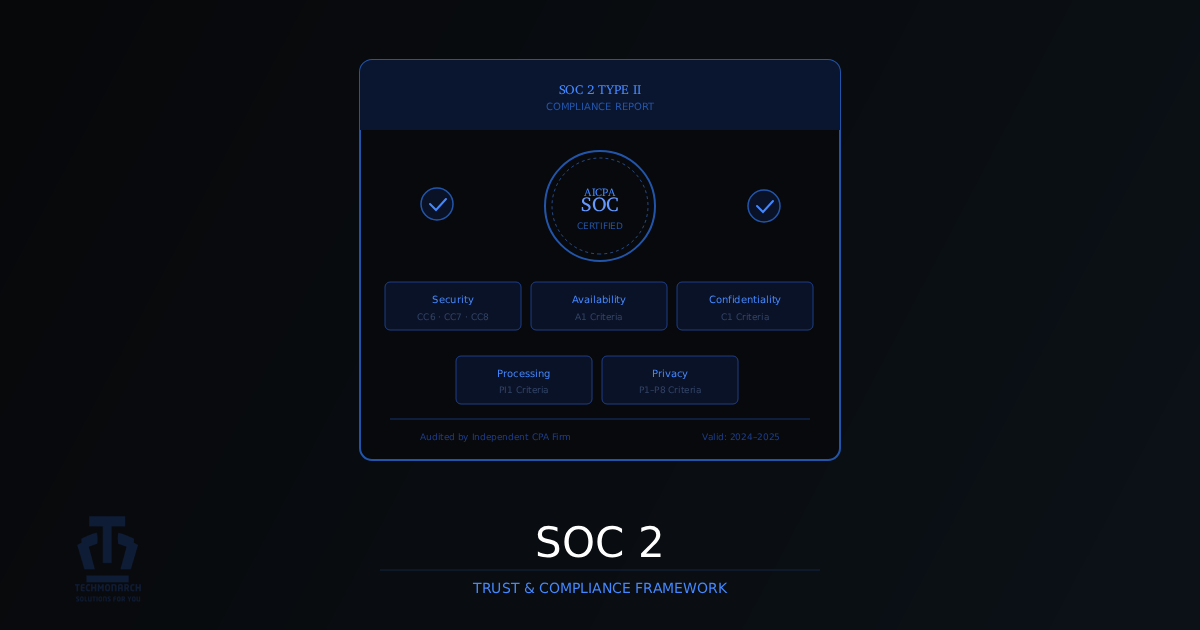
SOC 2 stands for System and Organization Controls 2. It’s a reporting framework developed by the AICPA to give technology and cloud service companies a standardised way to demonstrate that their systems meet defined security and data handling standards. A few things worth getting straight upfront, because the terminology gets muddled constantly:
| SOC 2 — Get the Terminology Right Not a certification — it’s an attestation. A licensed CPA firm examines your controls and issues a report. You cannot certify yourself. Not a checklist — it’s principles-based. Two companies with very different environments can both have valid SOC 2 reports. Not mandatory — but enterprise buyers, insurers, and regulated industries are making it effectively mandatory for any vendor handling their data. Not ISO 27001 — they overlap but serve different markets. SOC 2 dominates North America and SaaS; ISO 27001 is more prevalent in Europe. Many pursue both. Confidential — shared with clients under NDA, not published publicly. A SOC 3 is the public-facing summary version. |
The framework evaluates controls across five Trust Service Criteria. Security is the only required one. The rest are selected based on what’s relevant to the organisation’s services.
2. The Five Trust Service Criteria — In Plain English
Scope decisions matter more than most clients realise. Too narrow and the report won’t satisfy buyers. Too broad and the evidence burden becomes expensive and hard to sustain.
| Criterion | What It Means | Who Needs It | |
| ★ | Security (Required) | System is protected against unauthorized access, use, or modification. Covers access controls, encryption, monitoring, and incident response. | Every client, every environment. The floor, not the ceiling. |
| ◦ | Availability (Optional) | System is available as committed. Covers uptime SLAs, disaster recovery, and business continuity. | SaaS providers and cloud-hosted services with contractual uptime commitments. |
| ◦ | Processing Integrity (Optional) | Processing is complete, valid, accurate, and timely. Critical where incorrect processing has downstream consequences. | Payment processors, financial data systems, healthcare transaction platforms. |
| ◦ | Confidentiality (Optional) | Information designated as confidential is protected. Covers data classification, access restrictions, and disposal. | Clients handling trade secrets, legal data, NDA-protected information. |
| ◦ | Privacy (Optional) | Personal information is collected, used, and disposed of per commitments. Closely aligned with GDPR and CCPA. | Any client processing consumer PII — healthcare, retail, global businesses. |
Table 1: The five Trust Service Criteria — definitions and applicability (★ = required for all SOC 2 reports)
For most MSP clients — SaaS providers, cloud-hosted services, managed hosting — Security plus Availability covers the majority of what enterprise procurement wants. Add Confidentiality when the client handles data under NDA. Add Privacy when consumer PII and GDPR or CCPA obligations are in the picture. Piling on additional TSCs without a genuine business need for them is a common and avoidable mistake.
3. Type 1 vs. Type 2 — The Difference That Actually Matters
Type 1 is a point-in-time assessment: are your controls suitably designed? Type 2 tests whether those controls actually operated effectively over a defined period — typically 6 to 12 months. That distinction is everything, and getting it wrong costs clients significant time and money.
| Factor | Type 1 | Type 2 |
| What it assesses | Controls suitably designed at a point in time | Controls operated effectively over a defined audit period |
| Audit period | A single date (snapshot) | Typically 3–12 months of continuous operation |
| Time to complete | 4–8 weeks once ready | 6–12 months from readiness to report issuance |
| Market credibility | Acceptable for early-stage or first-time compliance | Gold standard — what enterprise procurement requires |
| Best for | Startups, first SOC 2 engagement, internal readiness benchmark | Any client selling to enterprise or serving regulated industries |
Table 2: SOC 2 Type 1 vs. Type 2 — practical comparison
| The Most Common Planning Mistake A client signs a contract with a Type 2 requirement, then asks their MSP how quickly they can get the report. The answer is: not quickly. A 3-month minimum audit period means a Type 2 cannot be issued in less than 5–6 months from the start of a readiness programme — assuming controls are clean and evidence collection starts immediately. The right time to start this conversation is during the sales process — before the contract is signed. |
4. Why Everyone Is Suddenly Asking for It
SOC 2 requests have moved from occasional to routine. Enterprise procurement teams have built formal third-party risk programmes off the back of regulatory pressure and supply chain breaches — and SOC 2 Type 2 is the clearest standardised evidence they can request from a vendor. It replaces the old self-attested security questionnaire model.
Cyber insurance underwriters are asking harder questions at renewal, and a valid SOC 2 is increasingly used as underwriting evidence. And the supply chain threat angle is real — MSPs are prime targets precisely because compromising one provider can unlock access to dozens of their clients. Sophisticated buyers know this. Asking for SOC 2 isn’t box-ticking; it’s a direct response to how attackers operate.
SOC 2 controls also overlap meaningfully with HIPAA, GDPR, CCPA, and PCI DSS — making it one of the most efficient paths for clients who need to satisfy multiple regulatory obligations simultaneously.
5. Where the MSP Fits — Responsibility and Opportunity
Because you manage much of the technical infrastructure your clients rely on, you’re already directly involved in the control areas auditors examine — whether or not you’ve been explicitly engaged on the SOC 2 process. Your systems generate the evidence. Your procedures either satisfy or undermine the controls being audited.
The domains where MSP accountability shows up most clearly: access controls and offboarding procedures, change and patch management records, incident response documentation, log retention and SIEM coverage, backup and recovery test records, and uptime monitoring data. In most client SOC 2 engagements, the MSP controls the majority of the technical environment under audit.
That creates responsibility — but also opportunity. Gap analysis, control implementation, evidence gathering, policy drafting, and continuous compliance monitoring are all natural extensions of what MSPs already do. For teams already running 24×7 NOC and SOC services, the logs, alerts, and records are already being generated. The question is whether they’re captured and documented in an auditable way.
6. A Realistic Timeline — Set Expectations Early
The number one expectation management failure in SOC 2 engagements is timeline. Here’s what the journey actually looks like: Scoping (1–2 weeks) → Readiness assessment and gap analysis (2–4 weeks) → Remediation and policy formalisation (2–6 months) → Evidence collection throughout the audit period → Auditor engagement (4–8 weeks) → Report issuance (2–4 weeks post-audit) → Annual ongoing compliance.
End-to-end for a Type 2 from scratch: minimum 8–10 months for a focused, well-resourced client. Typical is 12–18 months. Complex environments can run 18–24 months. For clients whose MSP has been running structured IT and security programmes, the readiness phase compresses significantly — controls may already exist, and the work becomes documentation and evidence formalisation rather than building from zero.
7. Four Misconceptions Worth Addressing Early
- ‘We just need to pass the audit’ — SOC 2 is not an exam. Controls must operate continuously. A Type 2 auditor samples evidence across the full audit window and will spot gaps if controls drifted after month two.
- ‘The MSP handles all this for us’ — the MSP is a critical contributor, not the owner. The client organisation owns the programme. They’re responsible for ensuring evidence is captured under their name and formally attributed to their system description.
- ‘Any auditor will do’ — SOC 2 audits must be conducted by a licensed CPA firm with SOC examination experience. Quality varies significantly. Recommending auditors with SaaS or managed service experience is part of the value you provide.
- ‘We’ll deal with evidence as we go’ — evidence collection is where most programmes stall. Systematic capture must begin on Day 1 of the audit period, not assembled retrospectively the month before the auditor arrives.
Final Thoughts
SOC 2 has become the default trust credential for technology service providers. The question is no longer whether clients need it — the market settled that. The question is when and how, and whether you’re positioned to guide them through it before the pressure becomes a crisis.
For MSPs, the strategic position is clear: the controls you implement, the logs you retain, the alerts you respond to — these are all audit evidence. The organisations that build SOC 2 readiness into how they deliver services, rather than treating it as a one-time project, have a genuine competitive advantage. Done properly, it’s not a compliance checkbox. It’s an operational maturity programme that makes organisations genuinely more secure, better documented, and more trusted.
Recent Comments
- No comments to show