
-
Vijit
- June 1, 2026
- No categories assigned.
- No Comments
The Misconception That Costs MSPs Clients
Picture the conversation. An MSP is pitching a prospect with a healthcare background — a clinic group that has been reading about ransomware in their sector and is nervous. The salesperson walks them through the managed IT stack and, near the end, mentions the SIEM. ‘We have a SIEM in place,’ they say, ‘so your environment is being monitored around the clock.’
The prospect hears: we have a security operations team watching your data 24/7. What the MSP actually has is a log correlation platform that fires alerts into a queue that gets reviewed during business hours by engineers whose primary job is helpdesk.
Nobody is lying. Nobody is deliberately misleading anyone. But the gap between what was said and what was understood is the gap that costs MSPs clients — sometimes at renewal, sometimes after an incident, and sometimes when a more security-literate competitor walks in the door and explains the difference.
The SIEM-is-a-SOC misconception is one of the most common and most consequential misunderstandings in managed IT security. It is worth understanding clearly — both so you do not fall into it yourself, and so you can explain it to clients in a way that builds rather than erodes trust.
1. What a SIEM Actually Is
A SIEM — Security Information and Event Management — is a software platform. It collects logs from across an environment (firewalls, endpoints, Active Directory, cloud services, email security), correlates them using detection rules and statistical models, and generates alerts when patterns match defined criteria.
That is a genuinely powerful capability. A well-configured SIEM, with quality data sources and properly tuned detection rules, can surface threats that no individual log source would reveal on its own. It is the closest thing to a nervous system that a security programme has.
But here is the critical thing: a SIEM does not respond to anything. It does not investigate its own alerts. It does not decide whether an alert is a genuine threat or a false positive. It does not contain an infected endpoint, disable a compromised account, or escalate to a senior analyst at 2am. It generates a ticket. What happens next is entirely a function of who is on the other end — and how quickly, and how capable they are.
Without trained analysts actively working those alerts, tuning the detection rules, hunting for threats that are not yet generating alerts, and making incident response decisions in real time — a SIEM is an extremely expensive log aggregator.
| The False Positive Problem Without constant tuning, 80-90% of SIEM alerts can be noise — false positives generated by legitimate activity that matches a detection rule. Analysts become desensitised to alerts they have seen fire on benign activity many times before. When the real threat arrives, it looks like noise. This is not a SIEM product flaw. It is the operational consequence of a SIEM running without the human layer required to maintain and improve it. A SOC actively tunes detection rules, removes low-value alerts, and builds new detections from incident findings. The quality improves over time. Without that loop, quality degrades — often invisibly. |
2. What a SOC Actually Is
A Security Operations Centre is an operational function — a team of people, supported by technology and guided by process, whose job is to detect, investigate, and respond to security threats continuously.
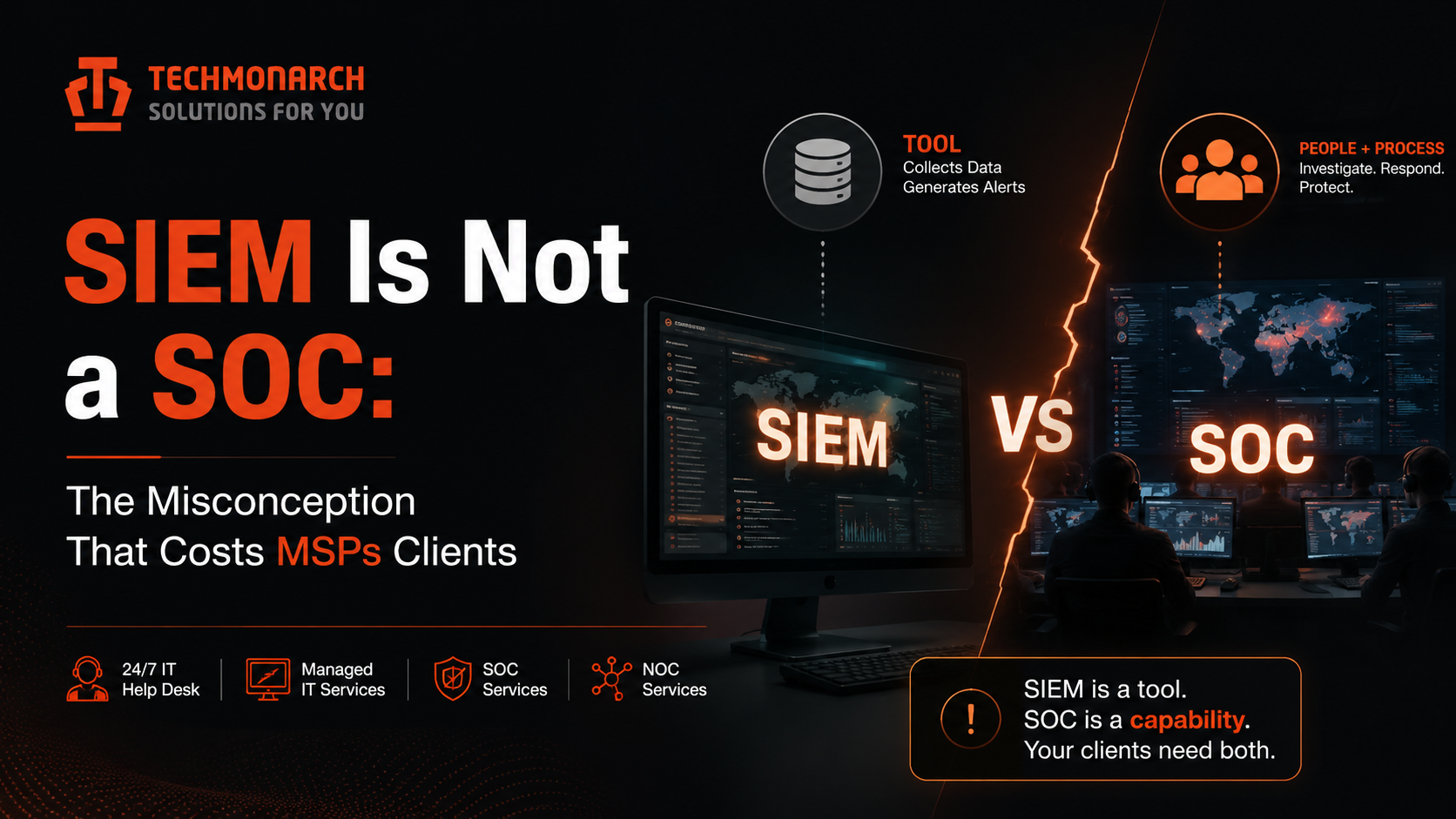
The SIEM is often the central tool of a SOC. But the SOC is not the SIEM. The SOC is the people who watch the SIEM, investigate what it surfaces, make judgement calls about severity and response, hunt for threats the SIEM has not yet detected, and improve the detection rules based on what they learn from real incidents.
A SOC typically has tiered analyst roles: Tier 1 triages incoming alerts and closes clear false positives. Tier 2 investigates more complex events, gathers evidence, and determines whether an incident is genuine. Tier 3 handles advanced threats, performs forensic analysis, and contributes to detection engineering. Without all three tiers functioning — or an equivalent structure — the SIEM output just accumulates in a queue.
Gartner predicts that 50% of organisations will use MDR services by 2025, driven partly by the recognition that maintaining a genuine SOC capability in-house is expensive, resource-intensive, and hard to sustain at quality across all hours. The tool alone is not the answer. The team operating it is.
3. Side by Side — The Difference in Plain Terms
| Dimension | SIEM (The Tool) | SOC (The Operation) |
| What it is | A software platform. It ingests logs, correlates events, fires alerts, and stores data. | A team of people, processes, and tools working together to detect and respond to threats. |
| What it does on its own | Generates alerts. That is all. A SIEM with no one watching it is a library with no librarian. | Investigates alerts. Makes decisions. Takes action. Escalates when needed. Hunts for threats proactively. |
| Who acts on alerts | Nobody — the SIEM does not respond. It surfaces information for humans to act on. | Analysts. Tier 1 triages, Tier 2 investigates, Tier 3 handles complex incidents and escalates. |
| False positive management | Without active tuning, 80-90% of SIEM alerts can be noise. The platform does not self-correct. | Analysts review, tune, and improve detection rules. Quality improves over time with human feedback. |
| Threat hunting | None. A SIEM responds to what it is configured to alert on. It does not go looking. | Proactive. SOC analysts hunt for threats not yet generating alerts, based on intel and hypotheses. |
| Incident response | None. The SIEM creates a ticket. What happens next is entirely up to whoever receives it. | Analysts investigate, contain, escalate, and coordinate response. The SOC owns the outcome. |
| Value without humans | Very low. A perfectly configured SIEM with no analyst team is an expensive log aggregator. | N/A — by definition, a SOC is a human operation. The tools serve the team, not the reverse. |
SIEM vs. SOC — seven dimensions that define the difference
The row that matters most in that table is the one about value without humans. A SOC, by definition, is a human operation — the tools are in service of the team. A SIEM without a team operating it is a very different proposition from a SIEM inside a functioning SOC. Most MSPs selling ‘SIEM-backed security’ are offering the former while implying the latter.
4. Why This Misconception Costs MSPs Clients
The damage from this confusion tends to arrive in one of three ways.
At the incident
A client environment experiences a genuine security incident. The SIEM fired an alert three days ago. Nobody investigated it, because the alert queue was too large, or the engineer assigned to check it was overwhelmed with helpdesk tickets, or it looked like a known false positive pattern. The incident escalates. The client asks: ‘Did your system see this coming?’ The honest answer is: the SIEM did. The SOC did not, because there was no SOC.
That conversation ends client relationships. And it should — because the client bought something they did not get. The fact that nobody lied does not matter at that point.
At renewal
A more security-literate client — or one whose board has started asking harder questions after reading about industry breaches — starts probing what ’24/7 monitoring’ actually means. They ask to see the analyst team. They ask about MTTR. They ask how many alerts were reviewed last month and how many were actioned. When the answers reveal a SIEM with no SOC behind it, they leave — often to a competitor who is honest about the distinction and charges accordingly.
At the competitor conversation
A competitor MSP who actually operates or partners with a SOC walks in and draws the distinction clearly. They do not even need to criticise the incumbent — they just explain what a SOC is and what it does, and the client does the rest of the thinking. The MSP who conflated SIEM with SOC loses the account without ever understanding exactly why.
5. What the Right Answer Actually Looks Like
The good news is that this is a solvable problem — and the solution is not necessarily building a full in-house SOC, which is expensive and difficult to staff well.
- Be precise in how you describe what you have: If you have a SIEM and a helpdesk team that reviews alerts during business hours, say that. It is a legitimate service. Name it accurately.
- Add the human layer through a partner: White-label SOC services exist specifically to solve this problem — giving MSPs analyst coverage they cannot staff internally, operating under the MSP’s brand. The SIEM becomes the tool of a functioning SOC rather than an orphaned platform.
- Differentiate between tiers: Offer a lower-cost tier that is honestly described as SIEM-backed monitoring with business-hours review, and a higher-cost tier that includes genuine 24/7 SOC analyst coverage. Clients who understand the difference will self-select appropriately.
- Use the distinction as a sales advantage: Most of your competitors are not making this distinction clearly. Being the MSP that explains it honestly — and offers both options — builds significantly more trust than the one that lets clients assume.
The MSPs who have navigated this well are typically the ones who had the conversation proactively, before an incident forced it. They sat down with clients, explained the difference between a SIEM and a SOC in plain language, and either upgraded the service or accurately right-sized the client’s expectations. Both outcomes are better than the alternative.
The Bottom Line
A SIEM is a powerful tool. A SOC is the operation that makes it useful. Selling one as the other is not a sustainable position — because the gap only stays hidden until something goes wrong, and when it does, the client remembers exactly what they were told.
The MSPs who build durable security practices are the ones who are honest about what they have, clear about what they offer, and deliberate about filling the gaps — whether through investment, partnership, or an honest conversation about what the client actually needs and what is actually being delivered.
| About TechMonarch TechMonarch provides white-label SOC services to MSPs who want to offer genuine analyst-backed security coverage under their own brand — without building and staffing the SOC team internally. The SIEM is your tool. The analysts are ours. The service is yours. If that model is what you have been looking for, let’s talk. Get in touch: www.techmonarch.com |
Recent Comments
- No comments to show