
-
Vijit
- May 21, 2026
- No categories assigned.
- No Comments
The MSP Dilemma in White-Labeling
Every MSP that has grown past a handful of clients eventually runs into the same wall. One client wants tickets handled their way. Another has a specific reporting format their board insists on. A third has a legacy application that does not fit neatly into your standard stack. And then there is the new client that came over from a competitor and expects everything done the way their old MSP did it.
You want to say yes to all of them. You probably do say yes to all of them. And then six months later you have eight different variations of your onboarding process, five different ticket categories across your PSA, and a white-label partner who is quietly struggling to keep up because no two clients work the same way.
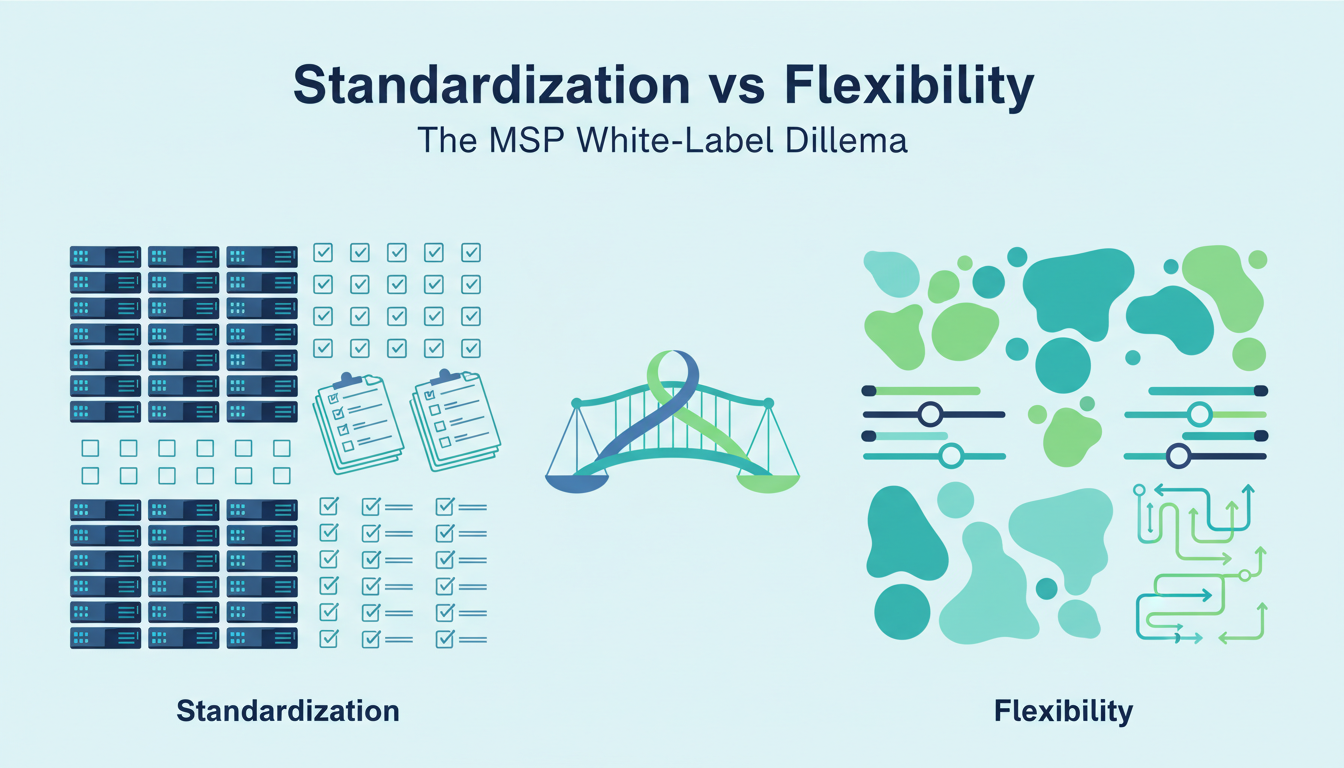
This is the standardisation versus flexibility dilemma. It is one of the most practically consequential decisions an MSP makes, and in white-label delivery models it becomes even more acute — because the partner delivering the service under your brand needs enough consistency to operate at quality and enough flexibility to feel like it is actually tailored to each client.
Getting this balance right is not about picking a side. It is about being deliberate about which things to standardise and which things to intentionally leave flexible — and why.
1. Why Standardisation Matters More Than Most MSPs Admit
There is a version of this conversation that treats standardisation as a corporate convenience — something that benefits the MSP at the client’s expense. That framing is wrong. Standardisation is what makes consistent quality possible at scale. Without it, quality becomes dependent on which engineer picks up the ticket, which shift is covering overnight, or how many new clients were onboarded this quarter.
When you bring in a white-label partner to extend your service delivery — whether for helpdesk, NOC, SOC, or cloud support — the only way they can represent your brand reliably is if they have documented, repeatable processes to follow. A partner engineer who handled a P2 ticket for Client A on Tuesday cannot perform at the same standard for Client B on Thursday if the process is different every time. They are not failing because they are not good enough. They are failing because there is no standard to meet.
The research is clear on this: MSPs who standardise their tooling and processes support more clients with fewer staff. An MSP with 40 managed clients and standardised workflows, automation, and tooling can support that load with five technicians. The same 40 clients, each with bespoke configurations and custom processes, might need twice that headcount — and deliver less consistent results.
| The Cost of Custom Every exception you make for a client has a hidden operational cost: • Your white-label partner needs a separate briefing for that client’s quirks • Your documentation becomes a patchwork of one-off notes rather than reliable runbooks • When a senior engineer leaves, the institutional knowledge about ‘how we do things for Client X’ leaves with them • Onboarding new staff (or partners) takes longer because there is no consistent baseline to train to None of this shows up on a single invoice. It accumulates slowly and invisibly until it becomes a capacity or quality crisis. |
2. Why Flexibility Is Not Optional Either
Here is the other side of it, and it is just as real.
A 12-person professional services firm and a 200-seat manufacturing company have fundamentally different IT environments, different risk profiles, different communication expectations, and different definitions of what ‘good service’ looks like. Treating them identically does not serve either of them well — and clients can tell when they are being served from a template rather than actually understood.
In white-label delivery specifically, the risk of over-standardisation shows up as a hollow brand experience. The helpdesk engineer picks up the ticket and follows the runbook correctly, but they do not know who the client is, how they communicate, or what they care about. The technical work is fine. The relationship is not.
Flexibility is also commercially necessary. Some clients — enterprise accounts, highly regulated organisations, clients willing to pay a premium — will have legitimate requirements that fall outside your standard offering. The ability to accommodate those requirements is what keeps them from outgrowing you.
The question is not ‘should we be flexible?’ but ‘which things should we be flexible about, and which things should we hold firm on?’
3. The Framework — What to Lock Down and What to Leave Open
The most useful way to think about this is in two layers: the delivery infrastructure and the client experience layer on top of it. Standardise the infrastructure ruthlessly. Allow flexibility at the experience layer deliberately.
| Area | Standardise This | Allow Flexibility Here |
| Tooling (RMM, PSA, documentation) | The platforms themselves. One RMM, one PSA, one documentation tool across all clients. | Configuration within the tool — alert thresholds, custom dashboards, client-specific monitoring profiles. |
| Ticket handling & SLA tiers | The tier definitions (P1-P4), response time commitments, and escalation paths. | Communication style and tone adjusted to client culture — formal for enterprise, casual for startups. |
| Onboarding process | The steps: discovery, documentation, baseline config, knowledge transfer. Same every time. | Depth and pace — a 10-person firm onboards differently from a 300-seat enterprise. |
| Security baseline | MFA, endpoint protection, backup policy, patch cadence. Non-negotiable minimums for all clients. | Additional controls layered on top for clients with elevated compliance requirements. |
| Reporting format | Report structure, data sources, and delivery cadence are standardised. | Branding, client-specific KPIs highlighted, and what gets called out in the executive summary. |
| White-label partner SOPs | The runbooks your partner follows. Same playbooks every time — this is how quality scales. | Client-specific notes appended to runbooks. The SOP is standard; the context is tailored. |
| Pricing model | Tier structures and base pricing. Complexity comes from exceptions, not the model. | Custom bundling for clients who fall outside standard tiers — done deliberately, not by default. |
What to standardise vs. where to allow flexibility — a working framework for MSP white-label delivery
The pattern in that table is consistent: standardise the structure, allow flexibility in the customisation on top of it. The SLA tier definitions are fixed. How you communicate within those tiers is tailored. The security baseline is non-negotiable. The additional controls layered on for a HIPAA client are specific to them.
This is how good white-label delivery actually works. The partner follows the same runbook for every client — that is what makes quality consistent. The runbook has a client-specific notes section that captures the things that are genuinely different. The standard and the tailored coexist without creating chaos.
4. The White-Label Dimension — Where This Gets Complicated
When you bring in a white-label partner, standardisation becomes even more important — and flexibility becomes more expensive to deliver.
Your partner can absolutely accommodate client-specific nuances, but every deviation from the standard process requires documentation, a briefing, an updated runbook, and ongoing quality monitoring to ensure the deviation is being followed correctly. That operational overhead is real. The more bespoke your client configurations are, the higher the burden on both your team and the partner delivering under your brand.
The MSPs that make white-labeling work cleanly have usually done two things before the partner engagement starts:
- Standardised their own house first: consolidated tools, documented SOPs, cleaned up the variation that had accumulated over years of saying yes to every client request.
- Made a deliberate decision about what is negotiable: defined which client requirements are accommodated (and charged for accordingly), and which requests are politely declined because they fall outside what the model can support.
That second point is harder than it sounds. Saying no to a client request — especially a long-standing client — feels like poor service. But saying yes to everything is what creates the operational complexity that makes it impossible to serve anyone well at scale.
5. A Practical Test for Any New Request
When a client (or a prospect) asks for something that falls outside your standard offering, run it through three questions before you decide:
- Can the partner deliver it reliably? Not in theory — in practice, with the documentation and runbook support required to do it consistently across shifts and team members.
- What does it cost operationally? Not just the time to set it up, but the ongoing overhead: the extra documentation, the training, the QA, the additional briefing every time a new partner engineer is assigned to that client.
- Is it priced accordingly? Custom work should have a custom price. If a client’s bespoke requirement is being absorbed into the standard monthly fee, you are effectively subsidising their complexity with the margin from your standardised clients.
If the answer to all three is yes — the partner can deliver it, the operational cost is understood, and the pricing reflects it — then accommodate it. If any of those three are uncertain, the default should be to bring the request back to standard rather than create another one-off.

The Bottom Line
The MSPs that scale well are not the ones who standardise everything rigidly or the ones who flex to every client demand. They are the ones who have been deliberate about the distinction — who decided what the baseline is, held it, and built the flexibility on top of that baseline rather than instead of it.
In white-label delivery, this discipline is not optional. A partner cannot represent your brand consistently across dozens of clients if every client is its own bespoke project. The standard is what allows the partner to function as your team. The tailoring on top is what makes clients feel seen. Both have to exist. The structure is what allows them to coexist.
| About TechMonarch TechMonarch provides white-label Managed IT, NOC, SOC, and Cloud Support to MSPs globally. Our delivery model is built around standardised runbooks with client-specific context — which means consistent quality without the rigidity that makes every client feel like they are getting the same generic service. If you want to talk through how this works in practice, we are easy to reach. Get in touch: www.techmonarch.com |
Recent Comments
- No comments to show