
-
Vijit
- November 19, 2026
- Cybersecurity
- No Comments
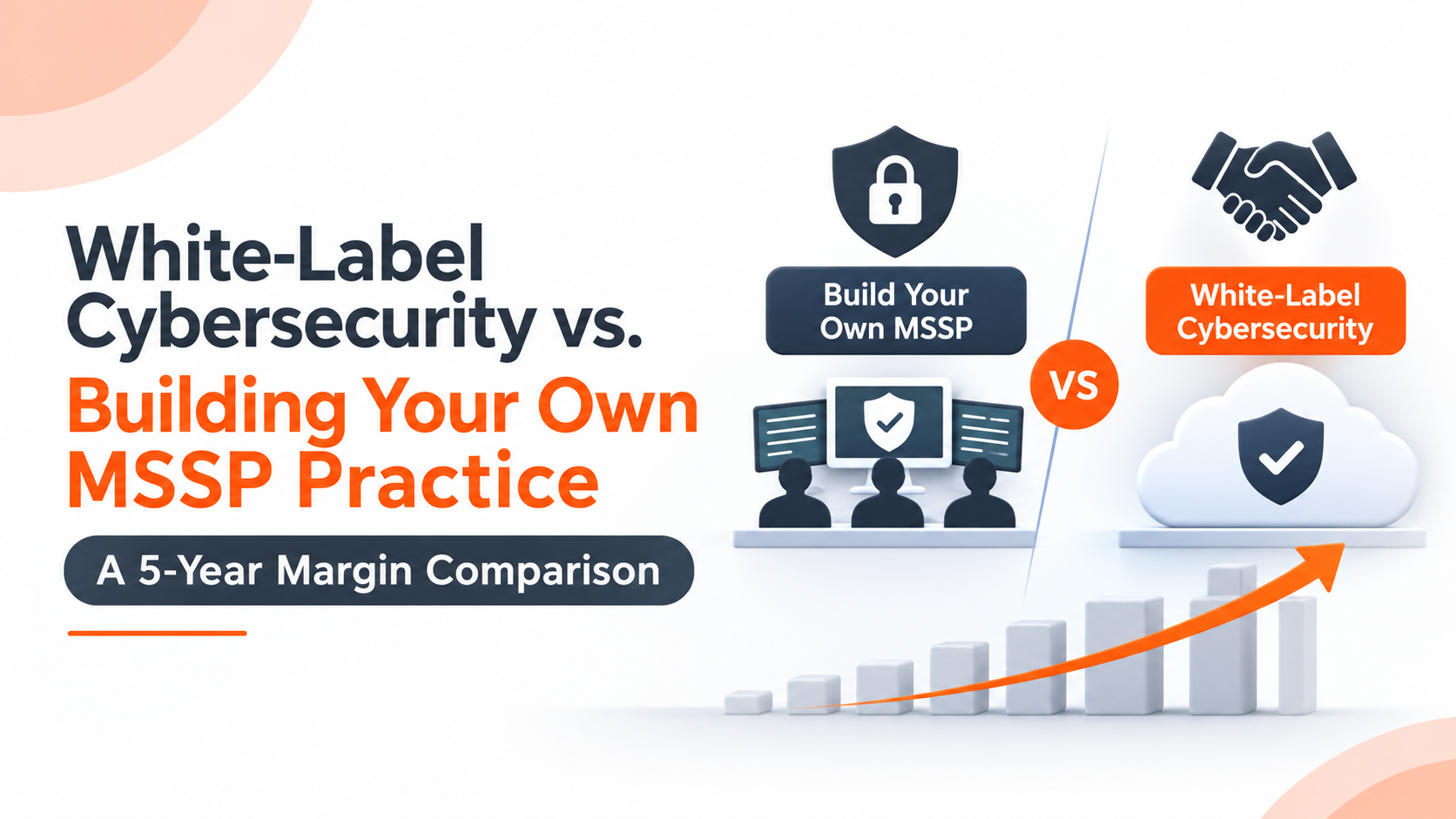
Every MSP owner eventually gets the same question from a client: “What are you doing about security?” The easy answer is a stack of tools and a monitoring dashboard. The real answer requires deciding whether to build a security operations practice of your own or resell one that someone else runs.
The tempting argument for building is margin. You keep everything the partner would have taken. The argument for white-labeling is risk and speed. Both are true, and neither tells you which wins over five years, because the answer depends on a few numbers most owners never write down. Let’s put them down.
Why Year One Misleads
An MSSP practice has a brutal cost shape. Before the first alert is worked, you need analysts who can cover every hour of the week, a SIEM and EDR stack, someone senior enough to lead it, and an audit trail credible enough to satisfy a client’s questionnaire. A single seat covered 24/7 takes roughly five to six full-time people once you account for shifts, leave, and sickness, and that’s before you add depth for investigation and escalation.
Revenue, meanwhile, arrives gradually as you sell security to existing clients one at a time. So the early years look terrible for a build and tidy for a partnership, and that gap gets misread in both directions. Owners who only see year one dismiss building. Owners who only see year five underestimate the cash they’ll burn getting there.
The Assumptions
This is a simplified model, and every input is my assumption, so replace them with your own before relying on it.
- You sell managed detection and response to your clients at $22 per endpoint per month.
- Average protected endpoints grow over five years: 2,000, 5,000, 8,000, 11,000, 14,000.
- White-label: the partner charges $11 per endpoint per month, and you carry $70,000 a year of internal oversight in years one and two, rising to $140,000 from year three.
- Build: a minimum of 7 staff for 24/7 coverage, then one analyst or manager added per 1,000 endpoints at a loaded cost of $105,000 each. Tooling runs $4 per endpoint per month plus $120,000 a year of fixed platform cost. Compliance, audit, and insurance cost $90,000 a year, and recruiting and training run between $60,000 and $110,000 a year.
The Five-Year Result
| Year | Avg endpoints | Revenue | Build margin | White-label margin |
| 1 | 2,000 | $528K | -$613K (-116%) | $194K (36.7%) |
| 2 | 5,000 | $1.32M | $75K (5.7%) | $590K (44.7%) |
| 3 | 8,000 | $2.11M | $608K (28.8%) | $916K (43.4%) |
| 4 | 11,000 | $2.90M | $921K (31.7%) | $1.31M (45.2%) |
| 5 | 14,000 | $3.70M | $1.23M (33.4%) | $1.71M (46.2%) |
| Total | $10.56M | $2.23M (21.1%) | $4.72M (44.7%) |
On these assumptions, white-label produces about $2.5 million more gross margin over five years. The build approach loses $613,000 in year one, doesn’t break even on a cumulative basis until year three, and even in year five earns a lower percentage margin than the partnership does.
That’s the headline. The more useful finding is what sets it.
The Variable That Flips the Result
Look at the build model’s staffing assumption: one analyst per 1,000 endpoints. Staff cost is by far the largest line, so the ratio of endpoints per analyst decides almost everything.
Rerun year five with one analyst per 2,000 endpoints, so you stay at the 7-person floor instead of 14. Staffing falls from $1.47M to $735,000, total cost drops to about $1.73M, and build margin rises to roughly $1.97M, or 53%. That beats the partnership’s 46%.
So the honest summary is this: building wins if you can run materially better analyst productivity than the market, and loses if you can’t. Productivity comes from automation, tuned detections, strong tooling, and mature playbooks. A partner serving many clients spreads that investment across its whole base, which is why it typically achieves ratios a single MSP can’t match at your size. And the partner’s price reflects that. If your productivity were better than theirs, you’d have little reason to buy from them.
That’s a hard question to answer honestly in advance. Our overview of SOC maturity models and how to progress from reactive to proactive operations is a useful yardstick: most new in-house SOCs spend their first years firmly in the reactive stage, where the ratio is poor, not the proactive stage where it improves.
What the Spreadsheet Doesn’t Capture
Hiring and retention. Security analyst roles carry high turnover and a competitive market. Every departure costs recruiting fees, training time, and weeks of reduced coverage. My model includes a modest allowance for this, and it may be too generous for a small team where one resignation is a quarter of the roster.
Depth of coverage. A seven-person team covers shifts. It doesn’t necessarily provide specialist threat hunting, malware analysis, or incident response skills. A larger partner pools those. We’ve written about how threat hunting works in a white-label SOC across multiple clients, and the cross-client visibility is something a single-MSP SOC can’t replicate: a technique seen at one client becomes a detection for all of them.
Liability and insurance. Running your own security operation puts you in the position of being the party that missed the alert. That affects your insurance, your contracts, and your exposure after an incident. A partner doesn’t remove that liability, since the client still holds you accountable, but contract terms can allocate some of it. The financial consequences of getting this wrong are covered in our piece on the hidden costs of cyberattacks and why MSPs need cyber insurance.
Enterprise value. An owned, profitable security practice can raise what a buyer will pay for your MSP. But the key word is profitable. A subscale SOC losing money drags valuation down instead of lifting it.
Control and differentiation. Building gives you control over detections, tooling choices, response behavior, and client relationships. For some MSPs, particularly those targeting regulated verticals, that control is part of the product.
What White-Label Costs You
The partnership isn’t free of downsides, and an honest comparison names them.
- A margin ceiling. The partner’s cut is permanent. In the model, you never exceed 46%, however much you scale.
- Dependency. Your security offering rests on another company’s staffing, tooling, and continuity.
- Less control over detection tuning, though good partners let you set escalation rules and response authority.
- Data and portability. If you leave, what happens to your detection history and tuning? Negotiate this up front.
- Brand risk. Your clients see the partner’s work as yours. That’s the point of white-label, but it means a partner’s failure is your failure.
A Sensible Path for Most MSPs
For most MSPs with fewer than a few thousand endpoints under protection, the numbers favor starting with a partner. You get coverage immediately, you learn what your clients actually buy, and you avoid committing seven salaries to a service line that isn’t yet proven.
From there, the decision becomes a matter of triggers rather than ambition. Consider building, in full or in part, when your protected endpoint count is large enough to keep a team busy, when you can demonstrate better analyst productivity than the partner’s published ratios, when clients specifically require capabilities a partner can’t provide, and when you have the management bandwidth to run a 24/7 operation. Plenty of MSPs end up in a hybrid: they keep client-facing security advisory and a small response function in-house, and leave round-the-clock monitoring with a partner.
Whichever way you lean, protect your options. Contract for portability of runbooks, detection content, and data. Ask for the partner’s analyst-to-endpoint ratio and mean time to respond. And track your own security margin per endpoint every quarter so you know when the economics change.
If you want to test the partnership model against your own numbers, our managed security services can be sized by endpoint count, which gives you a concrete rate to put into the model above. Replace my assumptions with yours, rerun the five years, and look hardest at the productivity line, because it’s the one that decides the answer.
Recent Posts
- White-Label Cybersecurity vs. Building Your Own MSSP Practice: A 5-Year Margin Comparison
- Scaling Through White-Label Partnerships vs. Scaling Through Acquisition: Speed-to-Revenue Compared
- Per-Device vs. Per-User vs. Per-Endpoint Pricing: Which White-Label Billing Model Protects Your Margin Best
- AI-Augmented NOC Monitoring vs. Traditional Threshold-Based Alerting: Comparing False-Positive Rates
- RMM-Native White-Label Support vs. Ticket-Only Outsourcing: Why Tool Access Changes the Math
Recent Comments
- No comments to show