
-
Vijit
- November 16, 2026
- No categories assigned.
- No Comments
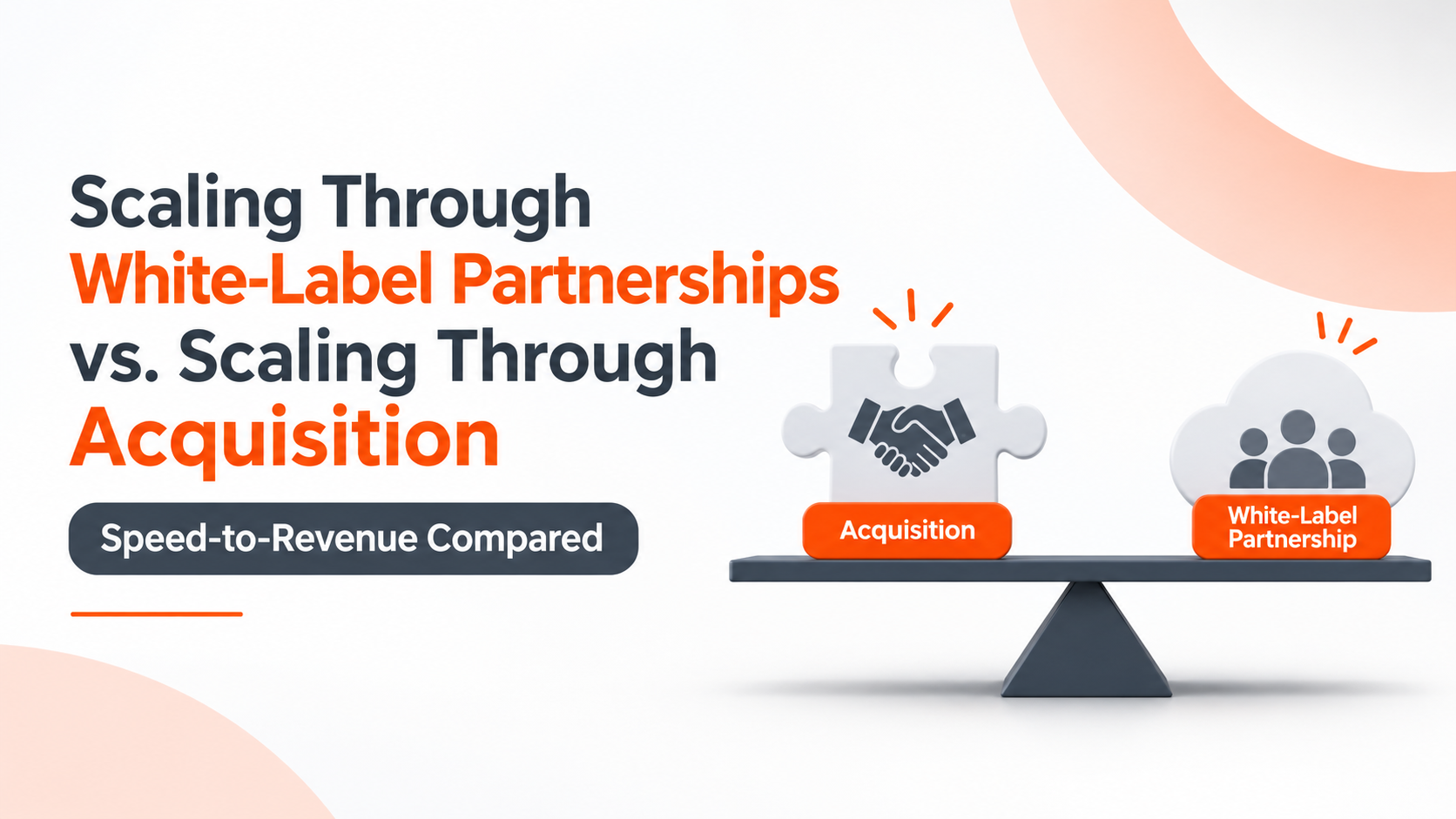
Ask an MSP owner how to grow faster and sooner or later someone says “just buy a smaller shop.” Ask another and you’ll hear “build the capacity through a partner and sell harder.” Both are legitimate. They are also solving different problems, which is why comparing them on speed alone produces confusing answers.
Acquisition buys customers. A white-label partnership buys capacity. If your bottleneck is demand, acquisition is the direct fix. If your bottleneck is delivery, it isn’t. Most of the regret I see comes from owners who picked the right tool for the wrong bottleneck. Let’s compare the two on speed-to-revenue properly, including the parts that don’t show up on a term sheet.
What Speed-to-Revenue Actually Measures
Speed-to-revenue isn’t just the day the first dollar arrives. It’s a combination of how long until revenue starts, how fast it grows after that, how much capital you tie up, and how much of the revenue survives the transition. An acquisition can start revenue on day one and still lose on every other measure. A partnership can start slowly and compound.
Track four numbers for any growth plan: time to first revenue, revenue at months twelve and twenty-four, capital at risk, and revenue retained after the transition period. Everything below hangs on those.
The Acquisition Timeline
An acquisition looks fast because the revenue already exists. The calendar tells a different story.
Sourcing and diligence. Finding a suitable target, negotiating, and completing diligence commonly takes several months, and often longer if you’re selective. Diligence on an MSP means reviewing contracts, recurring revenue quality, client concentration, tool stack, technician tenure, and the state of documentation.
Closing. Contract assignment can trigger consent requirements. Some client agreements carry change-of-control or assignment clauses, which means certain clients can leave or renegotiate at the moment of sale.
Integration. This is where the schedule stretches. Consolidating PSA and RMM platforms, migrating monitoring agents, standardizing service stacks, aligning pricing, and merging help desk operations typically runs for many months. During that time, the two operations are both running at partial efficiency.
Retention risk. The first twelve months after close carry elevated churn, both from clients who didn’t choose you and from technicians who didn’t choose your culture. A lot of the acquired recurring revenue is only secure once it survives that period.
So acquisition delivers the largest revenue step the soonest, but the revenue is only fully yours after integration, and you pay for all of it up front.
The White-Label Timeline
A white-label partnership is the reverse. Capacity comes online quickly, but revenue doesn’t appear until you sell something.
Onboarding. Connecting a partner to your PSA and RMM, documenting escalation paths, and aligning SOPs typically takes weeks rather than months. We’ve covered how white-label providers actually power MSP growth from the delivery side, and the operational picture is consistent: you can add coverage or a new service line without recruiting a team first.
The demand gap. Capacity alone doesn’t produce revenue. A partner lets you say yes to a client who needs 24/7 coverage or a SOC offering you couldn’t staff, but someone still has to find and close that client. Your growth rate is capped by your sales engine, not by the partnership.
Reversibility. If a white-label arrangement doesn’t work, you can renegotiate or switch partners. An acquisition that doesn’t work is far harder to unwind.

An Illustrative Comparison
Here’s a simplified model. The assumptions are mine for illustration, so replace them with your own numbers.
Assume an MSP with $2.0 million in annual recurring revenue (ARR) targeting $600,000 of additional ARR over 24 months.
Acquisition
- Purchase a smaller MSP with $600,000 ARR at an assumed 1.4× ARR, so $840,000
- Integration costs of $90,000, for $930,000 in total capital
- Six months to find, diligence, and close, so revenue begins in month 7 at $50,000 a month
- An assumed 10% churn through integration, bringing monthly revenue to $45,000 from month 13
White-label growth
- Onboarding takes about two months, with the first new client landing in month 3
- Sales add $2,500 of new monthly recurring revenue each month from month 3 onward
- Assumed spend on sales and marketing equal to 40% of new ARR, plus $25,000 for onboarding
| Acquisition | White-label growth | |
| First revenue | Month 7 | Month 3 |
| Cumulative revenue, month 12 | $300,000 | $137,500 |
| Cumulative revenue, month 24 | $840,000 | $632,500 |
| Monthly revenue at month 24 | $45,000 | $55,000 |
| Capital deployed | about $930,000 | about $290,000 |
On those assumptions, acquisition is ahead on cumulative revenue at month 12 and month 24. White-label growth starts earlier, finishes with a higher monthly run rate, and uses less than a third of the capital. Per dollar deployed, the partnership produces more than twice the revenue by month 24.
Be careful with what that does and doesn’t prove. The white-label result depends entirely on the assumption that your sales engine adds $2,500 of new MRR every month. If you can’t sell at that pace, the partnership produces nothing, and acquisition wins by default because it doesn’t require a sales engine. Acquisition, in turn, depends on the churn assumption: if integration loses 25% instead of 10%, most of the advantage disappears.
Where Acquisition Wins
Acquisition makes sense when the thing you need can’t be built quickly any other way.
- Customer density in a region or vertical. Buying a book of clients you couldn’t win in a reasonable time, such as a cluster of healthcare or legal clients in a specific market.
- Specialized expertise. A team with a credential or capability that would take years to build, like a compliance practice or deep cloud skills.
- A demand problem you can’t solve by selling. If your sales engine is weak and you have capital, acquisition buys demand directly.
- Scale benefits. Larger MSPs can consolidate tooling and overhead, and a bigger base improves purchasing power and valuation.
Where White-Label Partnerships Win
The partnership model is stronger when the constraint is delivery.
- Capacity bottlenecks. You’re turning down or under-serving clients because you can’t staff the help desk, NOC, or SOC.
- New service lines. Adding security monitoring without hiring a SOC team, or extending to 24/7 without three shifts of staff.
- Geographic reach. Offering round-the-clock support to clients in multiple time zones is a staffing problem a partner can solve, which we’ve broken down in how national MSPs structure follow-the-sun support.
- Capital efficiency. You grow with less cash tied up and can scale spend with revenue.
- Optionality. You can change direction without a divestiture.
The Overlooked Overlap: Acquirers Need Partners Too
These aren’t opposing strategies, and the most interesting result is where they meet. An acquisition creates a delivery problem the moment it closes. You now have two help desks, two NOCs, uneven coverage, and technicians stretched across two tool stacks. Many acquirers use a white-label partner to absorb that overflow, provide overnight coverage, and keep service levels stable while integration runs.
It also helps with the margin math. Acquired recurring revenue often arrives with the seller’s cost structure attached. Moving commodity work, such as Tier 1 support or after-hours monitoring, to a partner can improve gross margin without laying off the acquired team. If you’re planning to buy, build the delivery plan before the deal, not after. The operational side of that planning is covered in our overview of NOC-as-a-Service for growth-oriented MSPs.
Choosing Between Them
Start with one question: is your growth constrained by demand or by delivery?
If you’re winning deals but struggling to serve them, a partnership removes the constraint fast, cheaply, and reversibly. If you can’t generate enough qualified demand, acquisition may be the only way to buy it, but plan for integration cost and churn, not just the purchase price.
If you have both problems, sequence them. Fix delivery first with a partner so that when acquired clients arrive, you can serve them well. Acquirers who skip this step tend to discover the delivery problem in the middle of integration, when it’s most expensive.
Before committing to either path, run the comparison with your own numbers. Estimate your realistic monthly new-MRR rate from the last four quarters, not your target. Model integration churn at three levels, ten, twenty, and thirty percent. And calculate payback in months, not just revenue, because the two models will rank differently on those two measures.
If delivery capacity is the constraint, our white-label managed IT services can be brought online in weeks and scaled as your sales grow, which is worth weighing against the purchase-price route. Whichever direction you choose, be honest about which bottleneck you’re actually solving, because that decides how fast the revenue arrives.
Recent Posts
- Scaling Through White-Label Partnerships vs. Scaling Through Acquisition: Speed-to-Revenue Compared
- Per-Device vs. Per-User vs. Per-Endpoint Pricing: Which White-Label Billing Model Protects Your Margin Best
- AI-Augmented NOC Monitoring vs. Traditional Threshold-Based Alerting: Comparing False-Positive Rates
- RMM-Native White-Label Support vs. Ticket-Only Outsourcing: Why Tool Access Changes the Math
- ISO 27001 vs. SOC 2 Type II: Which Certification Should You Actually Require From a White-Label Partner?
Recent Comments
- No comments to show