
-
Vijit
- August 17, 2026
- No categories assigned.
- No Comments
In-House vs Outsourced SOC — Cost Comparison for Small vs Mid-Size US MSPs
Most of the cost comparisons floating around on this topic are written for a 2,000-employee enterprise deciding whether to build a security team. That’s not the calculation a small or mid-size MSP is actually running. You’re not protecting one org — you’re protecting forty or four hundred, each with its own stack, its own risk tolerance, and its own idea of what “acceptable downtime” means. The math changes when the thing you’re pricing has to scale across clients instead of across departments, and most of the generic build-vs-buy calculators never account for that.
So this isn’t another explainer on what a SOC is or why monitoring matters — you already know that. What’s worth walking through is where the real dollars go on each side of this decision, and why the crossover point that applies to a mid-market enterprise doesn’t map cleanly onto an MSP’s P&L.
The staffing math nobody puts in the sales deck
Round-the-clock coverage means 8,760 hours a year with someone watching the queue. One analyst can’t do that alone — once you factor in shift rotations, PTO, sick leave, and the training time that pulls people off the floor, a single 24/7 seat realistically needs five to six full-time analysts behind it. A lot of MSPs underestimate this and end up with a “24/7 SOC” that’s really two people quietly rotating on-call duty, with real coverage gaps on weekends and holidays that nobody talks about until an incident lands on a Saturday night.
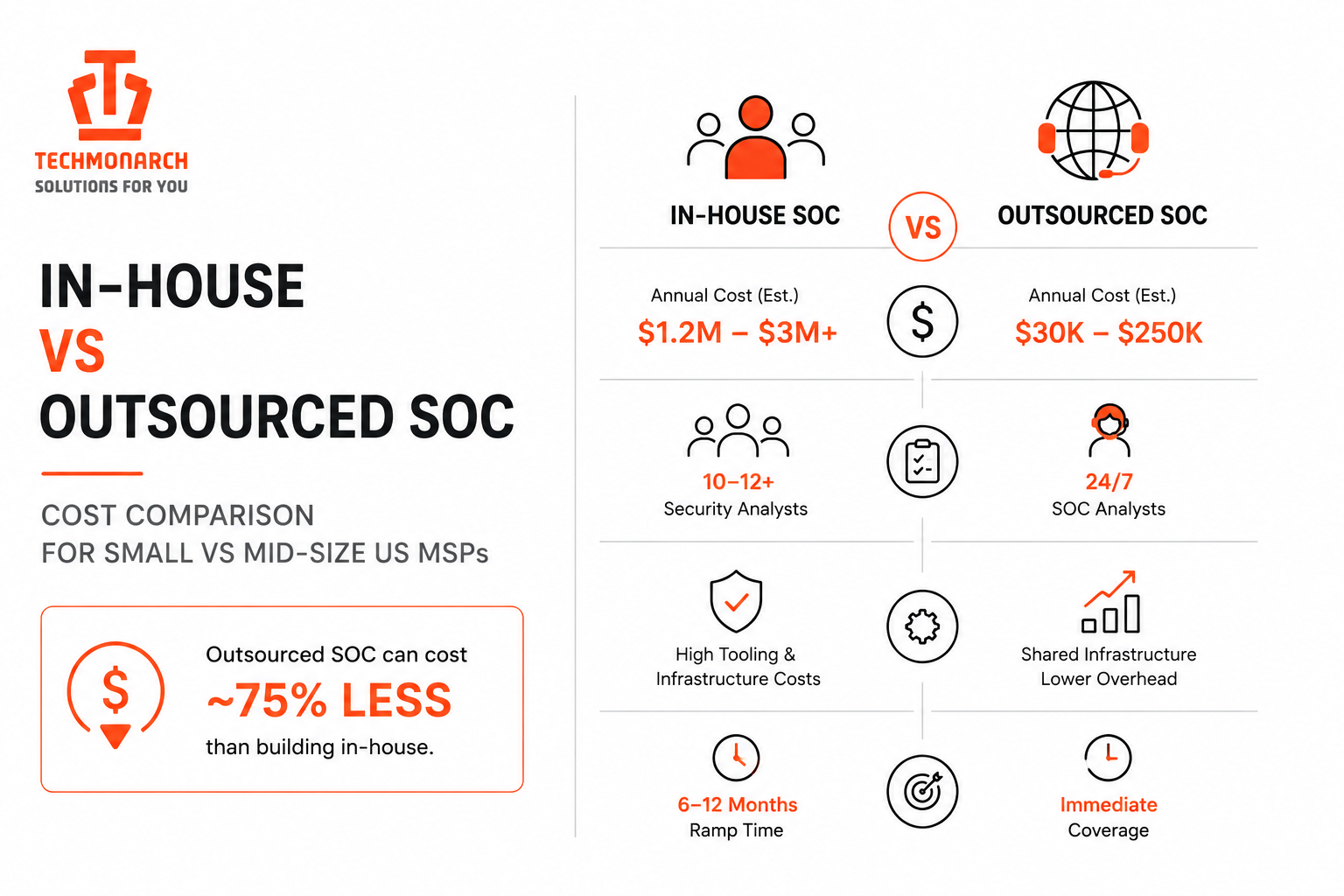
Current US salary data puts Tier 1 analysts in the $70,000–$95,000 range, Tier 2 investigators around $85,000–$120,000, and Tier 3 threat hunters or senior engineers between $110,000 and $150,000. A genuinely viable internal SOC — one that can triage, investigate, and escalate without leaning on a single point of failure — typically needs somewhere around ten to twelve people spread across those tiers. Before a single tool is licensed, that’s a payroll line north of a million dollars a year, and analyst tenure in this field averages under two years, so it’s not a cost you absorb once. You’re re-recruiting and re-training on a rolling basis indefinitely.
What the tooling stack adds on top of that
Staffing is usually 65–70% of the total bill, but the remaining slice isn’t small. A SIEM alone can run anywhere from $30,000 to $500,000+ a year depending on ingestion volume, and MSP environments tend to generate a lot of it once you’re pulling logs across dozens of tenants. Add a SOAR platform for automation ($50,000–$200,000), EDR or XDR licensing per endpoint, threat intelligence feeds, and a case management system, and the tooling line alone can land in the low-to-mid six figures before anyone’s tuned a single detection rule. Put the two halves together and a minimum viable in-house SOC for genuine 24/7 coverage tends to land somewhere between $1.2 million and $3 million annually — a range that shows up consistently across independent cost models this year, not just in vendor pitches.
For a small or mid-size MSP running on tight service margins, that number isn’t a rounding error. It’s often close to the entire revenue of the business.
What outsourcing actually costs
Outsourced SOC pricing works on a completely different curve because it’s shared infrastructure spread across many clients instead of one dedicated headcount block. SOCaaS pricing for an environment around 100 endpoints commonly falls between $30,000 and $250,000 a year depending on telemetry volume and how much response the provider actually performs versus just flagging alerts. Full outsourced or white-label SOC arrangements — where the provider supplies the SIEM, the analysts, and the playbooks under your brand — typically run at roughly a quarter of what the equivalent in-house build costs, sometimes less once you factor out the hiring and attrition overhead.
For an MSP specifically, this is where white-label matters more than it does for a typical enterprise buyer. You’re not just outsourcing a function — you’re reselling it, so the pricing needs to be predictable enough to build directly into your own client contracts without your margin swinging every time a client’s log volume spikes. This is essentially the gap providers like Techmonarch operate in — supplying the 24/7 SOC, NOC, and help desk layer under the MSP’s own brand, so the MSP keeps the client relationship and the margin without carrying the staffing and tooling load themselves.
Why the crossover point looks different for MSPs
For a standard enterprise, the widely cited crossover — the point where in-house starts becoming cost-competitive with outsourcing — sits somewhere around 1,000 to 2,500 employees, because fixed staffing costs get spread across more headcount. MSPs don’t scale that way. Your “headcount” is really an aggregate of client endpoints across wildly different environments, and each new client adds tool sprawl and tuning overhead rather than simply diluting a fixed cost the way an additional employee would in a single enterprise. That’s part of why even mid-size MSPs with several thousand endpoints under management rarely hit a genuine cost advantage by building in-house — the complexity scales with the number of environments, not just the volume of data.
The costs that don’t show up on the spreadsheet
A few things tend to get left out of the build-vs-buy math entirely. Alert fatigue is one — recent industry surveys put false positives as the top detection challenge for a majority of SOC teams, and tool sprawl across multiple client stacks makes that worse for an MSP than it would be for a single enterprise SIEM. Every redundant detection rule and unintegrated console adds analyst hours that never show up as a line item until you’re already short-staffed on a Friday afternoon.
Compliance is another. If any of your clients need SOC 2 or HIPAA evidence, an internal SOC means you’re the one generating and maintaining that audit trail — logging retention, control mapping, and evidence collection all become your operational overhead rather than something baked into a provider’s existing process. And then there’s the ramp time itself: building detection logic, tuning out noise, and reaching a mature, trustworthy SOC from a standing start commonly takes six to twelve months, which is six to twelve months of exposure while you’re paying full staffing costs and still not getting full value from it.
When building in-house still makes sense
None of this means outsourcing is automatically right for every MSP. If you’re serving a client base with genuine data sovereignty requirements, working in a regulated vertical like defense or government, or you’ve already got senior security staff on payroll as a sunk cost, a hybrid model often works better than an all-or-nothing decision — keep tier 2/3 escalation and client-facing strategy internal, and offload tier 1 triage and after-hours coverage to a partner. That split tends to capture most of the cost benefit of outsourcing while keeping the environmental context that only comes from staff who know a client’s systems intimately.
Running your own numbers
Before deciding either way, it’s worth pricing out three things specifically: your true blended cost per endpoint under each model, your realistic analyst attrition rate if you go in-house, and the actual size of your current off-hours coverage gap — not the one on paper, but the one that shows up when you check who’s actually watching the queue at 2 a.m. on a Sunday. Most MSPs that run this exercise honestly find the in-house number is larger than they assumed and the coverage they thought they had is thinner than it looked. Whichever direction the numbers point, it’s a decision worth revisiting annually rather than locking in once — client mix, compliance load, and endpoint count all shift enough year to year that yesterday’s math rarely holds for long. Techmonarch works with MSPs on exactly this kind of assessment, modeling the real cost delta against their own client base before they commit either way.
Recent Posts
- In-House vs Outsourced SOC — Cost Comparison for Small vs Mid-Size US MSPs
- Choosing a US-Based vs Offshore Help Desk Partner — What Actually Matters for SLAs
- Best White-Label NOC Partners for Regional US MSPs — What to Evaluate
- Serving Multi-Time-Zone Clients — How National MSPs Structure Follow-the-Sun Support
- How Data Breach Notification Laws Differ by State — What MSPs Serving Multi-State Clients Need to Know
Recent Comments
- No comments to show