
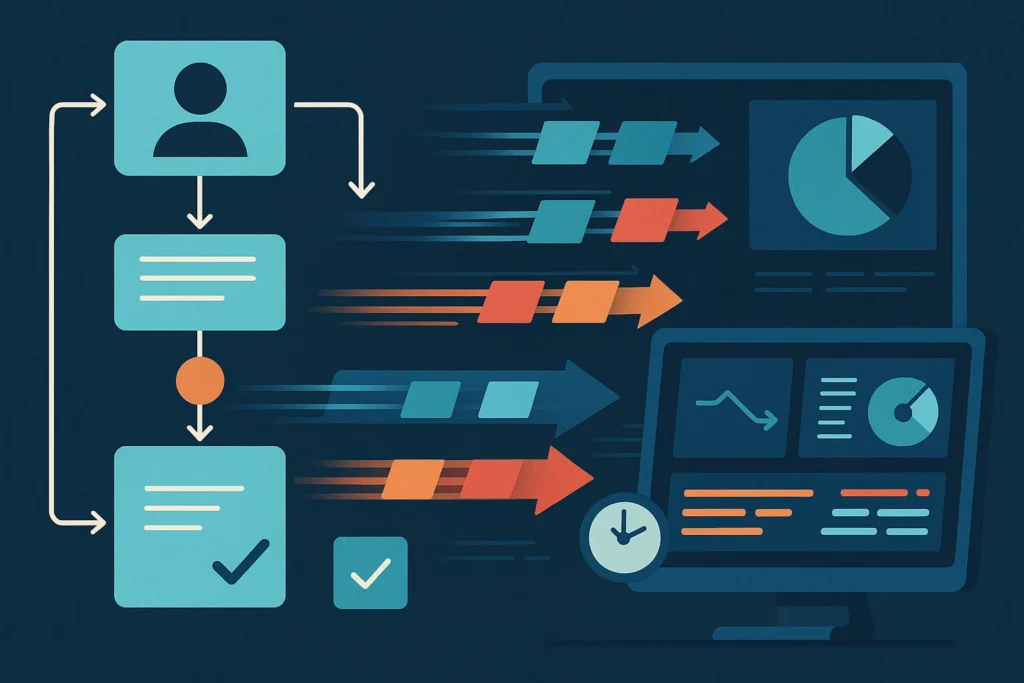
Industry: Civil Engineering & Consulting Region: Colorado, United States Engagement Model: White-label delivery for an MSP partner Core Services: ITSM workflow automation, ticketing system optimization, RMM integration
Quick Summary
A civil engineering and consulting firm with 180 employees across four offices had a ticketing system in name only. Zendesk was technically in place, but functioned more like a shared inbox than a real service management platform — an 85–120 ticket backlog at any given time, some tickets sitting unresolved for over 60 days, and users bypassing the system entirely to email or walk up to IT directly.
TechMonarch was engaged through the firm’s MSP partner to rebuild the ticketing platform into a fully automated IT workflow engine. The outcome: critical ticket response dropped from 2+ hours to 8 minutes, the backlog fell to a steady 15–25 tickets, and user satisfaction climbed from 2.9/5 to 4.5/5 — all without hiring a fifth IT staff member.
Meet the Client
This client is a civil engineering and consulting firm with 180 employees spread across four offices, supported by a four-person IT team responsible for everything from CAD workstations to core server infrastructure.
They’d already implemented Zendesk as a ticketing system, so on paper the tooling existed. In practice, it was being used more like a shared email inbox than an actual IT service management platform — no structure, no automation, no way to tell a critical outage from a routine password reset until someone happened to notice.
(Note: client details have been anonymized at the customer’s request. This is a real engagement delivered through one of TechMonarch’s MSP partners.)
The Challenge: A Ticketing System That Wasn’t Really Managing Anything
Here’s what was actually happening underneath a technically-functional Zendesk instance:
The backlog never really shrank. Open tickets averaged 85–120 at any given time, with some aging past 60 days without resolution — long enough that whatever the original issue was had probably already caused real disruption.
There was no real prioritization. Without formal SLAs, critical business issues waited in the same queue as low-impact requests, with no system distinguishing between them.
Handoffs were a mess. Duplicate work between technicians was common, since there was no structure ensuring one person knew what another had already tried.
Reporting was effectively useless. Ticket data was inconsistent enough that leadership couldn’t get any real visibility into how IT was actually performing — good or bad.
Users had already given up on the system. Rather than submitting tickets, people emailed IT directly or walked up to someone’s desk, which only made the backlog and prioritization problems worse.
The business impact was real: engineers lost billable hours waiting on delayed support, projects stalled waiting for access or system fixes, and IT ended up perceived as unresponsive — despite the team working long hours trying to keep up. The firm’s MSP partner brought in TechMonarch to convert the ticketing platform into a genuine automated IT workflow engine.
The Solution: Rebuilding Ticketing Around Real ITSM Practices and Automation
We treated this less as a “Zendesk cleanup” and more as a full ITSM rebuild — the tool was already there, but the process and automation around it needed to be built from scratch.
Phase 1: Process & Data Analysis
We reviewed more than 2,400 historical tickets to identify real demand patterns before designing anything:
- 35% access/password issues
- 25% software requests
- 15% hardware issues
- 12% network issues
- 13% application-specific, primarily CAD
From there, we built a structured framework: a business-impact priority matrix, standardized ticket categories, defined ticket lifecycle stages, and clear SLA targets for both response and resolution.
Phase 2: Zendesk Rebuild & SLA Automation
We fully reconfigured Zendesk with automated routing by issue type, location, and priority; real SLA enforcement with real-time escalation alerts; and customized submission forms that captured the diagnostic details technicians actually needed upfront. Critical tickets now route instantly to senior engineers, instead of sitting in a general queue.
Phase 3: Workflow & Self-Service Automation
A self-service password reset portal alone eliminated 30–40 tickets a week. An embedded knowledge base at the point of ticket submission reduced unnecessary tickets further. We layered in automated routing, round-robin assignment, after-hours escalation, aging alerts, and automated user updates, resolution confirmations, and satisfaction surveys.
Phase 4: Systems Integration
RMM alerts now automatically generate enriched tickets with relevant diagnostic data already attached. Asset management links every device to its ticket history, Microsoft Teams integration enables real-time IT collaboration, and mobile ticketing supports field technicians working outside the office.
Phase 5: Reporting & Analytics
We delivered real-time operational dashboards, SLA compliance reporting, trend analysis for recurring issues, and executive performance summaries — giving leadership the visibility that had simply never existed before.
Phase 6: Training & Adoption
We trained both IT staff and end users, rolled out adoption materials, and implemented weekly optimization reviews to keep refining the automation as real usage data came in.
The Results
- 73% faster response times overall
- Critical ticket response reduced from 2+ hours to 8 minutes
- Backlog reduction: From 85–120 tickets to a steady 15–25
- First-contact resolution improved from 42% to 68%
- Self-service eliminated ~150 tickets per month
- ~60 technician hours per month reclaimed for project work
- User satisfaction increased from 2.9/5 to 4.5/5
- SLA compliance reached 96% for response and 89% for resolution
- Avoided hiring a fifth IT staff member, saving roughly $85K annually
Leadership also gained real, clear visibility into IT performance for the first time — enabling data-driven decisions like targeted CAD training and proactive hardware refresh budgeting, instead of reacting to whatever broke last. IT staff reported higher job satisfaction, clearer priorities, and noticeably less day-to-day firefighting.
Why the MSP Chose TechMonarch
The firm needed more than a basic Zendesk configuration — they needed genuine ITSM and workflow automation expertise applied to a tool they already owned but weren’t using effectively.
At the center of the rebuild was a properly structured IT helpdesk support model — SLA-driven prioritization, automated routing, and self-service replacing what had functioned as a glorified shared inbox. That was paired with RMM integration so that infrastructure alerts generated enriched tickets automatically, closing the gap between monitoring and actual response.
The automation-first approach eliminated repetitive work instead of just organizing it more neatly, and the data-driven design fit naturally with the firm’s own engineering culture — they appreciated a solution built on their actual 2,400-ticket history rather than generic best-practice assumptions. A strong focus on user adoption ensured the changes stuck long-term rather than fading after the initial rollout.
The white-label MSP partnership let the firm keep their trusted provider relationship intact while gaining access to specialized IT workflow automation expertise they didn’t have in-house.
Frequently Asked Questions
Why does a company need workflow automation if they already have a ticketing tool like Zendesk? Having the software isn’t the same as having a process. In this case, Zendesk was technically implemented but functioned like a shared inbox — no prioritization, no SLAs, no automated routing — until it was rebuilt around real ITSM practices and automation rules.
How much can ticket backlog realistically be reduced with automation? It depends on the starting point, but the gains can be substantial. In this engagement, the backlog dropped from 85–120 open tickets to a steady 15–25, largely through SLA enforcement, automated routing, and self-service options that eliminated repetitive requests before they became tickets at all.
What’s the ROI of connecting RMM alerts directly to a ticketing system? It closes the gap between detecting a problem and actually responding to it. In this case, RMM alerts automatically generated enriched tickets with diagnostic details already attached, cutting out manual ticket creation and giving technicians the context they needed immediately.
Can an ITSM and ticketing automation project like this be delivered white-label for an MSP’s clients? Yes — this entire engagement was delivered white-label, with TechMonarch handling the ITSM rebuild and automation design while the MSP retained full ownership of the client relationship.
Ready to modernize your IT operations? TechMonarch specializes in ticketing optimization and IT workflow automation, helping MSP partners dramatically improve service delivery and response times. Let’s talk.
Recent Comments
- No comments to show