
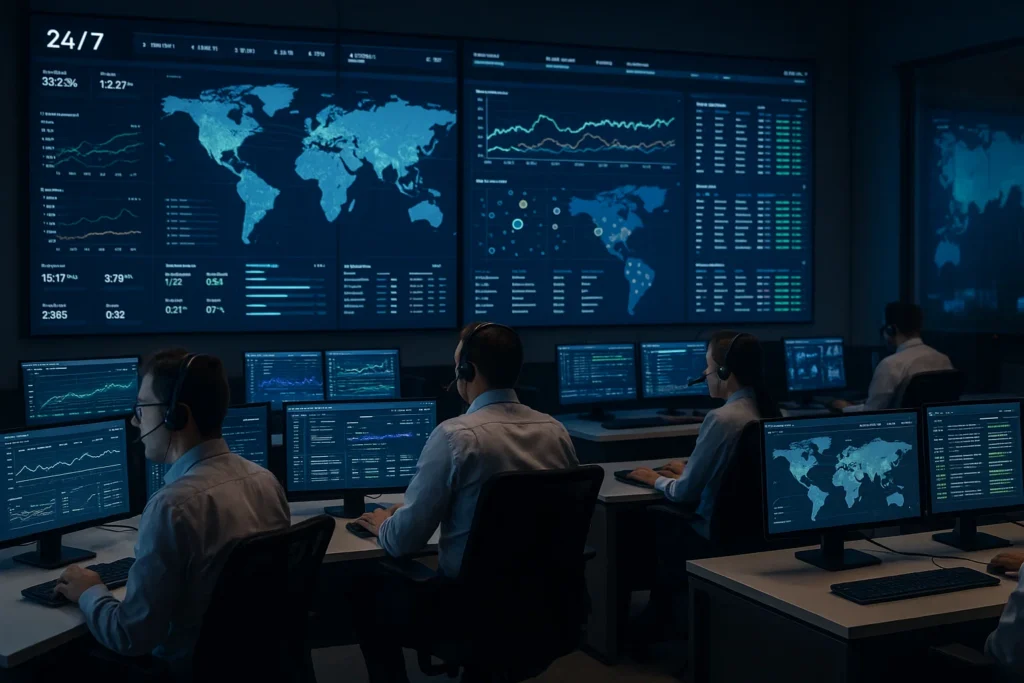
Industry: Managed IT Services / MSP Region: Texas, United States Engagement Model: White-label after-hours and overflow support Core Services: 24/7 tier 1–2 support, NOC/helpdesk coverage, incident response
Quick Summary
A regional MSP supporting around 45 SMB clients with eight engineers had strong daytime service but no real 24/7 coverage. After-hours on-call rotations were burning out the team, they were losing deals to competitors who could offer round-the-clock support, and hiring night-shift staff would have cost $300K+ a year — a non-starter for an MSP their size.
TechMonarch stepped in as a white-label after-hours and overflow partner, with engineers operating fully under the MSP’s own brand. Eighteen months later: true 24/7 coverage with zero added headcount, four new clients worth ~$180K in new annual recurring revenue, and off-hours customer satisfaction up from 3.2/5 to 4.6/5 — all for roughly $6,500/month instead of $300K+.
Meet the Partner
This client is a regional managed service provider supporting about 45 SMB clients across multiple industries, with a team of eight engineers delivering solid daytime service. The gap wasn’t skill — it was hours in the day. Nobody on an eight-person team can realistically cover nights, weekends, and holidays without something breaking, whether that’s response times or the team itself.
Several prospects specifically required round-the-clock support as a condition of doing business, and the MSP was losing those deals to larger competitors who could offer it. Meanwhile, the on-call rotation their existing engineers were stuck with was quietly driving down morale and pushing turnover up.
(Note: partner details have been anonymized at the customer’s request. This case study reflects a real MSP partnership.)
The Challenge: Growth Capped by Coverage, Not Capability
Here’s the bind the MSP found itself in:
Deals were being lost to coverage gaps, not competence. Prospects wanted 24/7 support as table stakes, and the MSP simply couldn’t offer it without stretching an already-lean team past its limit.
In-house night coverage wasn’t financially realistic. Hiring dedicated night-shift staff would have run $300K+ annually — a cost that didn’t pencil out against the revenue those after-hours contracts would actually bring in.
The existing team was burning out. On-call rotations meant engineers were getting paged overnight on top of a full daytime workload, and it was starting to show in morale and turnover.
Off-hours service quality was suffering. With an exhausted, stretched-thin team handling after-hours issues, customer satisfaction during nights and weekends lagged well behind daytime performance.
The MSP’s owner needed a white-label partner who could extend coverage to genuine 24/7 without diluting brand quality or eating into profitability. That’s the problem we were brought in to solve.
The Solution: A Hybrid White-Label Support Model
We built a model where TechMonarch engineers handle tier 1–2 after-hours and overflow support entirely under the MSP’s own brand — no scripted call-center hand-offs, no client-facing evidence that a second company was involved at all.
Phase 1: Integration & Onboarding
We fully integrated with the MSP’s existing toolset — ConnectWise Manage and Datto RMM — established secure VPN access, and ran deep knowledge transfer sessions for each individual client. For three full weeks, our team worked in parallel with theirs to guarantee a seamless handoff with zero disruption to existing customers.
Phase 2: Service Delivery Model
Coverage was structured to close the exact gaps the MSP had been struggling with:
- After-hours coverage, 6 PM–8 AM Monday through Friday
- Full weekend and holiday coverage
- Daytime overflow support during peak ticket volume
Our team handled tier 1–2 issues directly, with clearly defined escalation paths back to the MSP’s own engineers for complex or critical incidents. Response time targets, documentation standards, and even communication tone were all matched to the MSP’s existing brand — the goal was for clients to never notice a difference.
Phase 3: Communication & Reporting
Every morning, the MSP received a daily handoff report summarizing all overnight activity. Weekly operations syncs and monthly reviews kept both teams aligned and drove continuous improvement, rather than letting the after-hours function operate as a black box.
The Results
- True 24/7 coverage achieved without adding a single internal hire
- Revenue growth: 4 new clients won in 18 months, generating ~$180K in new annual recurring revenue
- Improved team morale: No more on-call burnout, and zero attrition since implementation
- Faster resolutions: A 35% improvement in after-hours resolution times
- Higher CSAT: Off-hours satisfaction rose from 3.2/5 to 4.6/5
- Greater productivity: A 22% increase in billable project hours, since daytime engineers were no longer drained from overnight pages
- Lower cost: ~$6,500/month, compared to $300K+ annually for dedicated in-house night staff
One moment stands out: during a weekend ransomware incident, our team contained the threat at 11 PM on a Saturday and had the client fully operational again by Monday morning. That single incident did as much for the MSP’s reputation as any sales pitch could have.
Why the MSP Chose TechMonarch
What the MSP’s owner needed was a true partner, not a scripted call center bolted onto their brand. TechMonarch’s engineers operate fully under the partner’s identity, integrate directly into their existing tools, and follow their exact workflows and documentation standards — so from a client’s perspective, nothing changes except that someone always answers the phone.
That extends to how we handle security incidents, too — the weekend ransomware response above is a good example of the kind of incident response and threat containment capability baked into the after-hours coverage, not bolted on as an afterthought.
The seamless white-label model, rigorous quality controls, and a flexible month-to-month structure gave the MSP the confidence to scale coverage without betting the business on it. Backing all of it is the same 24/7 helpdesk support infrastructure TechMonarch runs for MSP partners nationwide — the tier 1–2 engine that made true round-the-clock coverage possible in the first place.
The results speak for themselves: support expansion turned from a cost center worry into an actual profit center, generating new recurring revenue instead of just protecting existing accounts.
Frequently Asked Questions
How much does 24/7 white-label IT support cost compared to hiring in-house night staff? In this engagement, white-label after-hours coverage ran about $6,500/month, compared to an estimated $300K+ annually to hire and staff a dedicated in-house night shift — a difference significant enough to make round-the-clock coverage financially viable for a smaller MSP.
Can clients tell the difference when an MSP uses a white-label after-hours partner? When it’s done right, no. In this case, the partner’s response time targets, documentation standards, and communication tone were all matched to the MSP’s existing brand, with engineers working fully under the client-facing MSP identity rather than as a separate, visible vendor.
What’s a realistic timeline to onboard a white-label 24/7 support partnership? In this engagement, full integration with the MSP’s existing tools (ConnectWise Manage and Datto RMM), plus deep knowledge transfer for each client, took about three weeks of parallel operation before the after-hours coverage went fully live.
Does adding white-label after-hours support actually generate new revenue, or just cover costs? It can do both. In this case, the added 24/7 coverage helped win 4 new clients specifically requiring round-the-clock support, generating roughly $180K in new annual recurring revenue — turning what started as a coverage gap into a growth driver.
Want to expand your coverage without burning out your team? TechMonarch provides white-label 24/7 IT support for MSPs nationwide, enabling growth without sacrificing service quality. Let’s talk.
Recent Comments
- No comments to show