
-
Vijit
- June 11, 2026
- No categories assigned.
- No Comments
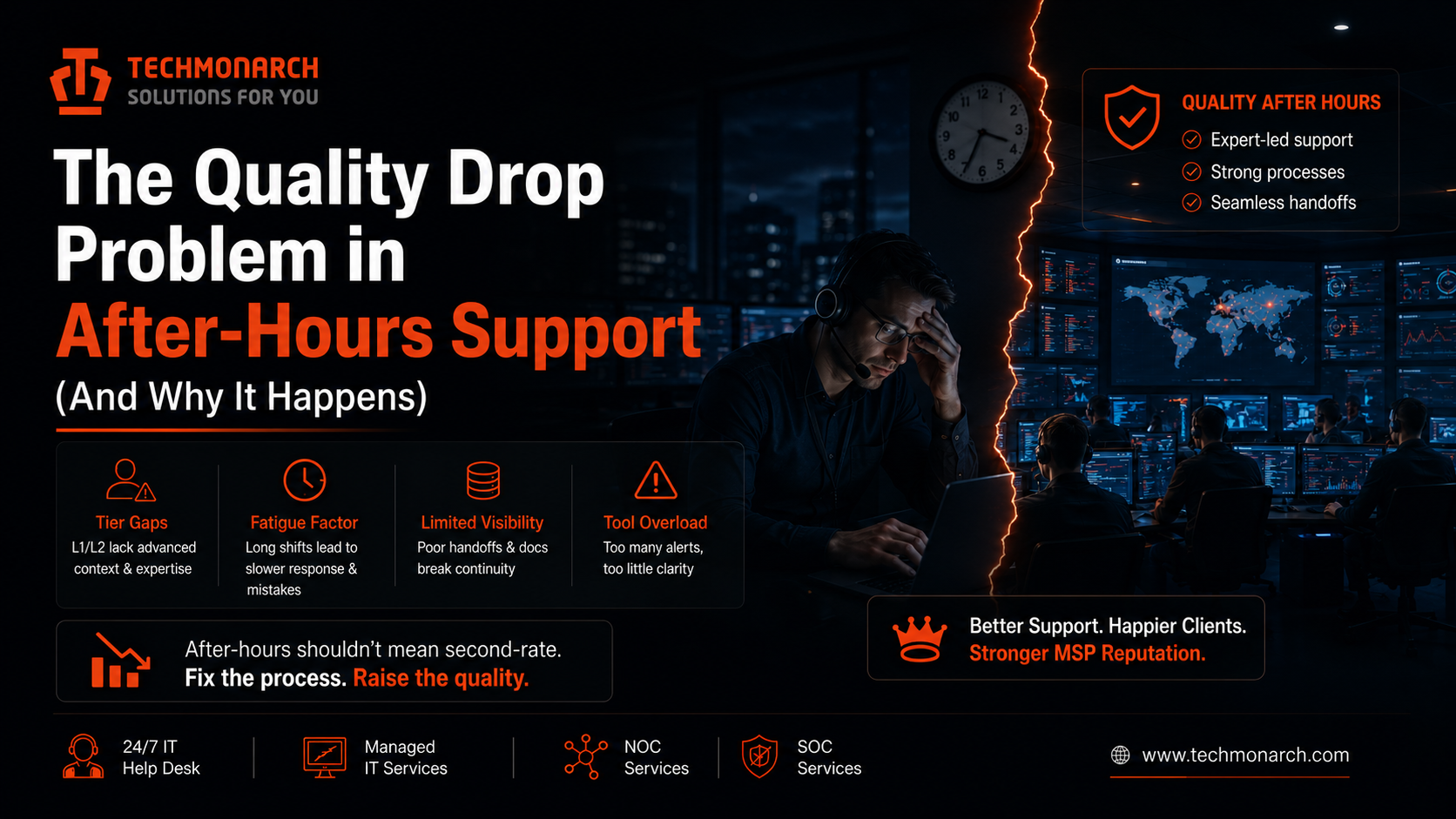
The gap between daytime and overnight service quality is real, structural, and almost never addressed directly. Here is an honest breakdown of its causes — and what it actually takes to close it.
There is a version of this conversation that happens in every MSP leadership team, usually after a client complaint surfaces on a Monday morning. Something went wrong overnight. A ticket sat unresolved for longer than it should have. A client called back because the engineer who picked up at 1 AM gave them an answer that turned out to be wrong. A P1 incident was handled at P3 pace because whoever was on shift did not classify it correctly. The service was technically available — the phone was answered, the ticket was logged — but the experience did not match what the client believes they are paying for.
This is the after-hours quality gap, and it is one of the most consistently underacknowledged problems in managed IT service delivery. The reason it goes underacknowledged is that it is structurally difficult to surface. Daytime quality is visible — managers are present, senior engineers are available, escalations happen in real time, and problems get caught and corrected quickly. After-hours quality is largely invisible until a client makes noise about it. By that point, the damage is already done.
Understanding why this gap exists — specifically, not generally — is the prerequisite for addressing it. ‘We need better overnight coverage’ is not an answer. It is a restatement of the problem. The actual causes are distinct, and each requires a different response.
The Talent Stratification Problem
The most fundamental driver of after-hours quality degradation is who is actually working those shifts. This is not a comfortable observation, but it is an accurate one. In most IT service operations, the talent distribution across shifts is not uniform. The most experienced engineers — the ones with the broadest technical range, the deepest client environment knowledge, and the most reliable diagnostic instincts — are, in the vast majority of operations, working during business hours. Overnight coverage falls to a combination of less experienced technicians, on-call arrangements that rely on fatigued senior engineers, and in some cases, third-party overflow providers whose familiarity with the specific client environment is limited.
This is not a staffing failure in the conventional sense. It reflects a real and persistent labor market reality: experienced IT engineers do not want to work night shifts as a long-term arrangement. The ones who do are either at an early career stage — still developing the judgment and breadth that complex overnight incidents require — or they are doing it under duress, which is its own problem. The result is an overnight team whose technical ceiling is structurally lower than the daytime team’s, regardless of how well-intentioned the hiring and scheduling decisions were.
The downstream effects are predictable. Incidents that a daytime Tier 2 engineer would resolve in twenty minutes take an hour overnight — not because the overnight engineer is incompetent, but because they are working a class of problem that is at the edge of their current capability. Escalation to a senior engineer happens more slowly because the overnight technician is less confident in their own classification of what warrants escalation. And when escalation does happen, the senior engineer being woken at 3 AM is not operating at their best — which is a cognitive performance issue well-documented in research on decision-making under sleep disruption.
The Documentation Gap That Widens After Dark
Documentation quality — or more precisely, the lack of it — is a compounding factor in after-hours quality problems that rarely gets the specific attention it deserves. Every IT service operation has documentation, in the same way that every operation has runbooks: technically present, practically incomplete, frequently outdated, and almost never as useful at 2 AM as it would need to be to actually help.
The reason this matters more after hours than during business hours is context availability. When something goes wrong at 10 AM, the engineer handling it has immediate access to colleagues who know the client environment, to account managers who can provide business context, and to senior engineers who can be consulted in real time without waking anyone up. The documentation gap is partially compensated by the human network around it.
After hours, that human network is unavailable or throttled. The on-call senior engineer is a last resort, not a first resource. The account manager is asleep. The colleague who worked that client account last week is not in the office. The overnight technician is working from whatever the documentation says — and if the documentation does not cover the specific scenario they are facing, they are working from first principles in an unfamiliar environment under time pressure. That is the exact combination of conditions that produces slow, inconsistent, and occasionally incorrect resolution.
Poor documentation of client environments — current network topology, known quirks, past incident history, escalation contacts and their actual availability — is the invisible substrate beneath most after-hours quality failures. The incident looks like a technician problem. It is usually a knowledge management problem.
Escalation Paths That Work Differently at Night
Escalation processes that function smoothly during business hours frequently degrade in practice after hours, and the degradation happens in ways that are rarely captured by SLA reporting. The formal escalation path exists. The on-call roster is posted. The thresholds for escalation are defined. But the actual behavior — what overnight engineers do when they encounter something beyond their capability — often diverges significantly from the documented process.
Some of that divergence is structural. An overnight technician who knows that escalating to a senior engineer means waking someone up at 2 AM will apply a higher threshold for escalation than is operationally appropriate. The social cost of making that call — the implicit expectation that they should have handled it themselves, the senior engineer’s audible frustration at being woken for something that ‘could have waited’ — conditions overnight engineers to hold on longer than they should. Incidents that should have been escalated at the ninety-minute mark are still being worked by the same technician at three hours. By the time the senior engineer is reached, the situation has worsened and the time available for resolution before business hours has compressed.
There is also the problem of escalation quality when it does happen. A properly constructed escalation hands off complete context: what the incident is, what has been tried, what the current state of the system is, and what the working hypothesis is at the point of handoff. Overnight escalations, when they are delayed and rushed, frequently hand off incomplete context — which means the senior engineer spends the first part of their involvement reconstructing what the overnight technician already knows, rather than immediately advancing the resolution.
Cognitive Load and Decision Quality Under After-Hours Conditions
There is a body of research on cognitive performance under conditions of sleep disruption and extended wakefulness that the IT industry largely ignores in its operational planning. The findings are relevant: decision-making accuracy declines meaningfully after extended periods of wakefulness, and the degradation is not always perceptible to the person experiencing it. Engineers working a midnight-to-8 AM shift are not operating at the same cognitive standard as engineers working 9 AM to 5 PM, regardless of how experienced they are or how strongly they feel they are managing.
This matters operationally because incident response at 3 AM frequently requires exactly the kind of judgment that is most affected by fatigue: pattern recognition across incomplete data, accurate risk assessment of whether a situation is stable or deteriorating, and clear communication under pressure. An engineer who is fatigued will not necessarily produce wrong answers — but they will produce less reliable answers, with longer latency, and with more susceptibility to fixating on an incorrect hypothesis rather than revising it when new evidence contradicts it.
For clients, the experience of a fatigued overnight engineer is often indistinguishable from the experience of an undertrained one. The response is slower. The communication is less clear. The resolution may require a follow-up the next morning to fully close. None of this shows up in the incident ticket as ‘engineer was fatigued.’ It shows up as a slower MTTR, a lower first-contact resolution rate, and a client who calls their account manager on Monday to say that the overnight experience was not what they expected.
The Burnout Feedback Loop
After-hours support quality does not just suffer from existing burnout — it actively generates it. Engineers who carry overnight on-call responsibility in addition to their regular daytime responsibilities accumulate fatigue and resentment that degrades their performance across both windows, not just the overnight one. Research on IT service operations consistently identifies after-hours on-call duty as one of the primary drivers of burnout and attrition. The most experienced engineers — the ones who would most improve overnight quality if they were consistently available — are frequently the ones most actively seeking to exit on-call arrangements.
The feedback loop is self-reinforcing. Burnout-driven attrition of senior engineers reduces the depth of the on-call bench, which increases the burden on remaining senior engineers, which accelerates burnout. Junior engineers develop more slowly because the senior mentors who would otherwise accelerate their growth are unavailable or disengaged. Overnight quality declines further. Client complaints increase. The pressure on the team intensifies.
For MSPs managing this dynamic internally, the only sustainable solution is structural: redistributing the overnight coverage burden so that no individual engineer carries it at a level that produces burnout. That typically means either a significantly larger team than most small-to-mid-sized MSPs maintain, or a different model for how after-hours coverage is organized altogether.
This is precisely the operational challenge that white-label help desk and NOC partnerships are designed to address. Techmonarch (techmonarch.com) provides 24/7 white-label support services to MSPs globally, enabling partners to extend genuine overnight coverage under their own brand without placing the capacity burden on their internal team. The coverage is staffed by engineers working normal business-hours shifts in distributed time zones — eliminating the cognitive load and burnout dynamics that degrade quality in traditional overnight staffing models.
What the Quality Gap Actually Costs
The business cost of after-hours quality degradation is frequently underestimated because it is diffuse and delayed rather than immediate and visible. A single bad overnight experience rarely ends a client relationship on its own. But it resets the relationship’s baseline — it introduces a doubt that was not there before, and that doubt surfaces at renewal time, at reference request time, and in the conversations clients have with peers about their MSP.
The industry data on this is consistent. Client retention in managed IT services correlates strongly with consistency of experience rather than with average experience quality. A client who receives excellent service 95% of the time and poor service 5% of the time does not retain at the same rate as a client who receives good service consistently. The memorable experiences in a service relationship are disproportionately the ones that went wrong — and after-hours incidents, by virtue of their timing and urgency, are precisely the moments most likely to produce memorable negative experiences when quality is not maintained.
There is also the internal cost, which compounds the client-facing one. Every after-hours quality failure generates remediation work the next morning: account manager calls, incident reviews, escalated tickets that still need proper closure. That remediation load falls on the daytime team — reducing their capacity for the proactive and strategic work that actually drives service improvement and client value.
Closing the Gap: What the Structural Fix Actually Requires
The after-hours quality gap cannot be closed by telling overnight engineers to try harder or by adding a few more items to the on-call checklist. It is a structural problem with structural causes, and the interventions that move it are correspondingly structural.
Documentation that is genuinely adequate for after-hours use.
This means per-client environment documentation comprehensive enough that an engineer who has never worked that account before can handle the most common incident types without consulting a colleague. Known failure modes, resolution procedures, escalation contacts with real-world availability, and recent change history — all current, all accessible from the ticketing system at the moment of need, not buried in a wiki that requires searching.
Escalation design that removes the social cost of escalating.
On-call senior engineers need to be explicitly told — and operationally reinforced — that timely escalation from overnight technicians is expected and valued, not an imposition. The threshold for escalation should be defined in terms of time and technical criteria, not technician confidence. An overnight engineer who has been working an incident for forty-five minutes without clear progress should have an automatic, process-defined trigger to escalate, independent of their own judgment about whether they ‘should’ be able to handle it.
Coverage models that remove fatigued engineers from the overnight equation.
The follow-the-sun model — distributing coverage across teams in different time zones so that each team is working normal business hours — is the most operationally sound answer to the cognitive and burnout dimensions of after-hours quality degradation. Implemented correctly, it means that the engineer handling a midnight incident in North America is a fully rested engineer working the middle of their business day in a different region. The quality differential disappears not because overnight performance was improved but because ‘overnight’ stops being a meaningful category for any individual engineer.
For MSPs that cannot build that model internally, the practical path is partnership — finding a white-label service partner whose after-hours coverage is structurally sound, whose engineering team is working in their own business hours, and whose documentation and escalation practices produce consistent quality regardless of what time the clock says on the client’s side of the relationship.

The Honest Conversation Worth Having
The after-hours quality gap persists in part because it is easier to not look at it directly. The SLA metrics hold. The client has not complained — yet. The team is managing. But if you have been in this industry long enough, you know that ‘managing’ is not the same as ‘delivering consistently.’ And the clients who matter most to your business are, over time, developing their own sense of whether those two things are the same in your operation.
The quality gap is real. It has specific causes that are well-understood. And it can be addressed — not perfectly, not overnight, but meaningfully — by operations that are willing to examine their after-hours delivery with the same rigor they apply to their daytime service. That examination is where the conversation worth having actually begins.
Recent Comments
- No comments to show