
-
Vijit
- July 9, 2026
- No categories assigned.
- No Comments
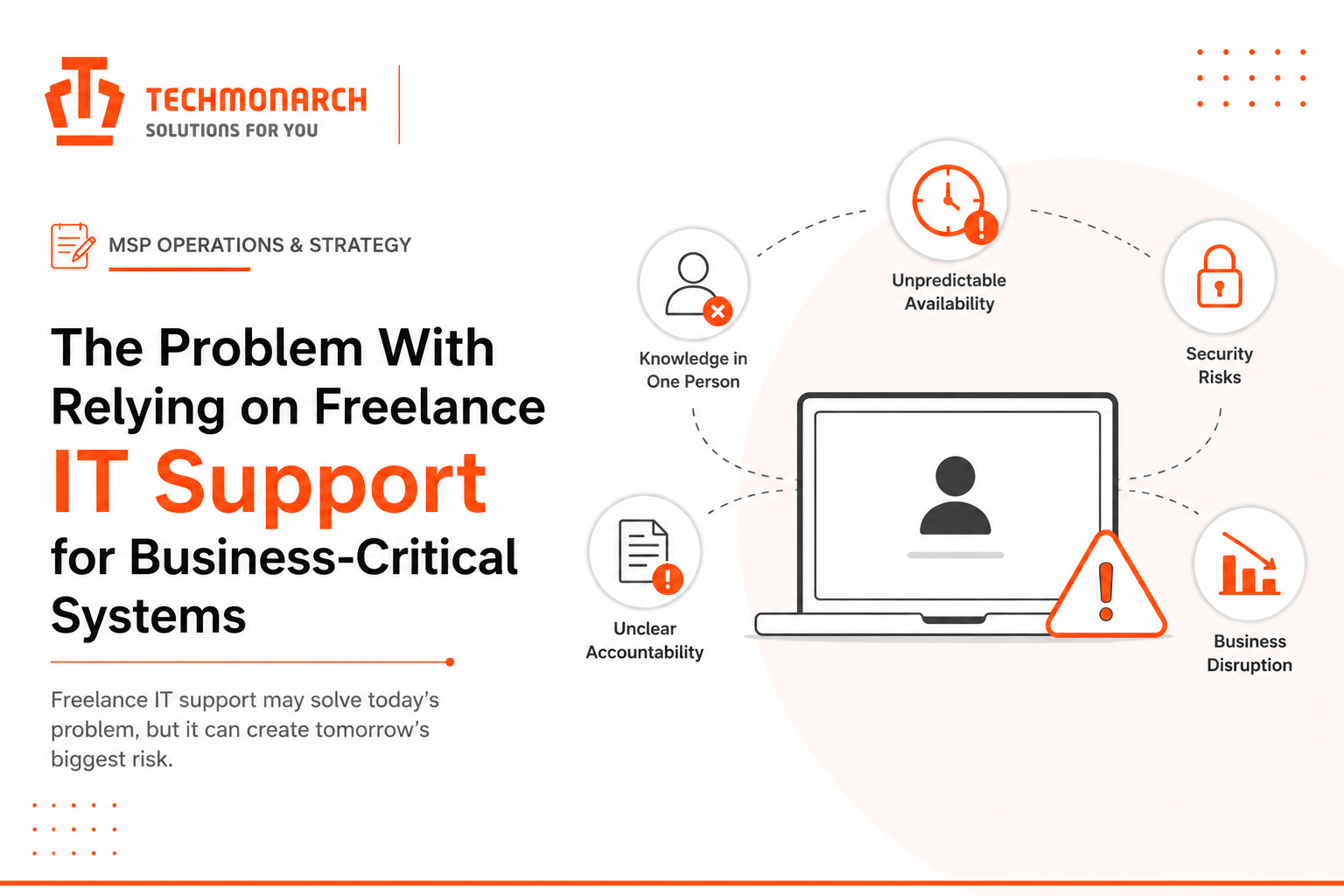
The Problem With Relying on Freelance IT Support for Business-Critical Systems
There’s a version of IT support that looks perfectly sensible on paper. You find a skilled freelancer, they fix your problems faster than your in-house team could, and you pay only for what you need. For ad hoc tasks — setting up a workstation, troubleshooting a one-off software issue, recovering a corrupted file — this arrangement works reasonably well.
The problem starts when that same arrangement quietly extends to business-critical systems. The server that runs your ERP. The network configuration that connects your two offices. The backup and recovery setup that everything else depends on. At some point, a pragmatic short-term decision becomes the de facto IT strategy for infrastructure that your entire operation sits on.
This article isn’t an argument against freelance talent. Skilled independent IT professionals exist and deliver real value in the right context. The argument here is narrower: that relying on freelance support for systems where continuity, accountability, and deep institutional knowledge matter introduces a category of risk that most businesses don’t fully price in until something goes wrong.
The Availability Problem Is Structural, Not Personal
One of the most common things businesses discover about freelance IT arrangements is that availability is unpredictable when it matters most. This isn’t usually a reflection of the individual’s professionalism. It’s a structural feature of how freelance work operates.
A freelance IT professional manages multiple clients simultaneously. When a critical issue surfaces at your organization, they may be mid-project for another client, travelling, or simply unavailable for hours or days. Unlike a managed service team with defined SLAs and rotational coverage, a single freelancer has no internal redundancy. When they’re unavailable, you’re waiting.
For systems that have a meaningful impact on business operations when they go down — internal communications, customer-facing applications, financial platforms, access management — those wait times translate directly into disruption. The calculus changes completely when you’re not comparing freelance to managed support on a quiet Tuesday, but on a Friday evening when something critical has failed.
Knowledge That Lives in One Person Is Fragile
Experienced IT managers tend to be acutely aware of something called the ‘bus factor’: the number of people who would need to leave an organization before critical knowledge becomes inaccessible. When your IT infrastructure is largely configured and managed by a single freelancer — even a highly capable one — that number is one.
Over months or years, a freelancer accumulates significant context about your environment. They know which servers are running which services, why a particular workaround exists, what the network topology looks like, and where the undocumented configuration decisions live. None of this is typically written down in any systematic way. It’s held entirely in their head.
If that person becomes unavailable — due to health, a better opportunity, or simply deciding to move on — the organization is left holding infrastructure it doesn’t fully understand. Onboarding a replacement isn’t a handover process; it’s an archaeology project. And during that gap, every change, troubleshooting effort, or upgrade carries more risk because the baseline understanding of the environment has walked out the door.
Accountability Without Structure Is an Illusion
In a vendor or managed service relationship, accountability has structure. There are contracts, service level agreements, defined escalation paths, and organizational liability. If something goes wrong, there is a process for what happens next and a legal framework that sits behind it.
Freelance arrangements rarely work this way. Most operate on informal agreements, project-based scopes, and the implicit assumption of good faith on both sides. When that good faith holds, everything is fine. When it doesn’t — when a configuration change causes an outage, when a security incident traces back to access that was never properly revoked, when a critical backup turns out not to have been running correctly for months — the accountability framework is essentially nonexistent.
This isn’t a question of the freelancer’s intentions. It’s a question of structure. Without formal agreements that define responsibility, liability, and remediation, a business-critical system managed by a freelancer is, from a governance perspective, effectively unmanaged. The organization carries all the risk without the formal assurances that a structured service relationship would provide.
The Security Exposure Is Harder to Manage Than It Looks
Freelancers who work on your IT infrastructure typically require elevated access to do so. Administrative credentials, VPN access, server logins, network device management — these aren’t courtesies, they’re technical necessities. And they create a security surface area that most businesses manage poorly.
The issue isn’t usually that freelancers are bad actors. The issue is that access governance for external individuals is rarely handled with the same rigor as it is for employees. Credentials don’t get rotated when the engagement ends. Access that was granted for a specific project persists indefinitely. Logging and monitoring of what that access is being used for is nonexistent or informal.
Data security research consistently finds that businesses focus their security frameworks on employees while treating contractors and freelancers as an afterthought — despite the fact that freelancers often have access to the same sensitive systems and data. For organizations handling customer data, financial records, or any regulated information, this gap is not just an operational risk. It is a compliance liability.

Breadth of Expertise Has a Real Ceiling
IT infrastructure for a functioning business involves a range of domains: networking, server administration, security, cloud services, endpoint management, backup and recovery, compliance, identity management. No single individual, however skilled, has deep expertise across all of these simultaneously. They have a primary area of strength and working knowledge in adjacent areas.
For point-in-time tasks, a skilled generalist can absolutely get things done. But for a business whose infrastructure spans multiple domains — and almost all mid-sized organizations fit that description — relying on one person’s working knowledge across all of it creates gaps that compound over time. Security hardening doesn’t get the same attention as the more familiar networking work. Backup configuration is set up adequately but never properly tested. Compliance requirements in one area of the stack get missed because they fall outside the freelancer’s primary expertise.
A structured IT support arrangement — whether that’s an in-house team, a managed service provider, or a combination of both — provides coverage across specializations rather than depending on the luck of finding one person who happens to be strong in all the areas your infrastructure requires.
The Hidden Cost Calculation Is Usually Wrong
Freelance IT support appears cheaper than managed services because the comparison is done on hourly rate. That comparison is incomplete.
The complete picture includes: the cost of unavailability during incidents, the cost of onboarding each new freelancer as relationships turn over, the cost of security incidents that result from inadequate access governance, the productivity lost while waiting for remote support that could have been handled proactively, and the cost of eventually needing to re-architect systems that were configured without a long-term plan in mind.
None of these costs appear on an invoice. They surface as operational friction, extended downtime, unplanned remediation projects, and in some cases, security incidents whose full financial impact dwarfs years of MSP fees. The hourly rate comparison is real, but it’s measuring the wrong thing.
When Freelance Support Makes Sense — And When It Doesn’t
To be clear: freelance IT support is not universally the wrong choice. For businesses in the early stages with limited infrastructure and predictable, low-complexity IT needs, a trusted freelancer can be a perfectly reasonable starting point. For specific project work where you need a specialist skill set for a defined period, bringing in freelance expertise is often the most practical option.
The inflection point comes when the infrastructure you’re running starts to matter enough that its failure would meaningfully impact the business. At that point, the nature of what you need from IT support changes. You need consistent availability, documented knowledge, structured accountability, and coverage across specializations. These are things a well-structured managed IT arrangement is specifically built to provide.
For growing businesses in Ahmedabad, Gandhinagar, and across Gujarat — organizations that have scaled to the point where IT is genuinely mission-critical but haven’t yet formalized their IT support model — this is often the defining moment. The question isn’t whether freelance support was a reasonable choice when the company was smaller. It probably was. The question is whether it’s the right structure for the infrastructure you’re running today. TechMonarch works with businesses navigating exactly this transition — helping organizations move from ad hoc IT arrangements to structured managed support without disrupting what’s already working.
The right IT support structure doesn’t just fix problems. It prevents them, documents them, and ensures the person who fixed the last one is reachable when the next one happens.
Recent Posts
- Why IT Vendors in Ahmedabad Take Days to Respond — And What "Managed" Should Actually Mean
- Why More Ahmedabad Companies Are Switching From Freelance IT Support to Managed Partners
- What Ahmedabad Businesses Get Wrong About IT Compliance Under India's DPDP Act
- A Look Inside How We Manage IT Infrastructure for Ahmedabad Businesses Across Industries
- Why Gandhinagar's Growing IT/ITES Sector Needs Local Managed Support, Not Remote-Only Vendors
Recent Comments
- No comments to show