
-
Vijit
- August 17, 2026
- No categories assigned.
- No Comments
Managed IT Services in Ahmedabad: What Local SMBs Pay vs. What They Actually Need
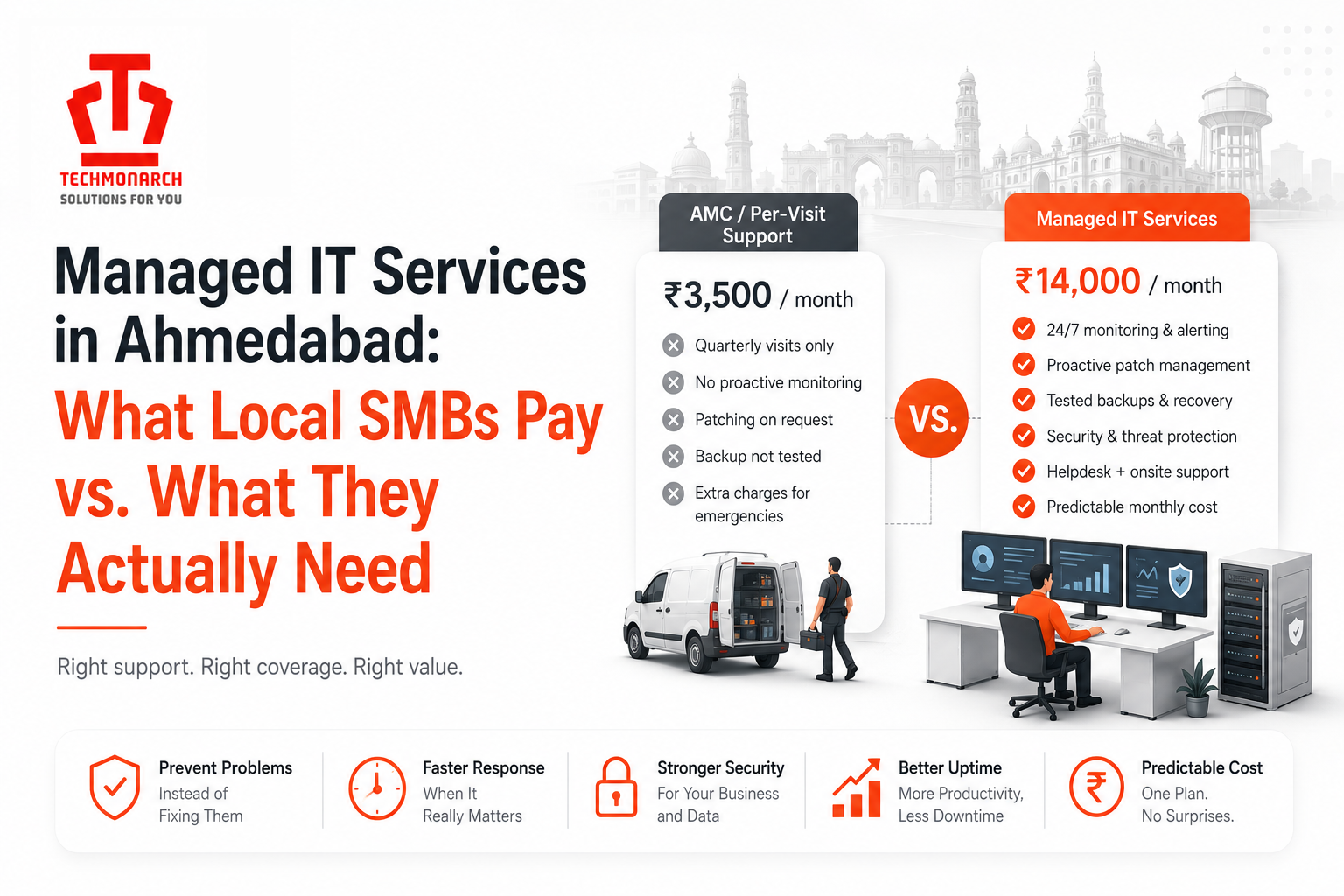
Two quotes land on the same desk. One vendor wants ₹3,500 a month and mentions an AMC — annual maintenance contract — with a technician visit once a quarter and call-out charges if something breaks in between. Another wants ₹14,000 a month and calls it managed IT services. On paper, both promise to “take care of your IT.” Most owners assume the second one is simply overpriced. Very often, it isn’t — it’s a different product wearing the same label, and the gap only becomes obvious the week something actually goes wrong.
This confusion shows up constantly across Ahmedabad’s SMB base — trading houses on Ashram Road, textile exporters near Naroda, chartered accountant firms around CG Road, small manufacturers scattered through the GIDC belt. Almost everyone budgets for “IT support” as a line item. Very few compare what that line item is actually buying, because the two dominant models in this market look similar from a distance and behave completely differently once you’re inside them.
Two different products, one shared name
The AMC-style, per-visit model has deep roots here — it grew out of hardware annual maintenance contracts for printers and desktops, and a lot of local IT support still runs on that logic. You pay a modest retainer, a technician comes when summoned or on a fixed visit schedule, and anything beyond the basics gets billed separately. It works reasonably well when IT is simple: a handful of desktops, one shared printer, nothing running around the clock.
Managed IT services are built on a different premise entirely. Instead of paying for visits, you’re paying for an outcome — systems monitored continuously, patches applied on a schedule, backups tested rather than assumed to be working, and a provider whose contract terms actually reward preventing problems instead of billing for them. The incentive structure flips: a per-visit vendor earns more when something breaks; a well-structured managed services contract earns the same fee whether anything breaks or not, which quietly aligns the provider’s interest with yours.
What the cheaper contract usually leaves out
The gap rarely shows up in the sales conversation — it shows up in the exclusions nobody asked about. Four gaps come up again and again when we review a business’s existing arrangement:
Security patching on a schedule, not on request. A quarterly-visit AMC typically checks that machines are running, not that Windows updates, browser patches, and antivirus definitions are current. Ransomware doesn’t wait for the next scheduled visit.
Backup that’s actually tested. Plenty of small businesses have backup software installed and assume that settles the matter. Whether that backup can actually be restored — and how long that restore would take — is a separate question almost nobody checks until the day they need it.
A documented, current asset and license inventory. Which machine has which software, which licenses are about to expire, which server is out of warranty — a single technician doing occasional visits rarely keeps this written down anywhere. It lives in someone’s memory, and that’s a liability the day that person is unavailable.
Vendor coordination. ISP outages, printer vendor disputes, accounting software escalations — someone has to chase these on your behalf. Per-visit contracts usually treat this as extra, billable, out-of-scope work, which is exactly when it tends to get deprioritised.
The single-person dependency most owners don’t notice
A pattern specific to a lot of Ahmedabad SMBs deserves its own mention: IT resting on one person — a freelance technician on call, or one internal employee who “handles computers” alongside other duties. It works fine for years, right up until that person takes an extended leave, changes jobs, or simply gets overwhelmed during a busy season. There’s no handover document, no second person who knows the network layout, no continuity plan. This isn’t a pricing problem so much as a structural one, but it’s directly connected to why cheaper arrangements stay cheap — a single point of contact has a ceiling on how much proactive work they can realistically do, no matter how capable they are.

So what should the number actually be?
Globally, managed IT pricing in India-based markets tends to sit meaningfully below what the same scope costs in the US or UK — broadly in the range that converts to somewhere around ₹2,000 to ₹5,000 per user per month for a genuinely proactive, security-inclusive plan, with the exact figure shaped by industry, compliance needs, and how much of the infrastructure is cloud-hosted versus on-premise. That’s a wide band on purpose: a 15-person trading office with straightforward email and accounting software needs far less than a 40-person manufacturer running an ERP, a factory network, and export documentation with strict data-handling requirements.
The number by itself tells you very little. What matters is comparing scope line by line — patch management, backup testing, endpoint security, helpdesk hours, onsite visit allowance, and what counts as an emergency versus a billable extra — against two quotes side by side, not against a single number in isolation. A lower quote that excludes half of that list isn’t a bargain; it’s the same set of risks, just deferred to a worse moment.
Matching the plan to the business, not the other way round
What an Ahmedabad SMB actually needs tends to track fairly closely with what the business does. An export-driven trading firm moving payments internationally has a real, specific exposure to invoice fraud and email compromise — a plan without dedicated email security controls is genuinely under-covered for that business, regardless of price. A manufacturer running Tally or an ERP on a factory network cares more about uptime and structured backup than about elaborate reporting dashboards. A professional services firm — CAs, lawyers, consultants — is usually more exposed on confidentiality and access control than on hardware.
This is the conversation worth having with a provider before comparing rupee figures at all: what does your business actually depend on to function for a normal working day, and does the plan on the table protect specifically that? At Techmonarch, this scoping exercise is usually the first real meeting with a prospective client, well before any pricing gets discussed — because a number without that context tells you almost nothing useful.
The cost that never appears on either quote
There’s a third number missing from both proposals entirely: what it costs the business when IT support falls short. An afternoon lost to a crashed server, an owner personally troubleshooting a network outage instead of running the business, a shipment delayed because export documentation sat on a machine nobody could access — none of that shows up on an invoice, but it’s a real cost, and it’s usually far larger than the difference between the two quotes on the table. Weighing a monthly fee against a competitor’s monthly fee, without weighing either against this hidden number, is how a business ends up genuinely underinsured on IT while still feeling like it’s paying a reasonable amount.
A short list of questions before comparing any two quotes
Is patching continuous or tied to a scheduled visit? Has the backup actually been test-restored in the last quarter, and by whom? Is there a documented asset and license list you can see, not just take on faith? What happens if your one point of contact is unavailable for two weeks? And finally — does the pricing model reward the provider for things staying quiet, or for things going wrong?
None of these questions require technical depth to ask, and the answers tend to say more about what you’re actually paying for than any number on the first page of a proposal. Techmonarch works through exactly this kind of comparison with SMBs across Ahmedabad and Gandhinagar before recommending a plan — because the right spend is almost never the cheapest one, and it’s rarely the most expensive one either.
Recent Posts
- Why IT Vendors in Ahmedabad Take Days to Respond — And What "Managed" Should Actually Mean
- Why More Ahmedabad Companies Are Switching From Freelance IT Support to Managed Partners
- What Ahmedabad Businesses Get Wrong About IT Compliance Under India's DPDP Act
- A Look Inside How We Manage IT Infrastructure for Ahmedabad Businesses Across Industries
- Why Gandhinagar's Growing IT/ITES Sector Needs Local Managed Support, Not Remote-Only Vendors
Recent Comments
- No comments to show