
-
Vijit
- September 8, 2026
- IT Infrastructure
- No Comments
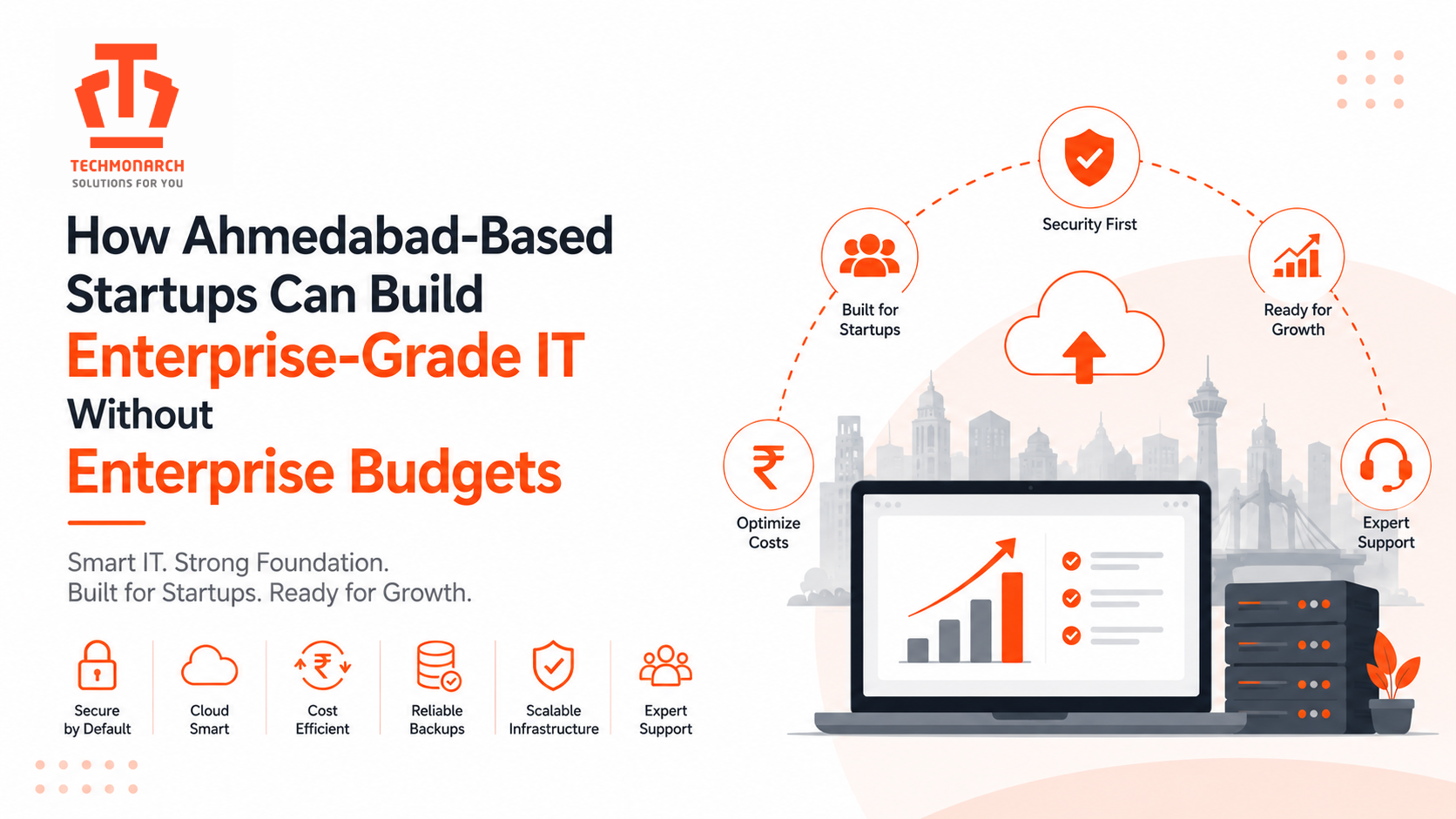
How Ahmedabad-Based Startups Can Build Enterprise-Grade IT Without Enterprise Budgets
Ahmedabad’s startup scene has moved past the point where you can excuse a shaky tech stack by calling yourself “early stage.” With GUSEC, iCreate and IIMA Ventures backing a steady stream of new companies, and Ahmedabad now sitting among India’s more active funding cities, investors and enterprise customers alike walk in with higher expectations than they did five years ago. The problem is that nobody’s budget grew at the same pace as those expectations. Enterprise-grade IT still sounds like something reserved for a company with fifty people in the ops team, not a twelve-person startup operating out of a co-working desk near SG Highway.
The good news is that “enterprise-grade” was never really about spending enterprise money. It’s about a handful of habits and design choices that most founders skip early on, not because they’re expensive, but because nobody flagged them as urgent until something broke. A surprising amount of what enterprise customers and investors actually check for — access control, backup discipline, basic documentation — costs more in attention than in rupees. Here’s what actually matters, and what doesn’t, if you’re trying to get there on a startup budget.
Stop confusing “enterprise-grade” with “expensive”
The instinct when someone says enterprise IT is to picture racks of hardware and a six-figure line item. In practice, most of what makes an IT Infrastructure setup enterprise-grade is discipline, not spend: consistent access controls, backups that are actually tested, documented systems, and a security posture that doesn’t rely on nobody noticing. A ten-person startup with tight identity management and tested backups is, in the ways that matter to an enterprise buyer or an investor’s due diligence checklist, ahead of plenty of companies five times its size that never got around to the basics.
The mistake worth avoiding is the opposite one — over-engineering for a scale you don’t have yet. Multi-region architecture and elaborate Kubernetes setups look impressive, but for a fifteen-person Ahmedabad startup still finding product-market fit, that complexity usually just becomes something to maintain badly rather than a genuine advantage.
Let the cloud do the heavy lifting, but read the fine print
Cloud infrastructure remains the single biggest equaliser available to a small team. AWS, Google Cloud and Microsoft all run startup credit programmes that can cover a meaningful chunk of infrastructure cost in the first year or two, and it’s worth actually applying rather than assuming your company is too small to qualify. The catch is that credits run out, and a startup that built its architecture entirely around one vendor’s free tier can find migration painful later. Keep core services reasonably portable, and revisit your cloud spend every quarter rather than letting it drift — it’s one of the few costs in a startup that quietly compounds if left unmanaged.
Open-source tooling deserves a mention here too. For a lot of backend infrastructure — databases, orchestration, monitoring — the open-source option is genuinely production-grade now, not a compromise. The real cost isn’t the software, it’s the time your team spends learning to run it well, so factor that into the decision rather than treating open-source as automatically free.
Security is cheaper before the incident than after
This is the one area where Ahmedabad startups most commonly cut corners, usually because security doesn’t feel urgent until it very suddenly is. Multi-factor authentication across every account that supports it, a proper password manager instead of a shared spreadsheet, and basic endpoint protection on every laptop cost very little and close off most of the easy attack paths. None of this requires a security team — it requires someone deciding it’s a day-one task rather than a someday task.
If your startup is chasing enterprise customers, this matters even more directly. A growing number of enterprise buyers now ask vendors for basic security documentation before signing, and startups that can’t answer simple questions about access control or backup policy lose deals over it, not over their product. Getting these fundamentals in place early isn’t just protective, it’s a sales enabler.
Treat documentation as infrastructure, not admin work
Founders tend to treat documentation as something to get to later, but an undocumented stack is a single point of failure disguised as a convenience. When the one person who set up your VPN or your CI pipeline is on leave, or leaves the company entirely, an undocumented system turns a small inconvenience into a genuine outage. A shared, current record of what’s running where, who owns it, and how to recover it costs almost nothing to maintain if it’s kept up as you go, and a great deal to reconstruct after the fact.
Get the in-house versus outsourced call right for your stage
Most early-stage Ahmedabad startups don’t need a full-time IT hire, and hiring one too early is a common way to burn runway on a role that’s underused for the first year. What tends to work better is a lean internal owner — often a technical co-founder or early engineer — supported by outside expertise for the parts that need depth: network security, infrastructure planning, or handling an incident properly rather than improvising one at midnight. This is essentially what managed IT support and staff augmentation exist to solve, and it’s a model TechMonarch works through regularly with growing companies around Ahmedabad — bringing in the specific expertise a startup needs at its current stage without the overhead of building an internal team for it.
The trade-off to watch for is picking a support model that scales with you. A startup at fifteen people has very different needs from the same company at eighty, and locking into a rigid vendor contract early can be as costly as no support at all. Favour arrangements that flex with headcount and workload rather than fixed packages sized for a company you aren’t yet — month-to-month or usage-based terms tend to suit a fast-moving startup far better than a long annual contract signed before you know what next year actually looks like.
Build for the next stage, not the one after that
The Jones IT framework of budgeting for where you’ll be in twelve to eighteen months, rather than where you are today, is a genuinely useful discipline for Ahmedabad startups moving fast on limited capital. It means your Wi-Fi and network setup should comfortably handle double your current headcount, your cloud architecture shouldn’t need a rebuild the moment you cross Series A, and your backup and access policies should already look like something a diligence checklist would approve of. It doesn’t mean building for a hundred people when you’re fifteen — that’s over-planning in the other direction, and it burns cash just as effectively as under-planning does.
The real difference isn’t budget, it’s sequencing
Enterprise-grade IT on a startup budget isn’t really about finding cheaper versions of expensive tools. It’s about doing the foundational things — access control, backups, documentation, a support model that fits your size — in the right order and early enough that they don’t become a crisis later. Ahmedabad’s startup ecosystem has the funding, the incubator support and the talent pool to compete well beyond its size; the IT layer just needs to keep up rather than lag a year behind. Whether that support comes from an internal hire, a managed IT partner like TechMonarch, or some mix of both, the startups that treat this as a day-one decision tend to spend a lot less fixing it later.
Recent Posts
- Why IT Vendors in Ahmedabad Take Days to Respond — And What "Managed" Should Actually Mean
- Why More Ahmedabad Companies Are Switching From Freelance IT Support to Managed Partners
- What Ahmedabad Businesses Get Wrong About IT Compliance Under India's DPDP Act
- A Look Inside How We Manage IT Infrastructure for Ahmedabad Businesses Across Industries
- Why Gandhinagar's Growing IT/ITES Sector Needs Local Managed Support, Not Remote-Only Vendors
Recent Comments
- No comments to show