
-
Vijit
- October 2, 2026
- No categories assigned.
- No Comments
Why IT Vendors in Ahmedabad Take Days to Respond — And What “Managed” Should Actually Mean
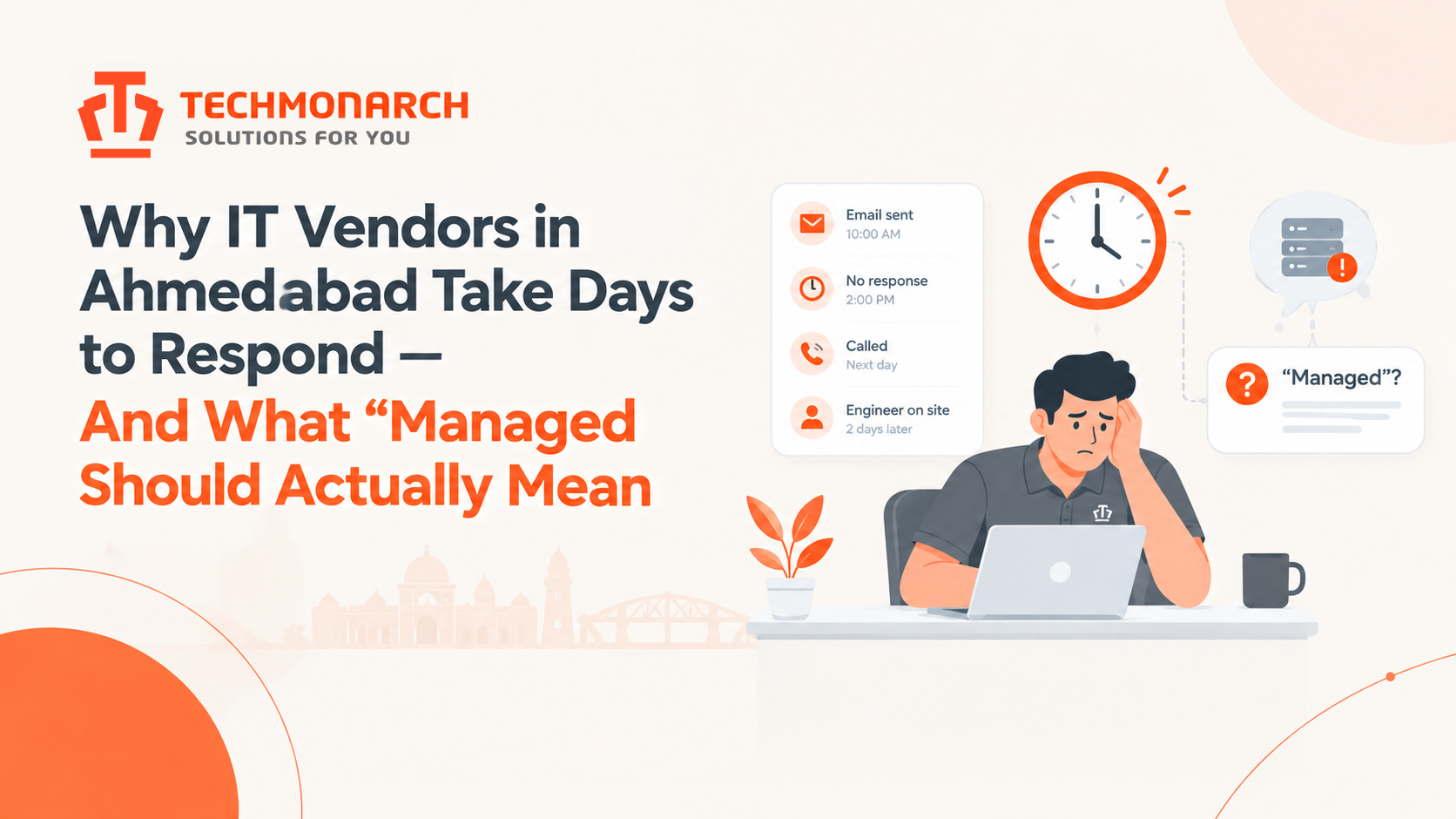
You send an email at 10 am. Server’s acting up, a couple of users can’t log in, nothing’s on fire yet but it’s annoying. By 2 pm, no reply. By the next morning, still nothing. You call. Someone says they’ll “check and get back to you.” Two more days pass before an engineer actually shows up.
If this sounds familiar, you’re not dealing with a bad vendor by accident — you’re dealing with a business model that was never built to respond fast in the first place. And if your current provider calls itself “managed,” but this is how support actually plays out, it’s worth asking what that word is doing in the contract at all.
It’s Not (Usually) Laziness — It’s Structure
Most IT support delays in Ahmedabad and Gandhinagar trace back to how the vendor is set up, not to individual technicians dragging their feet. A few patterns show up again and again.
One engineer, many clients, no real queue logic. Smaller IT vendors often run on a flat list — whoever emails or calls gets added to a pile, and the pile gets worked in roughly the order it came in, occasionally shuffled if someone shouts loud enough. There’s no triage separating “the whole office is down” from “can I get a new mouse.” Everything competes for the same technician’s attention with the same urgency, which means nothing actually gets urgency.
Break-fix habits inside a “managed” label. A lot of providers sell themselves as managed but still operate reactively — they wait for the phone to ring. No one is watching your servers, your backups, or your network at 6 am, so the first anyone knows about a problem is when a user reports it, hours after it started. By the time you’ve noticed and reported it, you’re already behind.
Understaffing relative to client load. Ahmedabad’s IT services market has grown quickly, and a lot of vendors have added clients faster than they’ve added engineers. A team that comfortably supported fifteen companies two years ago is now stretched across forty, using the same headcount. Response times don’t degrade dramatically overnight — they creep, month over month, until “day or two” quietly becomes the norm.
No defined escalation path. When there’s no documented rule for what happens if a ticket sits untouched for four hours, it sits for four hours. Then eight. Then it becomes tomorrow’s problem. Escalation only works if it’s built into the process — not left to whether you happen to call the right person.
Vague or non-existent SLAs. “We’ll get to it quickly” is not a commitment, it’s a hope. Without a written service level agreement specifying response windows by priority — critical, high, standard — there’s nothing to hold the provider accountable to, and nothing for you to measure against when things slip.
We’ve written before about how ticket backlogs build up when workflows aren’t planned properly — the same root causes apply here. A vendor without SLA-backed workflow planning isn’t choosing to be slow; they’ve just never built the system that would make them fast.
What “Managed” Is Supposed to Mean
Somewhere along the way, “managed IT services” became a label vendors put on whatever they were already doing, rather than a description of how the work actually gets done. That’s worth correcting, because the term has a real meaning.
Managed IT is supposed to mean the provider is watching your environment before something breaks — not waiting for you to notice and call. It means monitoring tools flagging a disk filling up, a backup job failing silently, or a server running hot, days before any of that becomes an outage. It means tickets are triaged by actual business impact, not by who complained loudest or arrived first in the inbox. It means there’s a documented SLA that specifies exactly how fast a critical issue gets a first response, versus a routine one — and that number is something you can hold the provider to, not a phrase from a sales call.
It also means accountability sits with one team, not scattered across whoever happens to be free. You shouldn’t have to explain your setup from scratch every time you call, or get bounced between three different people before someone takes ownership of the ticket. If your “managed” provider still requires you to chase updates, that’s reactive support wearing managed-service branding.
We’ve broken down how smarter ticket prioritization keeps IT teams from getting overwhelmed, and the same logic applies to any vendor supporting your business: a queue without prioritization isn’t a system, it’s a waiting room. Real managed support triages by impact — a full office outage jumps the line ahead of a single user’s printer issue — and that only happens when the process is designed for it, not improvised in the moment.
The Real Cost of Slow Response
It’s easy to treat a two-day wait as an inconvenience rather than a cost, but the math doesn’t hold up once you look at it. A finance team locked out of their accounting system for a day isn’t just annoyed — invoices don’t go out, approvals stall, and the ripple effect hits collections weeks later. A network issue left unaddressed for 48 hours in a manufacturing or logistics business can mean missed dispatches and unhappy customers. None of this shows up as a single dramatic failure; it shows up as a slow accumulation of lost hours that never get billed anywhere, because nobody tracks “time spent waiting for IT.”
There’s also a quieter cost: your own team stops trusting the support channel. Once people learn that raising a ticket means waiting two days, they stop raising tickets. They work around problems, use personal devices, or just tolerate broken things — all of which quietly increases risk while looking, on paper, like nothing’s wrong.
What to Actually Ask Before You Sign (or Renew)
If you’re evaluating a provider — or reconsidering your current one — a few direct questions cut through the marketing fairly quickly:
- What’s the written SLA for critical issues versus standard requests, in hours, not “as soon as possible”?
- Is monitoring proactive, with alerts generated before a user reports a problem, or purely reactive to tickets?
- How many client environments does each engineer actively support, and how is escalation defined if the SLA is missed?
- Can they show you a sample report of actual response times from the last quarter, not just promised targets?
A provider confident in how they operate will answer these without hesitation. One that gets vague, or pivots to talking about “relationships” instead of numbers, is telling you something too.
This is also roughly the checklist we use internally at Techmonarch when we onboard a new client under our managed IT services engagements — proactive monitoring, defined priority tiers, and an SLA that’s actually written down rather than implied. It’s a fairly basic bar, honestly. It’s just one a surprising number of vendors in Ahmedabad and Gandhinagar haven’t cleared yet. For a broader look at what the term is meant to cover in the first place, our earlier piece on what managed IT services actually includes goes into more depth.
Where This Leaves You
Slow vendor response isn’t usually a character flaw in the people answering your tickets — it’s almost always a structural gap: no proactive monitoring, no real SLA, no prioritization logic, and a client-to-engineer ratio that’s stopped making sense. Those are fixable problems, but only if you’re asking the right questions before you sign, and holding the provider to specifics rather than reassurances.
“Managed” should mean you rarely have to think about your IT at all — not that you’ve added a second job of chasing your IT vendor. If your current setup has you doing the latter, that gap between the label and the actual service is worth closing.
Recent Posts
- Why IT Vendors in Ahmedabad Take Days to Respond — And What "Managed" Should Actually Mean
- Why More Ahmedabad Companies Are Switching From Freelance IT Support to Managed Partners
- What Ahmedabad Businesses Get Wrong About IT Compliance Under India's DPDP Act
- A Look Inside How We Manage IT Infrastructure for Ahmedabad Businesses Across Industries
- Why Gandhinagar's Growing IT/ITES Sector Needs Local Managed Support, Not Remote-Only Vendors
Recent Comments
- No comments to show