
-
Vijit
- August 13, 2026
- No categories assigned.
- No Comments
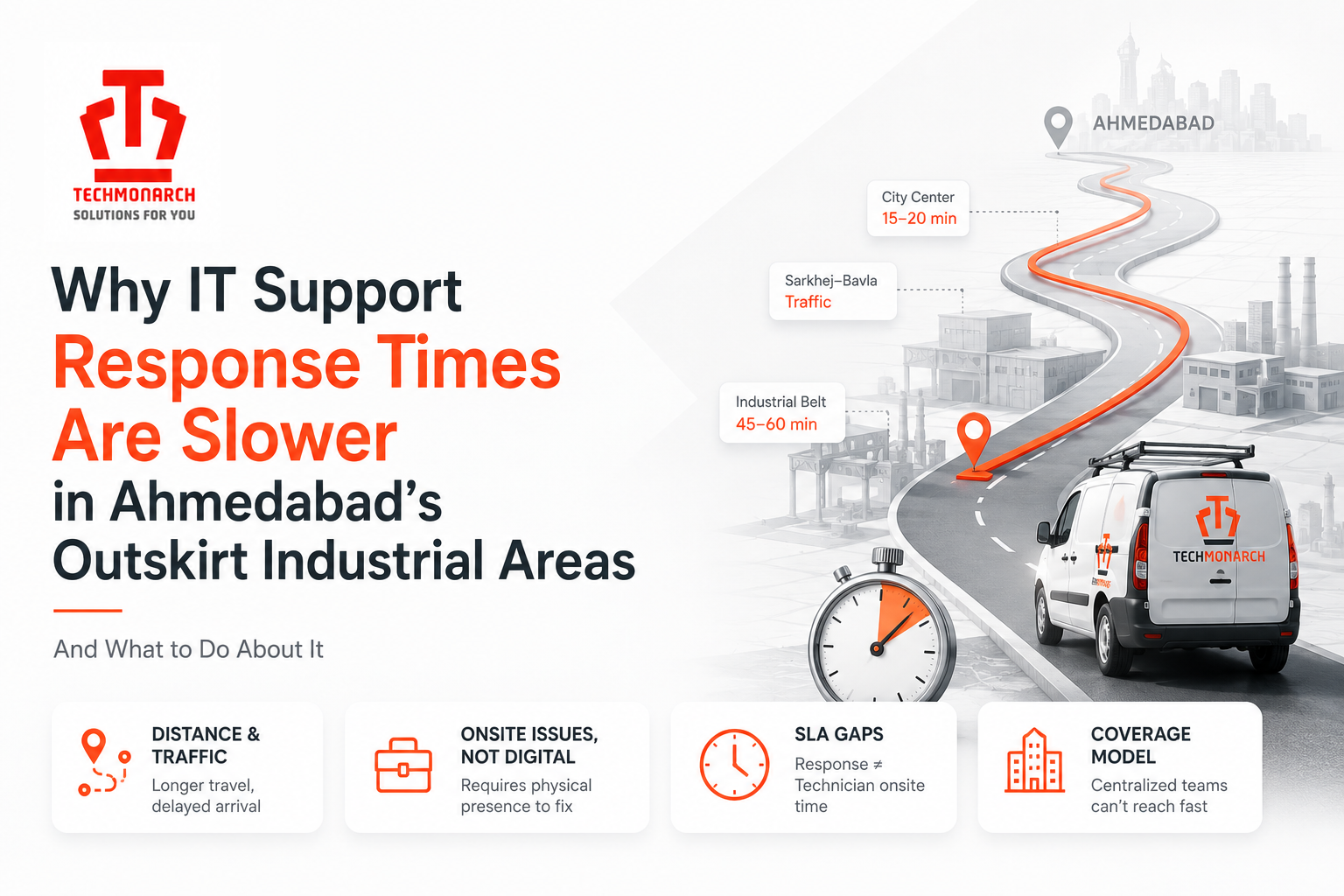
Why IT Support Response Times Are Slower in Ahmedabad’s Outskirt Industrial Areas — And What to Do About It
A plant head in Changodar logs a P1 ticket a little after 11 in the morning. The production line has stalled because a managed switch has dropped, and every minute matters. The support portal sends back an acknowledgement within two minutes — technically, that counts as “response.” But the technician’s live location on the tracking link still shows fifty-five minutes away, crawling past the Sarkhej-Bavla stretch behind two trailers. By the time he walks onto the shop floor, close to an hour of the shift is gone.
If this sounds familiar, you are not dealing with a careless vendor. You are running into something structural — a gap between how most IT support contracts are written and how industrial geography around Ahmedabad actually behaves. It shows up again and again across Vatva, Naroda, Odhav, the Sanand-Viramgam belt, and the Changodar-Bagodara corridor, and it rarely gets discussed openly because most SLA conversations stop at the number printed on the contract, not the terrain the technician has to cross to honour it.
The map isn’t the problem. The coverage model is.
Most IT support companies build their technician bench around where the bulk of their clients sit — and for a large share of providers, that is still the commercial corridors: SG Highway, Prahladnagar, CG Road, Iscon. Corporate offices are close together, parking is predictable, and a technician can realistically cover four or five visits in a day. Industrial clients on the outskirts get treated as an exception that a central-office technician drives out to, rather than a zone with its own dedicated coverage.
That single design choice is the real reason response times stretch out near GIDC estates. It isn’t distance on paper — Changodar and Sanand aren’t that far from the city — it’s the combination of distance, road conditions inside industrial estates, container and loader traffic near entry gates, and the fact that a technician already assigned to a city-side ticket can’t simply drop it midway. The ticket queue doesn’t know about traffic on the Sarkhej-Bavla highway; the technician does, every single day.
Remote monitoring fixes what’s digital. Industrial estates fail in ways that aren’t.
A good chunk of the IT industry’s confidence in “fast remote resolution” comes from RMM tools catching disk failures, failed patches, or a service that’s silently stopped. Genuinely useful — and for office environments, it closes most tickets before anyone notices a problem. Industrial units complicate that picture. A voltage spike during a machine start-up can take out a switch or a PoE injector outright. Point-to-point wireless links, still common where fibre hasn’t reached every plot inside a GIDC estate, need someone physically present to realign an antenna after a storm or a crane movement nearby. Dust ingress and humidity shorten UPS battery life in ways a dashboard won’t flag until the battery has already failed under load.
None of that is solvable from a helpdesk seat in the city, no matter how good the monitoring stack is. It needs a technician on-site with the right spare part already in hand — which is precisely the piece most standard SLAs quietly assume away.
Where the SLA clock plays tricks on you
Here is a detail worth checking in your own contract: does the response clock run on business hours or calendar hours? A ticket raised at 6:45 pm from a unit running a second shift often sits untouched until 9 am the next morning if the SLA only counts standard office hours — and that clause rarely gets read closely until it’s already cost a shift.
The other trap is the difference between “response” and “resolution.” An automated acknowledgement email is technically a response. It does nothing for a stalled conveyor. When you’re evaluating a provider for a factory floor, ask for a separate, written commitment on time-to-technician-onsite for critical tickets — not just time-to-first-reply. The two numbers can differ by hours, and only one of them affects your production.
What actually shortens response time out here
A few practical changes make a measurable difference, and none of them are exotic:
Hub-based technician placement. A provider who keeps a technician stationed near the Vatva-Narol or Sanand-Bavla belt, rather than dispatching every visit from a central Ahmedabad office, cuts travel time to a fraction of what a city-based dispatch model gives you. This is one of the reasons Techmonarch keeps its field engineers assigned by zone rather than by client list — a Changodar ticket goes to whoever is already closest, not whoever is next in a general queue.
An on-site managed spares cabinet. Keeping a spare switch, a PoE injector, and a charged UPS battery locked in a cabinet on your own premises means a technician — or even trained factory staff walked through it over a call — can restore service in minutes while the root cause gets diagnosed properly afterward, instead of everyone waiting for a part to arrive from a warehouse across town.
A production-aware escalation matrix. A ticket from a shop floor controlling a live production line should never sit in the same triage queue as a request to reset someone’s email password. Providers who separate these queues by business impact, rather than by time-of-arrival, consistently show shorter effective response for the tickets that matter most.
Backup connectivity for control-room links. Road digging and cable damage near GIDC estates happen more often than in developed city zones, simply because more construction is ongoing. A SIM-based failover link for critical control systems is inexpensive insurance against exactly that.

A quieter option: put someone of your own in the loop
For units large enough to justify it, there’s a middle path between fully outsourced support and building an in-house IT team from scratch — placing a dedicated, vendor-managed engineer on-site who already knows your machines, your network layout, and your shift patterns, backed by a wider team for anything beyond routine work. This is essentially what staff augmentation for IT roles is meant to solve, and it removes the travel-time problem entirely for day-to-day issues, while still giving you specialist backup when something bigger comes up. It’s an approach Techmonarch has leaned into for a number of clients along the industrial belt, precisely because a familiar face who’s already on the floor responds faster than the best-written SLA ever could.
Questions worth asking before you sign anything
Before finalising an IT support contract for a unit outside the city core, it’s worth asking a provider directly: where is your nearest technician actually based, not headquartered? Does your response clock run on calendar hours or business hours? What’s your committed time-to-technician-onsite for a P1 ticket at this specific address, not a citywide average? And do you carry spares locally, or does hardware replacement mean a trip back to a central store first?
The answers tend to separate providers who have genuinely planned for industrial geography from those who are simply extending a city support model outward and hoping the distance doesn’t show. For a plant that can’t afford an idle hour, that distinction is worth more than almost anything else in the contract.
Techmonarch works with manufacturing and industrial units across Ahmedabad and Gandhinagar on exactly this kind of infrastructure planning — from field coverage to spares strategy — if it’s something worth a conversation for your own site.
Recent Posts
- Why IT Vendors in Ahmedabad Take Days to Respond — And What "Managed" Should Actually Mean
- Why More Ahmedabad Companies Are Switching From Freelance IT Support to Managed Partners
- What Ahmedabad Businesses Get Wrong About IT Compliance Under India's DPDP Act
- A Look Inside How We Manage IT Infrastructure for Ahmedabad Businesses Across Industries
- Why Gandhinagar's Growing IT/ITES Sector Needs Local Managed Support, Not Remote-Only Vendors
Recent Comments
- No comments to show