
-
Vijit
- July 13, 2026
- Helpdesk
- No Comments
How Modern Businesses Build IT Teams Without Increasing Permanent Payroll Burden
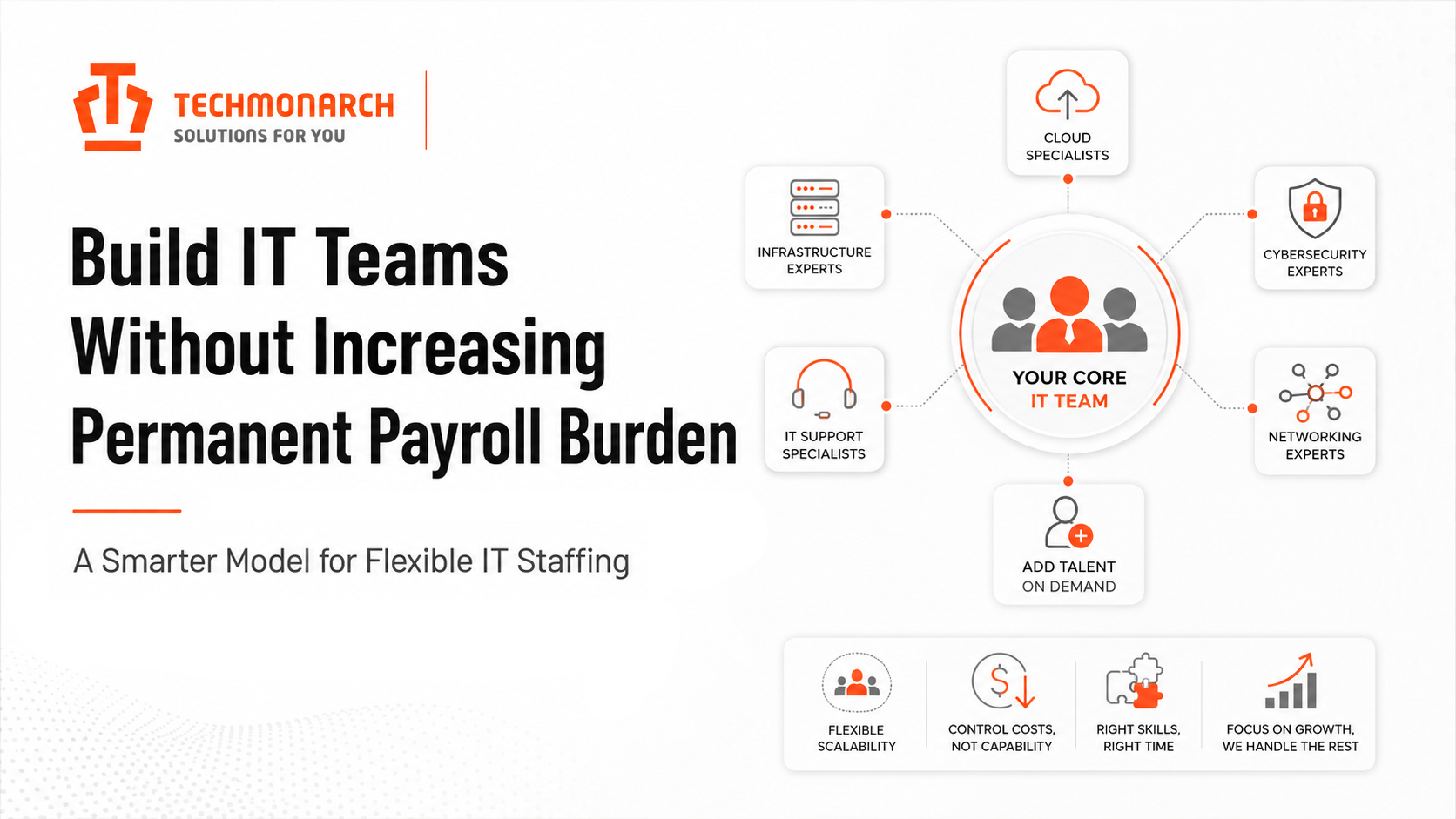
Hiring is one of the more consequential decisions a growing business makes — and in IT, it carries extra weight. The skill sets you need today may not be the ones you need in eighteen months. The scale of work fluctuates. The talent market is competitive. And once someone is on permanent payroll, the full financial commitment — salary, benefits, statutory contributions, onboarding, training, and the hidden cost of a bad hire — is in place regardless of whether the workload justifies it.
This is why a growing number of businesses, across industries and company sizes, are rethinking how they build IT capability. Not by abandoning the idea of a strong internal team, but by being more deliberate about what belongs on permanent payroll and what doesn’t. The outcome is a more flexible model that can scale with business demand, access specialist skills on demand, and maintain cost structures that make sense even as needs shift.
This article explores how that model works in practice — the logic behind it, the mechanics of implementation, and the considerations that determine whether it’s the right structure for a given organization.
The Real Cost of a Permanent IT Hire
Most hiring decisions in IT are evaluated on salary. That’s the number that goes into a budget, gets approved in a hiring plan, and gets measured against. But salary is rarely the complete picture.
When you account for employer contributions, health and insurance benefits, device provisioning, software licenses, training and upskilling, the time invested in recruitment, the productivity gap during onboarding, and the cost of eventual attrition and replacement, the total cost of a permanent hire typically runs significantly higher than the base salary figure. Conservative estimates put the all-in annual cost of an IT professional at 1.25 to 1.4 times their salary. More comprehensive analyses, including recruitment, ramp time, and turnover risk, push that figure higher.
For a business that needs a specific capability for a defined period — a network infrastructure project, a cloud migration, a security audit, a platform implementation — the permanent hiring model is structurally inefficient. You’re paying for a long-term commitment to cover a medium-term need, and the math rarely improves over time.
What Staff Augmentation Actually Means in an IT Context
The term ‘staff augmentation’ gets used loosely enough that it’s worth being specific. In an IT context, it refers to the practice of bringing external, vetted professionals into your existing team to fill specific roles or deliver specific capabilities — for defined periods, under your team’s direction.
The critical distinction from outsourcing is that augmented staff work within your organization’s structure. They attend your standups, use your systems, report to your managers, and work toward your priorities. The engagement is managed externally in terms of contractual and HR responsibility, but operationally, the person is embedded in your team. This makes it meaningfully different from handing a function off to a third party and managing it at arm’s length.
It’s also distinct from freelance arrangements. In staff augmentation, the external partner — typically a managed IT or staffing firm — is responsible for ensuring availability, quality, and continuity. If someone is unavailable or not the right fit, there is a mechanism for replacement. That layer of structured accountability is what separates augmented staffing from ad hoc freelance relationships.
The Roles That Organizations Augment Most Often
Not every IT function is equally well-suited to this model. The positions that businesses most commonly fill through staff augmentation share a few characteristics: the skill set is specialized, the demand is project-driven or cyclical, and the work can be clearly scoped and measured.
In practice, the most common roles include:
- Network and infrastructure engineers brought in during redesign or expansion projects, then transitioned out once the environment is stable
- Cybersecurity specialists engaged for audits, penetration testing, or remediation work that requires deep expertise most organizations don’t need full-time
- Cloud architects and migration specialists who are needed intensively during a platform transition, but whose work naturally concludes once the migration is complete
- IT helpdesk and support staff used to manage volume during periods of rapid growth, new office openings, or large-scale software rollouts
- Systems administrators for specific platforms, especially where an organization has adopted a tool that requires expertise beyond what the existing team holds
The common thread is that these are genuine business needs, not roles that were invented to justify the model. The work needs to be done; the question is what employment structure best fits it.
How the Hybrid Model Actually Works
The businesses that implement this most effectively don’t abandon permanent hiring — they become more deliberate about it. The internal team is built around roles that require deep institutional knowledge, long-term continuity, and cultural alignment: IT managers, internal architects, security leads, people who need to understand the business deeply to make good decisions on its behalf.
Augmented staff are brought in around that core to handle specific functions that would otherwise require adding permanent headcount that the business doesn’t actually need on an ongoing basis. The internal team retains strategic direction and institutional memory. The augmented layer handles capacity and specialist needs.
This structure solves a problem that many growing businesses hit: the period between “we need more IT capacity” and “we’re large enough to justify a full-time hire in this role.” That window can last months or years. Without a flexible staffing option, businesses either under-resource the function (and absorb the operational consequences) or hire permanently before the workload justifies it (and absorb the financial consequences). Augmentation gives you a third option.
The Talent Access Argument
Beyond cost flexibility, there’s a capability argument for this model that matters particularly to IT-intensive organizations. The talent market for specialized IT skills is genuinely competitive. Cybersecurity architects, cloud infrastructure specialists, and experienced network engineers are in short supply relative to demand. For a mid-sized business in Gujarat competing with larger organizations for the same profiles, winning that competition through permanent hiring alone is difficult.
Staff augmentation changes the access equation. You’re not competing to own the talent permanently — you’re accessing it for the period you need it. A specialist who wouldn’t consider a permanent role with a 200-person company in Ahmedabad may be perfectly available through an augmentation arrangement. The same applies to emerging skill areas: organizations that need expertise in a domain they haven’t historically hired for don’t need to build that capability from scratch internally. They can access it externally while their needs in that area are taking shape.
Industry data reflects this shift. The global IT staff augmentation market was projected to reach over $80 billion in spending by 2025, with adoption growing fastest among small and mid-sized businesses that previously would have considered this model beyond their reach. The driver isn’t just cost — it’s access to skills that the permanent hiring market simply can’t deliver fast enough.
Making the Model Work: What the Internal Team Needs to Own
Staff augmentation works best when the internal team has clear ownership of a few non-negotiable things. Strategic direction — knowing what the IT function is trying to achieve over the next one to three years — cannot be delegated externally. Neither can knowledge of the business itself: the operational context that determines what technology decisions actually make sense.
Documentation and institutional knowledge management also need to be actively owned internally. One of the risks of relying heavily on external or rotating talent is that institutional knowledge doesn’t accumulate in a structured way. The internal team’s job is to ensure that doesn’t happen: that configurations are documented, decisions are recorded, and the environment remains understandable to anyone coming in behind the current team.
When these things are in place, the model is robust. Augmented staff contribute specific capabilities without creating dependency. When an engagement ends, the knowledge stays. When a new specialist comes in, they have a documented environment to work with. The internal team retains control; the external layer adds capacity without creating fragility.
Choosing the Right Partner for Augmented IT Staffing
The quality of a staff augmentation arrangement depends heavily on the partner through which it’s structured. Not all are equivalent. The key differentiators are the depth of vetting applied to the professionals being placed, the partner’s familiarity with IT-specific roles and requirements, their ability to maintain continuity when someone becomes unavailable, and their understanding of the business context in which the augmented staff will be operating.
For businesses in Ahmedabad and Gandhinagar, there’s also a practical argument for working with a partner who understands the local business environment — the specific regulatory context, the operational realities of scaling an IT function in Gujarat, and the kinds of infrastructure challenges that growing businesses in the region typically face. That contextual knowledge makes a meaningful difference in whether augmented staff are genuinely productive or spend weeks getting oriented.
TechMonarch works with businesses across Gujarat specifically on IT staffing and managed support arrangements, helping organizations build the right combination of internal and external capability for where they are in their growth. The goal in every case is the same: an IT function that can do what the business needs, without carrying overhead that doesn’t justify itself.
A Structural Shift, Not a Tactical Fix
The businesses that get the most value from flexible IT staffing models are the ones that treat it as a deliberate structural choice rather than a stopgap. They’ve thought clearly about what belongs on permanent payroll and what doesn’t. They’ve built internal teams around the roles where continuity and institutional knowledge matter most. And they use external talent strategically — to access specialist skills, manage capacity fluctuations, and keep the IT function aligned with actual business demand rather than a headcount plan that was written eighteen months ago.
The permanent payroll question is ultimately a question about risk and flexibility. A permanent hire is a commitment made in advance of knowing exactly how the need will evolve. For some roles, that commitment is exactly right. For others, the business is better served by a model that can adapt as the work does.
Building a capable IT team and keeping permanent payroll lean are not competing goals. With the right structure, they’re the same goal.
Recent Posts
- What Ahmedabad Businesses Get Wrong About IT Compliance Under India's DPDP Act
- A Look Inside How We Manage IT Infrastructure for Ahmedabad Businesses Across Industries
- Why Gandhinagar's Growing IT/ITES Sector Needs Local Managed Support, Not Remote-Only Vendors
- IT Infrastructure Checklist for Companies Moving Into SG Highway and Prahlad Nagar Offices
- How Ahmedabad-Based Startups Can Build Enterprise-Grade IT Without Enterprise Budgets
Recent Comments
- No comments to show