
-
Vijit
- July 6, 2026
- IT
- No Comments
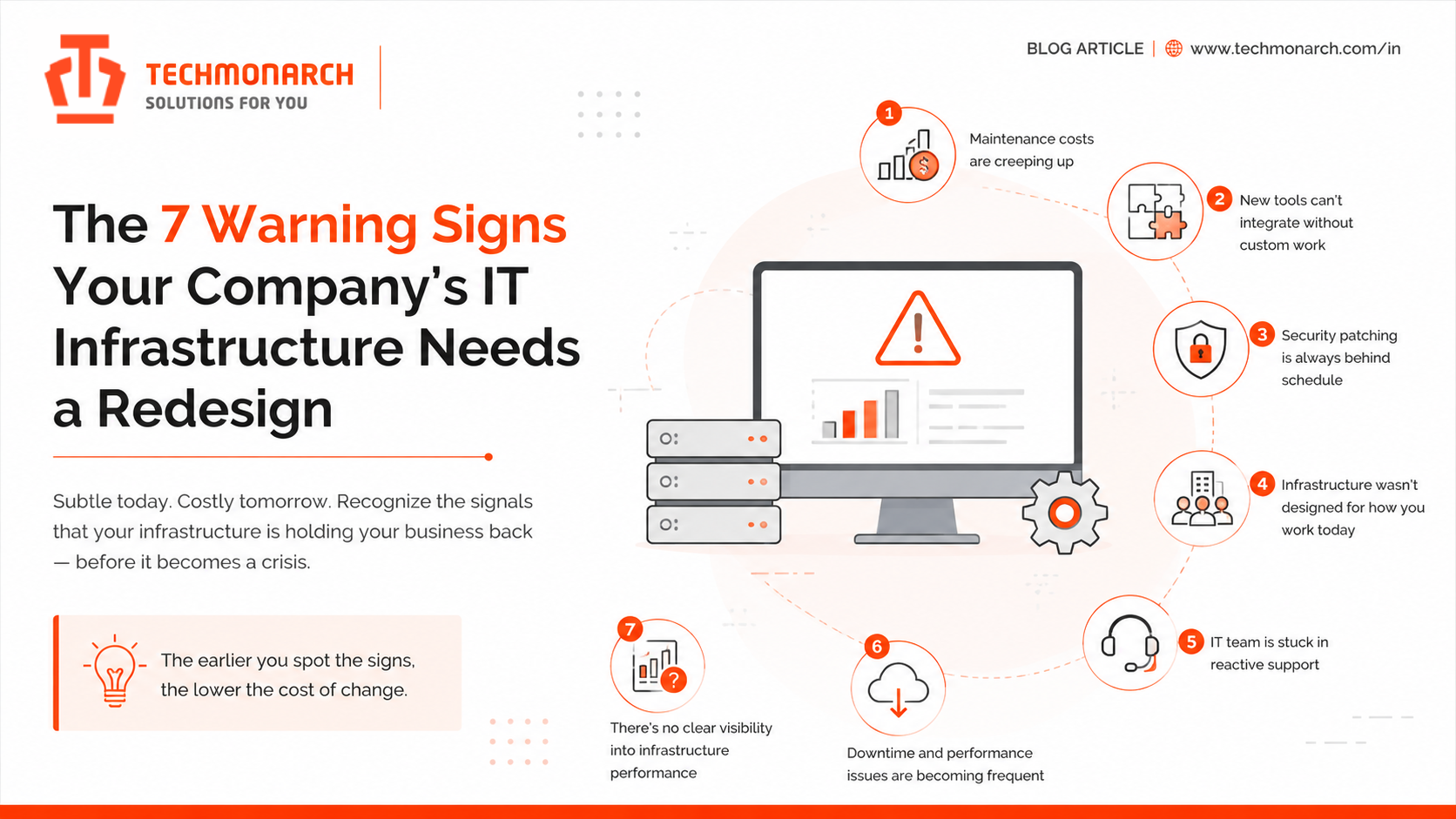
The 7 Warning Signs Your Company’s IT Infrastructure Needs a Redesign
Most IT infrastructure problems don’t announce themselves. They accumulate quietly — one workaround at a time, one deferred upgrade at a time — until the gap between what the business needs and what the infrastructure can actually deliver becomes impossible to ignore. By then, the cost of change is almost always higher than it would have been a year earlier.
The tricky part is that many organizations are living inside that gap right now and don’t realize it. Systems are technically running. Business operations are continuing. But there’s a persistent sense that things are harder than they should be — that the technology is something the team works around rather than works with.
This piece is aimed at IT decision-makers and business owners who want to know whether their infrastructure is starting to work against them. These are not red flags for broken systems. They are signals that the architecture underneath your operations is no longer built for what your business has become.
Warning Sign 1: Your Maintenance Costs Are Quietly Creeping Up
There’s a predictable financial pattern that plays out with aging infrastructure. In the early years, maintenance costs are low and predictable. Over time, as hardware moves past its supported lifecycle and software requires increasingly complex compatibility workarounds, those costs begin to climb — not dramatically, but consistently.
The insidious part is that this often gets absorbed into operational budgets without triggering a formal review. A server repair here, an emergency support contract there, a specialist brought in to troubleshoot an issue that shouldn’t require a specialist. Individually, each expense is justifiable. Together, they’re telling you something: the infrastructure is beginning to cost more to sustain than it would cost to replace.
If your IT spend has been trending upward without a corresponding increase in capability, that is a directional signal worth taking seriously. The question to ask is not “what did we spend this quarter” but “what percentage of that spend kept things the same versus made things better.”
Warning Sign 2: New Tools and Systems Can’t Integrate Without Custom Work
Modern business software is built on the assumption that other systems exist around it. CRMs need to talk to billing platforms. HR systems need to connect with payroll. Project tools need to sync with communication platforms. When your underlying infrastructure makes every integration a custom engineering project, you’re not dealing with a software problem — you’re dealing with an architecture problem.
Legacy infrastructure often lacks the API surface, the network segmentation, or the directory services structure that modern SaaS tools expect. So each new adoption becomes its own mini-project, requiring custom connectors, manual data transfers, or middleware that nobody is formally responsible for maintaining.
The business impact is twofold. Teams adopt fewer tools because adoption is too painful, which means they miss productivity gains that competitors are capturing. And the integrations that do exist become fragile dependencies that break unpredictably when any one component is updated.

Warning Sign 3: Security Patching Is Always Behind Schedule
Patch management is one of those things that sounds operational but is actually architectural. In a well-designed environment, patches can be tested and deployed consistently without major disruption. In a fragile one, patching becomes dangerous — because updating one component risks breaking dependencies elsewhere in the stack.
If your IT team regularly delays patches because “we can’t afford the downtime right now” or “we’re not sure what it’ll break,” that’s not a process failure. It’s a structural signal. An infrastructure that can’t be safely patched on a reasonable schedule is an infrastructure that is gradually accumulating risk with every day that passes.
The 2024 average cost of a data breach crossed $4.88 million globally. For most mid-sized businesses, a single significant incident of that nature isn’t just a financial setback — it’s an existential one. Persistent patch debt is one of the clearest early indicators that the underlying design needs revisiting.
Warning Sign 4: Your Infrastructure Wasn’t Designed for How You Work Today
This one catches a lot of growing businesses off guard. An infrastructure that was thoughtfully designed for a 25-person, single-location company does not gracefully evolve into one that supports 80 people across multiple offices, remote workers, cloud applications, and mobile devices — at least not without deliberate architectural decisions along the way.
The symptoms tend to surface in specific places: VPN performance that degrades as headcount grows, file access that’s reliable in-office but inconsistent remotely, collaboration tools that work for some teams but not others depending on their connectivity, or cloud applications that are slow because traffic is being backhauled through on-premises infrastructure unnecessarily.
For businesses in and around Ahmedabad and Gandhinagar that have scaled significantly in the last few years, this is a particularly common situation. The operational model has changed but the infrastructure underneath it was never redesigned to match. At that point, patchwork fixes stop working — the architecture itself needs to be re-evaluated.
Warning Sign 5: Your IT Team Spends Most of Its Time on Reactive Support
There’s a useful mental model here: every IT team has a fixed amount of capacity. That capacity gets split between reactive work — fixing things that break — and proactive work — improving, planning, securing, and optimizing. In a healthy environment, that ratio skews toward the proactive side. In an environment where the infrastructure is under strain, it flips.
When your IT team is perpetually in firefighting mode, a few things happen simultaneously. Technical debt compounds because there’s no time to address root causes. Strategic projects get indefinitely deferred. The team burns out. And the business loses access to the forward-looking IT thinking that it needs to make good technology decisions.
If you’re regularly pulling your IT people away from planned work to handle recurring incidents — especially the same categories of incidents, over and over — that pattern is telling you something about the infrastructure design rather than the team’s capabilities. Some organizations choose to address this through managed IT support arrangements that absorb the reactive load, freeing internal resources for higher-value work. Others find that the reactive volume is simply a symptom of an architecture that needs to be rebuilt.
Warning Sign 6: Scaling Up Requires a Disproportionate Amount of Effort
In a well-architected environment, adding capacity is relatively straightforward. A new office is connected without weeks of networking work. New users are provisioned in hours, not days. Additional compute or storage is added without touching production systems. None of this is effortless, but the effort should be proportionate to the scale of what’s being added.
When scaling requires heroic effort every time — when every growth milestone becomes an IT project in its own right — that’s a sign that the infrastructure was built without meaningful consideration for future expansion. Rigid architectures, undocumented configurations, hardware that’s already near capacity, and network designs that can’t accommodate additional load without redesign are all symptoms of the same underlying issue.
The business consequence isn’t just IT pain. It’s that growth itself becomes slower, because the infrastructure can’t keep pace with business momentum. Companies that get this right — that invest in infrastructure that scales smoothly — can onboard people, enter new markets, and adopt new tools significantly faster than those that don’t.
Warning Sign 7: There’s No Single Source of Truth for Your Infrastructure Documentation
This last one often gets dismissed as a process issue rather than an infrastructure issue, but they’re more closely connected than they appear. An infrastructure that’s been built incrementally over many years, by different people, using different approaches, tends to accumulate undocumented complexity. Configurations that only one person understands. Systems with unknown dependencies. Network segments whose purpose isn’t clear. Servers running services that nobody is sure are still needed.
This kind of undocumented complexity makes everything harder: troubleshooting takes longer, changes carry more risk, onboarding new IT staff requires weeks of tribal knowledge transfer, and disaster recovery planning becomes nearly impossible to do with confidence.
If your current infrastructure can’t be cleanly documented — if the honest answer to “can we map exactly what we have and how it’s connected” is “not really” — that’s not just an administrative problem. It’s an architectural one. An infrastructure that can’t be documented can’t be reliably managed, and it certainly can’t be improved systematically.
What to Do When You Recognize These Signs
Recognizing these signals is the necessary first step. The second is resisting the impulse to address them one at a time through point fixes, because that’s how you end up with an infrastructure that’s had many things patched but never actually improved.
A proper infrastructure redesign starts with a clear-eyed assessment of what you actually have: hardware, network topology, software dependencies, security posture, and the gap between all of that and where the business needs to be in three to five years. From there, redesign work is prioritized and phased — not everything changes at once, but changes are part of a coherent plan rather than a series of reactive decisions.
For businesses that don’t have the internal capacity to run that kind of assessment alongside their day-to-day operations, working with an external partner who specializes in IT infrastructure planning can compress the timeline significantly and reduce the risk of missing things that internal teams are too close to see. TechMonarch works with businesses across Gujarat on exactly this kind of structured infrastructure evaluation and redesign — helping organizations get from where they are to where they need to be, without disrupting what’s already working.
The goal is infrastructure that serves your business — not infrastructure that your business has learned to work around.
Recent Posts
- What Ahmedabad Businesses Get Wrong About IT Compliance Under India's DPDP Act
- A Look Inside How We Manage IT Infrastructure for Ahmedabad Businesses Across Industries
- Why Gandhinagar's Growing IT/ITES Sector Needs Local Managed Support, Not Remote-Only Vendors
- IT Infrastructure Checklist for Companies Moving Into SG Highway and Prahlad Nagar Offices
- How Ahmedabad-Based Startups Can Build Enterprise-Grade IT Without Enterprise Budgets
Recent Comments
- No comments to show