
-
Vijit
- May 7, 2026
- No categories assigned.
- No Comments
Let’s be honest: no one expected a global pandemic to be the cause of one of the biggest IT changes in modern business history. But here we are. What began as a forced experiment in early 2020 has completely changed how companies think about, plan for, and spend money on their technology infrastructure.
At TechMonarch, we work closely with businesses across Ahmedabad — from growing startups to established enterprises — and we’ve had a front-row seat to this transformation. Clients used to ask us, “Can you fix our server?” but now they ask us very different things.” Now it’s “How do we make sure our entire team can work from anywhere, securely, without missing a beat?”
That shift isn’t just interesting — it’s permanent. And in this article, we’re going to break down exactly how remote work has rewired the way businesses approach IT, and what that means for the future.
1. The Old IT Playbook Is Officially Dead
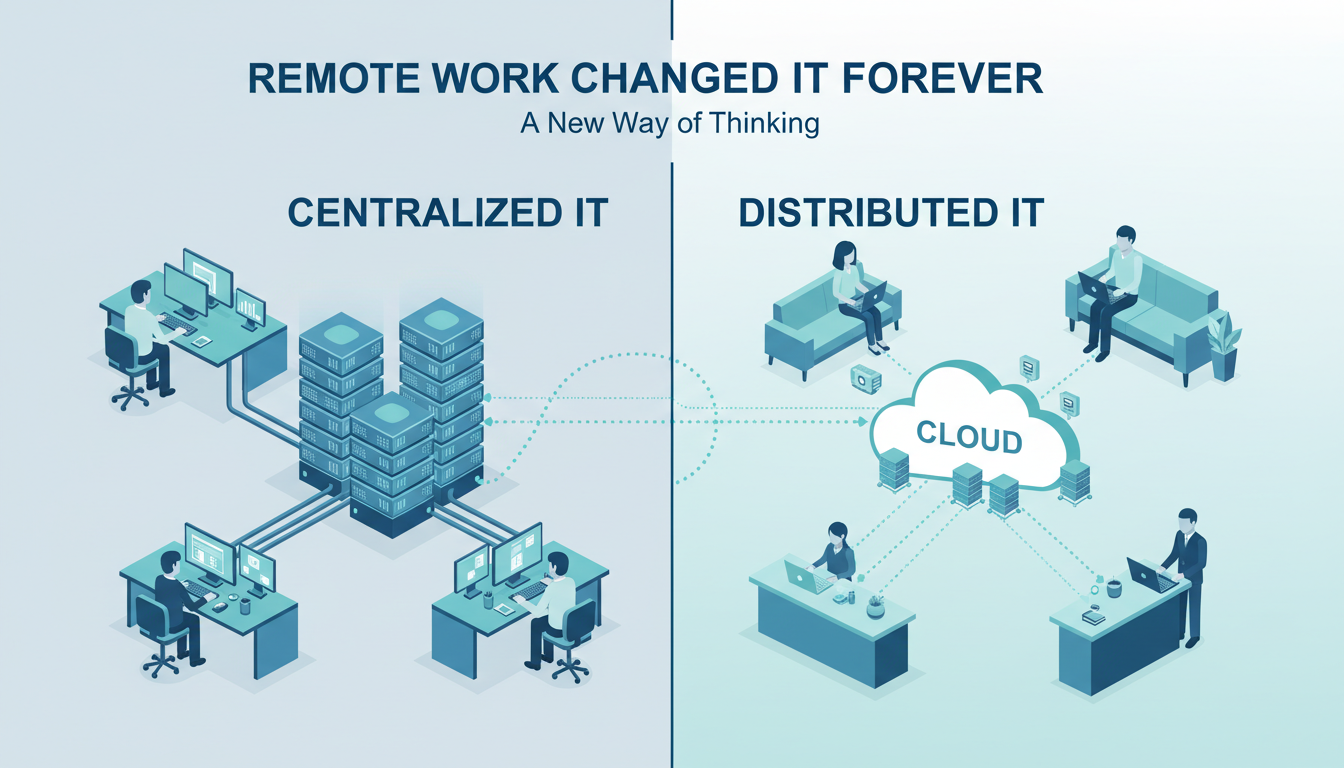
For decades, traditional IT was built around a simple model: everything lives in the office. Your servers, your files, your applications — all tucked away neatly behind physical walls and a firewall. Employees came to the office, plugged in, and IT could manage everything from a central point.
Remote work blew that model up almost overnight. According to a Stanford University study, remote work adoption jumped from around 5% of working days pre-pandemic to over 60% during peak lockdown periods. Even as restrictions eased, a significant portion of that shift stuck. By 2023, Gallup reported that around 52% of employees in the U.S. were working in some form of hybrid arrangement.
The implication for IT? The perimeter — that sacred boundary IT teams used to protect — essentially dissolved. Your network is no longer just inside your office. It now extends into employees’ homes, coffee shops, co-working spaces, and yes, sometimes airport lounges.
2. Cloud Adoption Went from “Nice to Have” to “Non-Negotiable”
Before the pandemic, a lot of businesses — especially mid-sized ones — were still sitting on the fence about cloud migration. The on-premise servers were “good enough,” and the thought of moving everything to the cloud felt risky, expensive, or simply unnecessary.
The argument over remote work didn’t last long. Companies quickly switched to cloud-based platforms when teams couldn’t access local servers from home. Almost overnight, Microsoft 365, Google Workspace, cloud ERP systems, and SaaS tools became the main tools that businesses used to run their operations.
According to Gartner, global end-user spending on public cloud services went up by 23.1% in 2021 alone. This big jump was mostly because people needed to be able to access services from afar. Since then, that growth has continued steadily.
This was both a problem and a chance for businesses in Ahmedabad. Companies that had been putting off moving to the cloud had to do it faster, and many found that cloud infrastructure was actually more flexible, scalable, and cost-effective than what they had before.
3. Cybersecurity: From Afterthought to Boardroom Agenda
This is the one that keeps IT managers up at night — and honestly, it should. The rapid expansion of remote work dramatically widened the attack surface for businesses. More endpoints, more home networks, more personal devices being used for work — it’s a cybersecurity professional’s nightmare.
The numbers tell a sobering story. IBM’s Cost of a Data Breach Report 2023 found that the average cost of a data breach reached $4.45 million — the highest figure ever recorded in the report’s history. Organizations with fully remote workforces saw breach costs that were significantly higher than those with on-site staff.
Phishing attacks surged, ransomware incidents multiplied, and the human error factor — always a risk — became even more pronounced when employees worked in less controlled environments. Businesses that used to rely on basic antivirus software and a firewall suddenly found themselves dangerously exposed.
The response? A fundamental rethink of cybersecurity strategy. Zero Trust Architecture — the principle that no user or device should be automatically trusted, even inside the network — moved from a buzzword to an actual implementation priority. Multi-factor authentication (MFA), endpoint detection and response (EDR) tools, VPN solutions, and regular security training became standard requirements, not optional extras.
4. Endpoint Management Became Its Own Discipline
When everyone worked in the office, it was easy to keep track of devices. There were only a few machines in one place, and IT could touch them when they needed to. With remote work, those devices scattered across the city — or the country.
This gave rise to a growing need for robust Mobile Device Management (MDM) and Unified Endpoint Management (UEM) platforms. IT teams needed to be able to push software updates, enforce security policies, remotely wipe lost devices, and monitor device health — all without being in the same room as the machine.
Policies that let people bring their own devices (BYOD) were once a small issue, but now they are a big deal. How do you secure a company’s data on an employee’s personal laptop? What’s the boundary between corporate control and personal privacy? These are not small questions, and answering them requires a well-thought-out IT strategy.
5. Collaboration Tools Became Critical Infrastructure
Before 2020, tools like Zoom, Microsoft Teams, and Slack were “nice additions” to the workplace toolkit. Post-pandemic, they are as essential as electricity. Businesses that didn’t have these platforms scrambled to adopt them, and those that did had to significantly scale their use.
Before 2020, tools like Zoom, Microsoft Teams, and Slack were “nice additions” to the workplace toolkit. Post-pandemic, they are as essential as electricity. Businesses that didn’t have these platforms scrambled to adopt them, and those that did had to significantly scale their use.
But with collaboration tools comes a new set of IT challenges: licensing management, data governance, integration with existing systems, and making sure performance is consistent across different internet connections and devices. IT teams had to become experts in platforms they barely touched two years earlier.
McKinsey says that companies that spent a lot of money on digital collaboration tools during the pandemic saw measurable increases in productivity compared to companies that didn’t. This confirmed what smart IT leaders already thought: collaboration infrastructure isn’t a soft investment; it has a direct effect on how well a business does.
6. IT Support Had to Become Remote-First
This is something that doesn’t get talked about enough: when employees worked from home, so did their IT problems. IT support teams couldn’t just walk across the office to fix things anymore.
Remote desktop tools, ticketing systems, chatbot-driven first-level support, and proactive monitoring became the new standard. TechMonarch and other managed IT service providers (MSPs) saw a huge rise in demand because businesses realized they needed reliable, 24/7 remote support that their own teams couldn’t provide on their own.
It was also easier to use AI-powered automation and monitoring when IT support was done remotely. Instead of waiting for users to report problems, proactive systems now find and often fix problems before the employee even knows something is wrong. This is a big change in how IT support works.
7. IT Budgets changed — and Businesses Got Smarter About how they spent money.
Remote work changed not only what companies spent on IT but also how they thought about IT spending. The old model was often reactive: something breaks, you fix it, you pay for it. The new model is far more strategic.
According to a Deloitte survey, more than 70% of businesses reported increasing their technology budgets post-pandemic, with a clear shift toward cloud services, cybersecurity, and collaboration tools. But more importantly, the conversation about IT moved up the org chart. CEOs and CFOs who once delegated IT decisions entirely to their tech teams are now actively involved in technology strategy discussions.
For growing businesses in Gujarat, this is particularly significant. Companies that used to see IT as a cost center are now beginning to see it as a competitive advantage. The ones investing in solid infrastructure, cybersecurity, and remote-capable systems are pulling ahead of those that aren’t.

What This All Means for Your Business
If there’s one takeaway from everything we’ve discussed, it’s this: IT is no longer a back-office function. It’s a core business capability. The companies that understand this — and invest accordingly — are the ones that will be resilient, secure, and positioned to grow regardless of what the next disruption looks like.
Here’s a quick checklist of where your IT strategy should stand in today’s hybrid world:
- Cloud infrastructure that enables your team to access what they need, from anywhere
- A cybersecurity framework built on Zero Trust principles, not just perimeter defence
- Endpoint management tools that give IT visibility across all devices — office or remote
- Collaboration platforms that are properly licensed, integrated, and governed
- Remote IT support capabilities, either in-house or via a trusted MSP partner
- A proactive monitoring setup that catches problems before users do
- Regular security training for employees — because the human firewall matters
At TechMonarch, we’ve helped businesses across Ahmedabad navigate exactly these challenges. Whether it’s setting up a complete IT infrastructure from scratch, migrating to the cloud, locking down cybersecurity posture, or simply being the reliable IT partner that’s there when things go sideways — that’s what we do.
Remote work didn’t break IT. It revealed just how important IT really is. And the businesses that took that lesson seriously are better positioned today than they’ve ever been.
If you’re wondering where your business stands — or what the next step in your IT journey should be — reach out to the TechMonarch team. We’d love to have that conversation.
Recent Posts
- What Ahmedabad Businesses Get Wrong About IT Compliance Under India's DPDP Act
- A Look Inside How We Manage IT Infrastructure for Ahmedabad Businesses Across Industries
- Why Gandhinagar's Growing IT/ITES Sector Needs Local Managed Support, Not Remote-Only Vendors
- IT Infrastructure Checklist for Companies Moving Into SG Highway and Prahlad Nagar Offices
- How Ahmedabad-Based Startups Can Build Enterprise-Grade IT Without Enterprise Budgets
Recent Comments
- No comments to show