
-
Suresh Kalal
- January 12, 2026
- No categories assigned.
- No Comments
How Zero-Trust Network Access Differs Across Cisco Duo, Palo Alto ZTNA, and FortiClient ZTNA
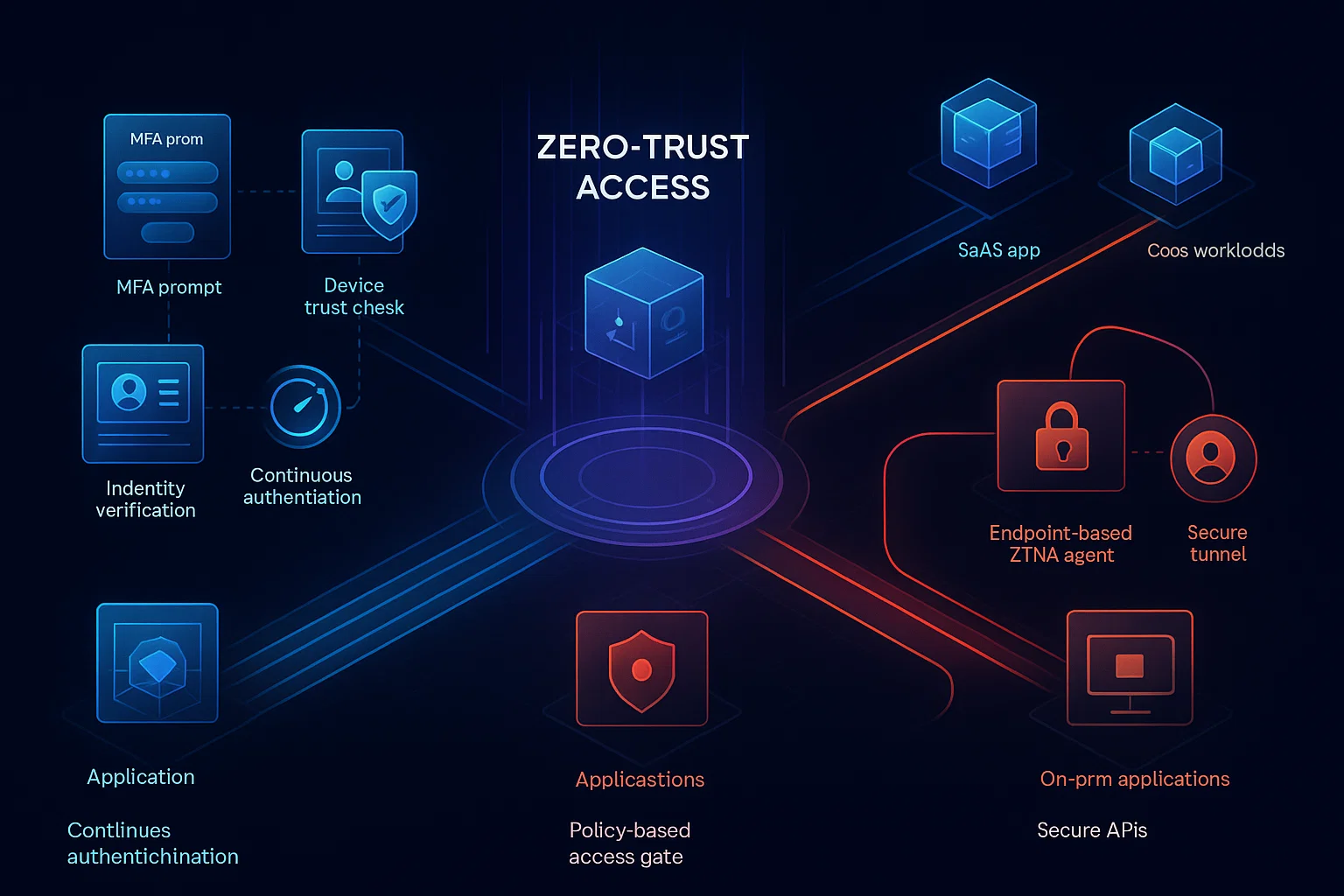
Zero Trust is no longer just a buzzword, it’s the foundation of modern security architecture. With hybrid work the rule rather than the exception, multi-cloud deployments and SaaS sprawl, traditional VPNs fall woefully short. This is where Zero-Trust Network Access (ZTNA) comes into play—identity-based, context-aware, restricted access for applications without the exposure of the network.
But here is where it gets interesting: not all ZTNA implementations are created equal. Cisco Duo, Palo Alto’s ZTNA (part of Prisma Access), and Fortinet FortiClient ZTNA all address the framework with their unique architectural philosophies, integration methods and security logic.
This article unpacks how each platform views Zero Trust and where they diverge — so you can begin to grasp the nuance beyond the buzzwords, and choose which one better maps onto reality as your environment actually operates.
1. What ZTNA Really Means Today
Before comparing products, it’s worth aligning on what “Zero Trust Network Access” actually means in practice.
Modern ZTNA frameworks usually revolve around:
- Identity as the new perimeter
- Continuous verification instead of a one-time trust
- Least-privilege access applied at the application level
- Micro-segmentation that prevents lateral movement
- Context-based decisioning (device posture, user state, location, behavior, risk)
- Encrypted, brokered connections that never expose internal routes
The idea is straightforward: treat every request as hostile until verified. But the way vendors execute these pillars varies. Some emphasize identity, some focus on firewall enforcement, while others lead with endpoint posture.
That’s where the differences begin to show.
2. Cisco Duo ZTNA: Identity-First, Cloud-Delivered Access
Cisco Duo doesn’t try to be everything at once. It stays laser-focused on identity security and device trust. Duo’s approach to ZTNA builds around the assumption that access control should be driven primarily through identity verification and device posture checks—not the network layer.
What Cisco Duo Does Really Well
a. Identity and Access Management Core
Duo prioritizes:
- Strong MFA
- Risk-based authentication
- User behavior tracking
- Adaptive access policies
Its ZTNA capabilities hook into Duo Single Sign-On and the Duo Secure Access product, making identity the heart of the policy engine.
b. Device Trust and Posture
Duo analyzes:
- OS version and patch level
- Endpoint encryption status
- Certificates and compliance markers
- Managed vs. unmanaged device posture
It’s especially strong for organizations with a Bring-Your-Own-Device culture or remote teams where device validation is critical.
c. Application-Level Access
Duo’s ZTNA gateway brokers secure access to:
- Internal web apps
- SSH servers
- RDP
- SaaS apps
- Cloud apps
Connections are authenticated through Duo’s cloud, creating an identity-driven perimeter without exposing network subnets.
Where Cisco Duo Isn’t as Strong
- It’s not a full network security stack.
- If you need firewall-level segmentation or inline traffic inspection, you need broader Cisco components (e.g., Umbrella SIG, ASA/FTD, or Secure Access by Duo).
- For deep network policy enforcement or SD-WAN integration, Duo alone doesn’t offer the control Fortinet or Palo Alto pushes.
Duo is ideal for environments that want simplicity and identity-centric ZTNA without re-architecting the network.
3. Palo Alto Networks ZTNA (Prisma Access): Security-Brokered Access With Inline Analysis
Palo Alto takes a much more security-heavy approach to ZTNA. It extends its Next-Gen Firewall philosophy into the cloud, bringing deep traffic inspection, threat prevention, and content filtering into the ZTNA pipeline.
ZTNA for Palo Alto isn’t just about access control—it’s about enforcing security controls inline, every time a user accesses an application.
What Palo Alto Does Really Well
a. ZTNA 2.0 Framework
Palo Alto positions itself as “ZTNA 2.0,” focusing on:
- App-level segmentation
- Continuous risk evaluation
- Inline traffic inspection for threats
- Fine-grained access and behavior analysis
This goes beyond traditional ZTNA, which often only checks identity and posture at the start of a session.
b. Deep Application Traffic Inspection
Palo Alto inspects all user-to-app traffic through:
- Threat prevention profiles
- URL filtering
- WildFire malware analysis
- Behavioral analytics
This “trust but continuously inspect” model is meant to prevent attacks that originate from authenticated users.
c. Strong Integration With Prisma SD-WAN
ZTNA becomes part of:
- Cloud firewall
- Secure web gateway
- CASB
- SD-WAN
This consistency across services is useful for companies adopting a unified SASE stack.
Where Palo Alto May Not Fit Every Environment
- It’s more complex to deploy and maintain.
- Licensing can be higher compared with identity-focused ZTNA products.
- Requires alignment with Palo Alto’s ecosystem for full potential.
Palo Alto’s ZTNA is powerful in environments where all traffic must be inspected, analyzed, and controlled using consistent NGFW logic.
4. FortiClient ZTNA: Firewall-Attached, Endpoint-Driven Zero Trust
Fortinet approaches ZTNA differently than Cisco Duo or Palo Alto. Instead of centering on identity or cloud enforcement, Fortinet makes the endpoint and the firewall the core of its Zero Trust strategy.
The result is a tight integration between:
- FortiClient (endpoint)
- FortiGate firewalls
- FortiAuthenticator
- FortiSandbox
- FortiSASE components
What Fortinet Does Really Well
a. Endpoint-Embedded ZTNA
FortiClient acts as:
- ZTNA agent
- Compliance checker
- VPN client
- EDR-lite posture engine (when paired with FortiEDR)
This tight coupling gives Fortinet one of the most seamless ZTNA–firewall integrations.
b. Application Access Proxying
Access is brokered by a FortiGate, which becomes the ZTNA gateway. Enforcement occurs at:
- Firewall policy level
- Device identity level
- User identity level
- Application identification level
This makes ZTNA feel like a natural extension of traditional firewall segmentation.
c. Micro-Segmentation via Firewall Policies
Fortinet allows:
- Application-level segmentation
- Device-based access rules
- Internal segmentation firewall (ISFW) support
- Integration with NAC for network-level enforcement
This is one of the strongest ZTNA implementations if your infrastructure already runs on FortiGate.
Where Fortinet Might Not Be Ideal
- Requires investment in the Fortinet ecosystem to unlock full ZTNA features.
- Less flexible in multi-vendor networks.
- Heavier reliance on endpoint agents than Cisco or Palo Alto.
If an organization is already committed to the Fortinet stack, its ZTNA becomes extremely cost-effective, scalable, and tightly integrated.

5. Side-by-Side Comparison: Cisco Duo vs. Palo Alto vs. FortiClient ZTNA
Below is a conceptual breakdown comparing the three ZTNA strategies across key categories.
a. Core Philosophy
- Cisco Duo: Identity-first ZTNA with device posture as the primary driver.
- Palo Alto: Security-brokered ZTNA with inline inspection and continuous monitoring.
- Fortinet: Endpoint-and-firewall-centric ZTNA tightly tied to FortiGate enforcement.
b. Deployment Style
- Cisco Duo: Fully cloud-delivered; minimal infrastructure.
- Palo Alto: Cloud security edge (Prisma Access) plus NGFW enforcement.
- Fortinet: Hybrid approach (endpoint + firewall + cloud).
c. Best Use Cases
- Cisco Duo: Lightweight ZTNA for hybrid workforces, BYOD users, and identity-driven access.
- Palo Alto: High-security environments needing deep traffic inspection and unified SASE.
- Fortinet: Organizations with FortiGate-centric networks wanting firewall-native ZTNA.
d. Strength of Ecosystems
- Cisco: Strong IAM ecosystem.
- Palo Alto: Strong NGFW, security analytics, and SASE ecosystem.
- Fortinet: Strong unified security fabric with tight endpoint–firewall synergy.
6. Which ZTNA Approach Makes Sense for Your Environment?
Choosing between Cisco Duo, Palo Alto ZTNA, and FortiClient ZTNA comes down to your architecture priorities.
You may lean toward:
- Cisco Duo if the priority is identity security, simple deployment, and frictionless remote access.
- Palo Alto if your philosophy is “trust nothing and inspect everything,” with full SASE adoption long-term.
- Fortinet if your network foundation already sits on FortiGate and you want ZTNA as a natural extension of firewall access policies.
The good news is that all three platforms embrace the core Zero-Trust principles. The differences lie in how deeply each vendor embeds ZTNA into its ecosystem and how much operational overhead your team is willing to handle.
ZTNA is rapidly becoming the new default for secure access. Understanding these product-level differences helps you align the right technology with your existing security posture and long-term roadmap.
Conclusion
Zero-Trust Network access is changing rapidly, and the Cisco, Palo Alto and Fortinet approaches demonstrate how different those interpretations can be. Cisco Duo prioritizes identity. Palo Alto emphasizes security inspection. Fortinet is based on endpoint, firewall intergration. Every model does something — and does it powerfully in the right setting.
The point here is to know where you are; what’s your current environment like today, how do your teams function and just how much control/visibility do you require into the pipeline of access. With such clarity, it is now less about the features and more about how well the ZTNA solution aligns with your actual way of running your business.
Recent Posts
- Building a High-Performance VPN Mesh for Distributed Teams
- Building Resilient VPN Architectures Using Route-Based VPN and Tunnel Interfaces
- Understanding SonicWall DPI-SSL Architecture and Its Impact on Throughput
- Advanced Threat Prevention: Inline ML and DNS Security Architecture Explained
- App-ID: How Palo Alto Firewalls Identify Traffic Beyond Ports & Protocols
Recent Comments
- ISO 27001 Certification Audit on The Impact of Quantum Computing on Cybersecurity: Preparing for the Future
- ISO 27001 Certification Audit on The Impact of Quantum Computing on Cybersecurity: Preparing for the Future